Most technical consultants are not short of expertise.
They are short of protected conditions for using that expertise well.
The options paper gets written between meetings. The expert review happens after three client calls and a morning of email. The proposal follow-up gets pushed to Friday afternoon, then disappears. The client day technically ends, but the unresolved questions, relationship concerns and half-finished deliverables keep running in the background.
On paper, the practice is busy.
Client work is moving. Meetings are happening. Reports are being drafted. Questions are being answered. The consultant looks responsive, useful and professionally committed.
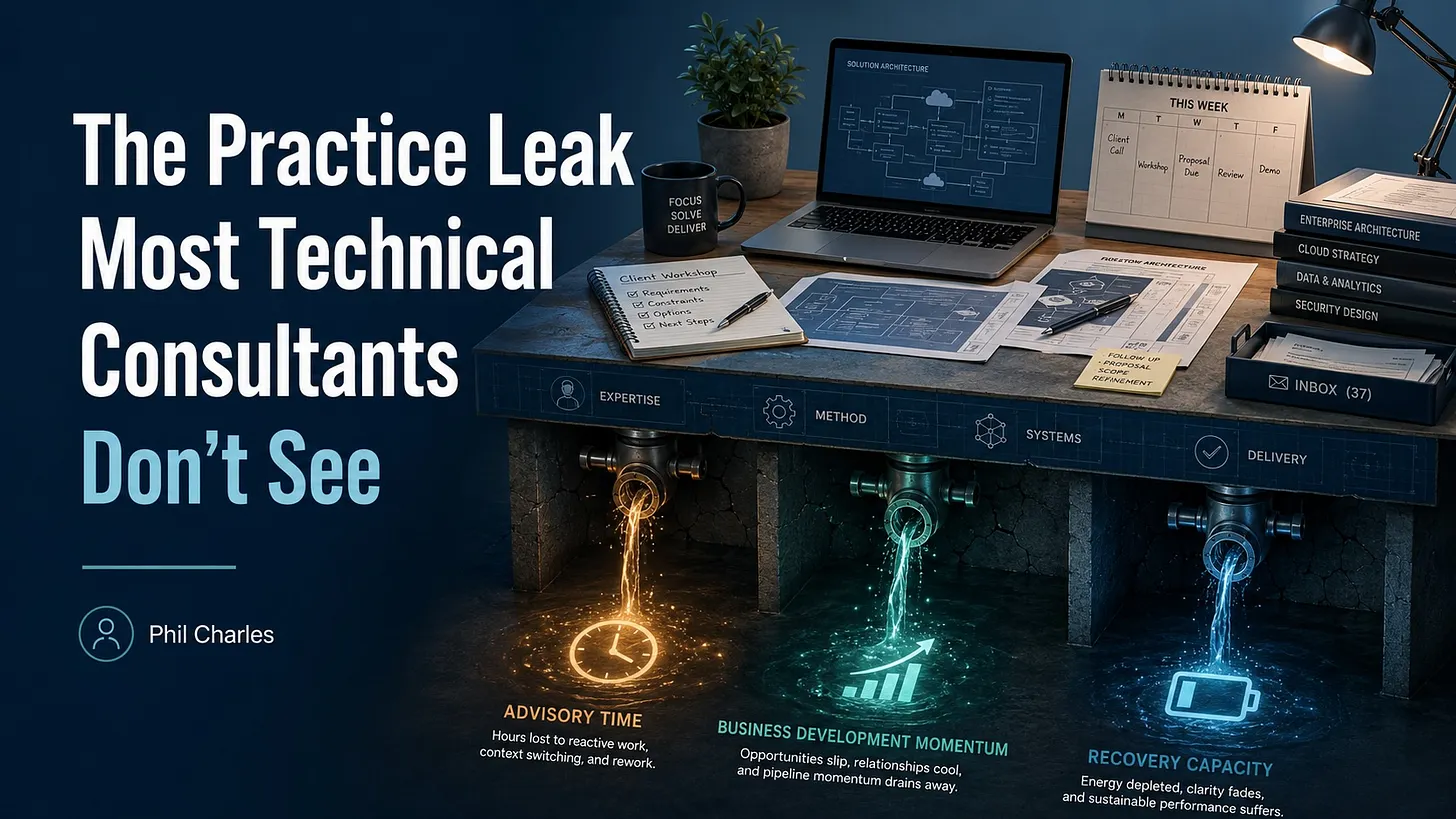
But underneath the activity, the practice may be leaking value in three places.
The first leak is advisory time.
This is the time required for deep expert work: technical options assessment, risk judgement, feasibility synthesis, strategic recommendations, expert review, workshop design, due diligence, or the kind of advisory thinking that only works because it comes from years of accumulated judgement.
This is the work clients are really paying for.
But in many technical consulting practices, this work happens in fragments. It is squeezed between meetings, interrupted by messages, or pushed to the wrong part of the day when the best thinking has already been spent on operational noise.
The consultant still produces the work. The client still gets the deliverable. But the work is being produced in conditions that reduce its quality.
That is the hidden cost.
The second leak is business development momentum.
Most independent consultants understand that business development matters. They know they should be maintaining relationships, following up with past clients, publishing useful thinking, refining their positioning, building referral pathways and keeping the next opportunity warm.
But business development has a structural disadvantage.
Client delivery has deadlines. Client delivery has people waiting. Client delivery has immediate consequences. Business development is important, but rarely urgent. So when delivery gets heavy, business development quietly disappears.
The practice then enters the familiar cycle.
Delivery is full, so business development is deferred. The engagement ends or slows, so the pipeline looks thin. Business development becomes reactive. The consultant starts chasing conversations, rushing proposals, discounting too easily, or accepting work that is close enough rather than right enough.
Then a new engagement lands, delivery fills the week again, and business development disappears again.
That is not a discipline problem. It is a practice architecture problem.
The third leak is recovery capacity.
This one is easier to ignore because it looks personal rather than commercial.
The consultant closes the laptop, but the client work does not close with it. An unresolved conversation keeps replaying. A delayed deliverable creates background anxiety. A client email needs a thoughtful response. A proposal is out, but no follow-up has been scheduled. The brain keeps carrying the practice into the evening.
The cost is not just lower quality rest. It is lower quality thinking the next day.
For technical consultants, recovery is not a lifestyle luxury. It protects tomorrow’s expert judgement. A tired, mentally loaded consultant does not produce the same clarity, precision or strategic usefulness as one who has properly closed the client day.
These three leaks, advisory time, business development momentum and recovery capacity, often get mistaken for separate problems.
- The fragmented expert work looks like a time management problem.
- The inconsistent business development looks like a sales problem.
- The client access pressure looks like a responsiveness problem.
- The evening rumination looks like a work-life balance problem.
But they usually have the same root cause: the consulting practice is running without a deliberate operating system.
A technical consulting practice, left to run on default settings, will usually serve today’s clients at the expense of tomorrow’s practice. Not because the consultant is careless. Usually the opposite. The consultant is committed, responsive and professionally serious.
That is exactly why the leak happens.
The calendar fills with client requests. The inbox stays close because responsiveness feels like professionalism. Business development gets fitted into the gaps. Deep advisory work gets done whenever there is a spare block. Recovery depends on whether the day happens to end cleanly.
That is not a system. That is drift.
The fix is not to work harder.
Most technical consultants are already working hard enough. Some are working too hard on the wrong parts of the practice.
The fix is to identify where the practice is leaking, then install the right control points.
- What work actually earns your fee?
- Where is that work being fragmented?
- Where is business development being displaced?
- What client access standard have you trained clients to expect?
- Does the client day actually end, or does it keep following you into recovery time?
Is there a weekly control loop that catches the drift before it becomes a pattern?
These are architecture questions.
And once you see the leak clearly, the next fix becomes much more obvious.
The Technical Consultant’s Focus System builds the weekly structure that protects these three things:
- Advisory time: the expert work clients actually pay for
- Business development momentum: the work that keeps the future practice alive
- Recovery capacity: the clean end to the day that protects tomorrow’s thinking
The mechanism is practice architecture: five practical control points that stop the week being run by urgency, client access, operational noise, and good intentions.
The Technical Consultant’s Focus System: protect your expert work, keep business development moving, and stop client demands from running your week.