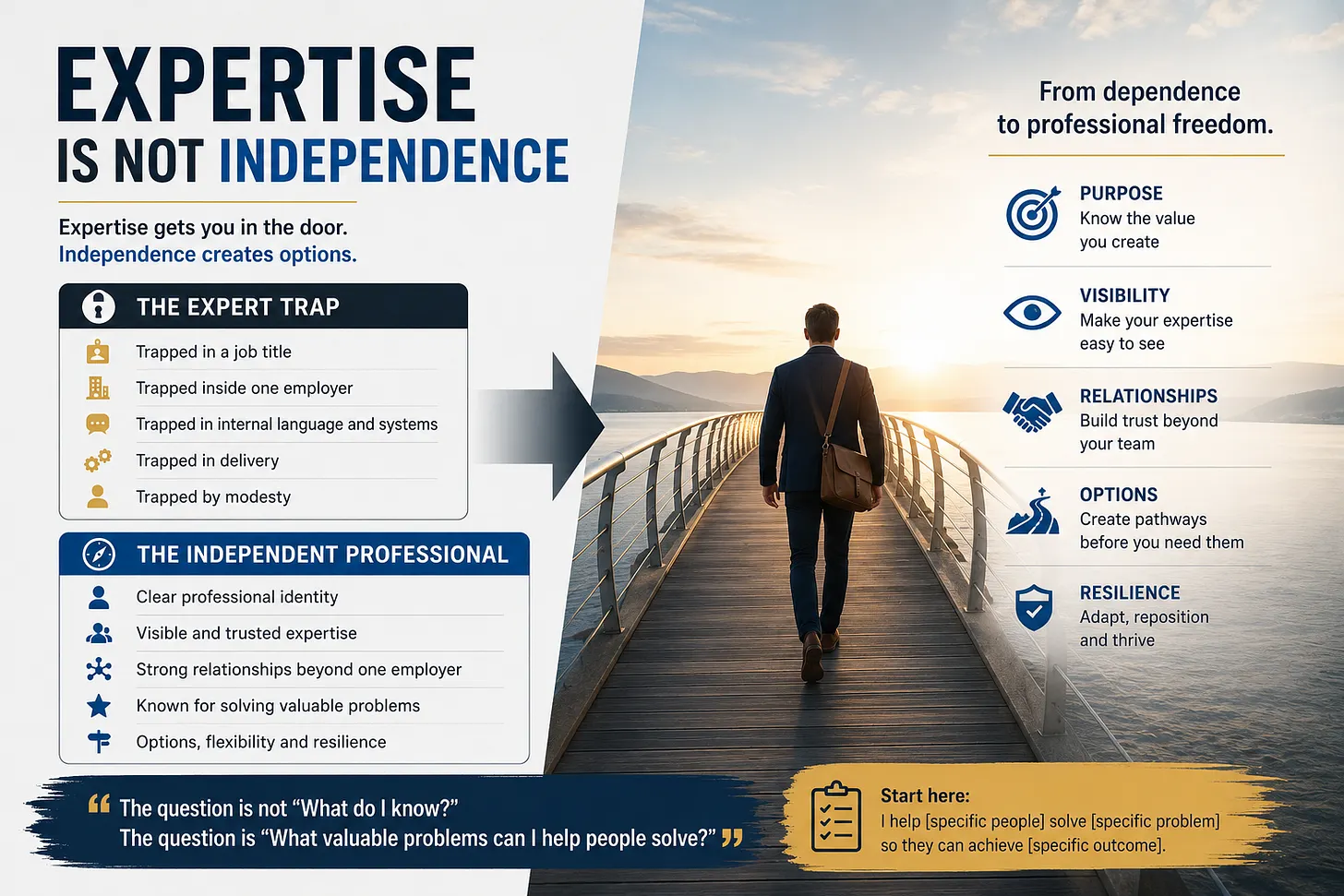
Most consultants started with a version of the same plan.
Leave employment, take your expertise with you, and build a practice around what you know. It’s a reasonable plan. For a while, it often works.
But expertise, by itself, is not a business. It’s raw material.
The consultant’s version of the hidden expert problem
Employed professionals often become hidden experts, doing valuable work that never reaches beyond their employer, team, or immediate manager.
Consultants face a version of the same problem. The difference is that for consultants, the consequences arrive faster and hurt more directly.
You can be technically excellent and still struggle to fill your pipeline. You can do outstanding work and still find that clients don’t refer you.
You can have 20 years of hard-won judgement and still find it difficult to explain your value to a prospect who doesn’t already know you.
The issue isn’t competence. It almost never is.
The issue is that expertise and commercial leverage are not the same thing.
Expertise is capability. Leverage is what it does for you.
Leverage means your expertise creates options.
It attracts clients who aren’t just people you already know. It makes you referable to people who’ve never met you. It gives you a professional identity that’s bigger than your last client engagement. It lets you choose the work rather than just accepting what comes through.
Most consultants I’ve seen struggle commercially are not short on expertise. They’re short on leverage. And the reason is usually one of five traps.
- The methodology trap. Your expertise is real, but it’s trapped inside your own head. You solve problems through instinct and experience, but you’ve never captured the method. That makes you hard to trust from a distance and impossible to price systematically.
- The delivery trap. You’re so busy doing the work that you never extract the thinking behind the work. Your insight stays buried in project deliverables, meeting notes, and emails that nobody outside the project will ever read.
- The language trap. You describe what you do in the language of your discipline, not the language of your client’s problem. “I provide strategic advisory services in transport planning” is accurate. It is not compelling.
- The visibility trap. Your reputation is strong with clients who know you. Beyond them, you’re largely invisible. You’re not creating content, not building public authority, not maintaining a presence that works when you’re not in the room.
- The referral trap. People like you and respect you, but they can’t easily explain what you do to someone else. If your value isn’t clear and specific, referrals stay soft or don’t happen at all.
The shift from expert to value creator
This is where the work is. Not becoming someone you’re not. Not building a personal brand that makes you cringe. Not turning yourself into a content machine.
The shift is simpler than that.
It’s translating your expertise into the language of the problems you solve.
“I am a civil engineer” is a credential. “I help infrastructure organisations make better long-term investment decisions under uncertainty” is a value proposition.
“I am an independent management consultant” is a job description. “I help leadership teams in complex technical organisations align on strategy before they commit capital” is a commercial statement.
“I have 25 years in financial services” is experience. “I help mid-sized firms understand what’s actually driving client attrition before they lose another year to the wrong retention strategy” is something a client can act on.
The translation is not wordsmithing. It’s the work of understanding exactly who you help, what they’re struggling with, and what becomes possible when they work with you.
A quick self-audit
Ask yourself these questions honestly:
- Can you explain what you do in one sentence that a non-specialist prospect would find immediately useful?
- Do you have a documented methodology, or is your approach mostly tacit?
- Do people who don’t know you well understand what problems to bring to you?
- Is your pipeline built on relationships alone, or are there assets working for you when you’re not in front of someone?
- If your three best clients stopped renewing, how quickly could you replace that revenue?
These aren’t branding questions. They’re business resilience questions.
The uncomfortable truth
Leaving employment was the first act of independence. But professional independence for a consultant isn’t a destination; it’s a discipline.
It means continually asking whether your expertise is doing commercial work, or whether you’re still hoping that good work will speak for itself. It often mumbles.
The consultants who build durable, profitable practices aren’t necessarily the most technically accomplished. They’re the ones who’ve done the harder work of making their expertise visible, specific, and easy to buy.
That’s the shift from expert to practice.
This week
Write one sentence that translates your expertise into client value. Use this format: I help [specific people] solve [specific problem] so they can [specific outcome].
Don’t workshop it to death. Get a first draft on paper. That sentence is where your practice starts to get traction.