
The feedback that stings is usually the most accurate feedback you’ll ever get.
The meeting had been going well. The recommendation was solid, well-evidenced, clearly structured, the product of six weeks of careful analysis. And then a client stakeholder pushed back. Not aggressively. Not unreasonably. She said, calmly, that she wasn’t sure the approach accounted for something the team had tried eighteen months ago, and asked whether that had been factored in.
It hadn’t. Not fully.
The consultant’s response was immediate and instinctive. He explained why the previous attempt was different. He walked through the evidence again, more thoroughly this time. He noted that the methodology was robust. He did everything, in short, except engage with what she’d actually said. By the time the meeting ended, the recommendation was still standing. So was the gap in the analysis. And the stakeholder had quietly stopped engaging.
Six weeks later, the implementation ran into exactly the problem she’d identified.
This is not a story about a bad consultant. It’s a story about a very common one, technically capable, genuinely experienced, and in possession of a blind spot so well-disguised as expertise that he couldn’t see it himself.
The expert trap
There is a version of fixed mindset that consulting culture actively builds and rewards. Call it the expert trap, and understanding it is worth the discomfort it requires.
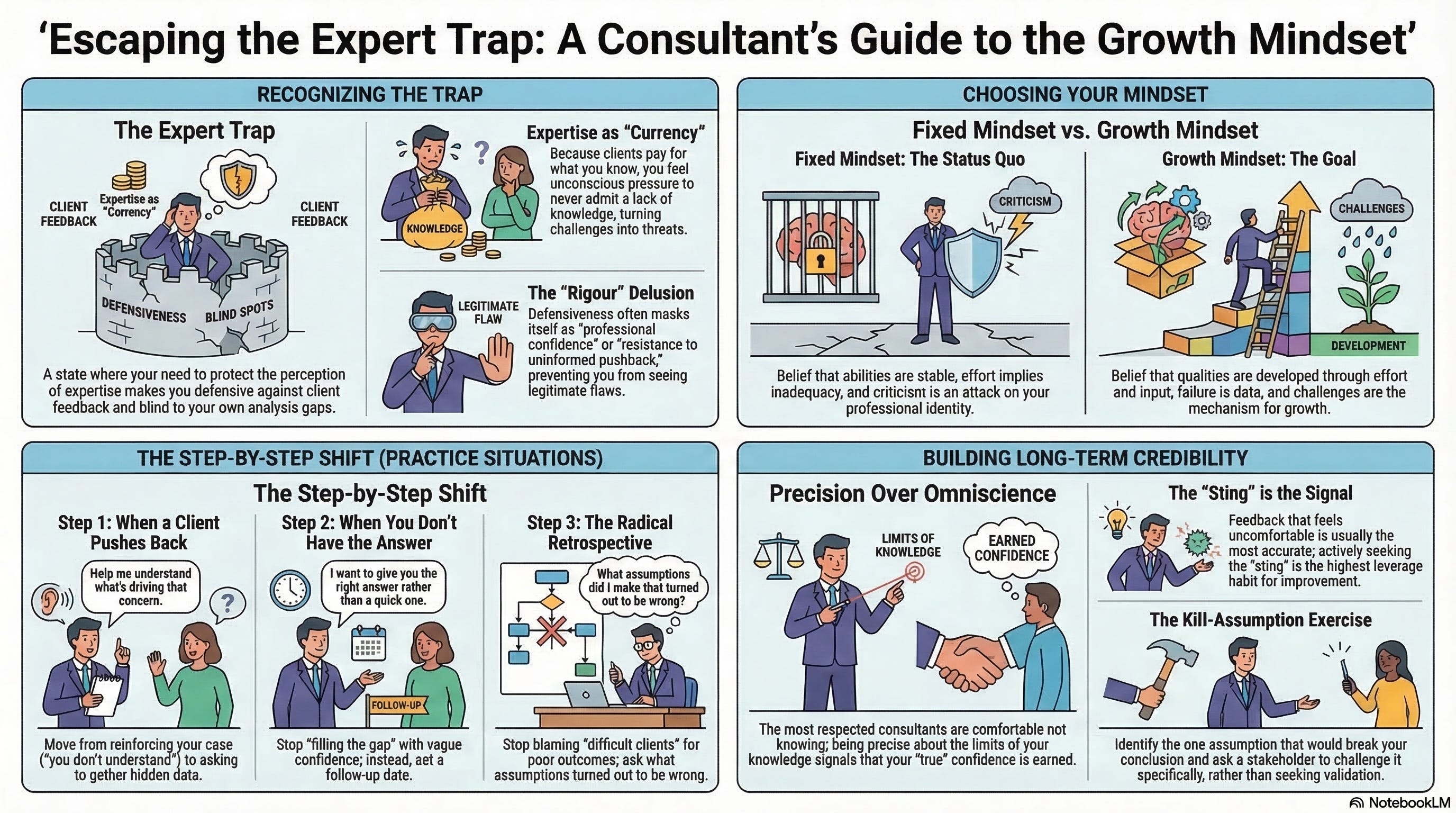
Your value as a consultant is predicated on expertise. Clients engage you because you know things they don’t. That expertise is your currency, your competitive advantage, and a significant part of your professional identity. This creates enormous, and often entirely unconscious, pressure to protect the perception of that expertise at all costs.
When your recommendation is challenged, the instinct is not to examine the challenge. The instinct is to defend the recommendation. When a client suggests an approach you hadn’t considered, the instinct is not curiosity. It’s a quiet, almost reflexive assessment of whether the suggestion is less valid than what you’d already concluded. When feedback arrives that suggests your analysis had a gap, the instinct is not to learn from it. It’s to explain why the gap doesn’t matter, or why the person who identified it has misunderstood the problem.
None of this feels like defensiveness from the inside. From the inside, it feels like rigour. Like professional confidence. Like the appropriate resistance to uninformed pushback that experienced consultants learn to maintain.
But here is what it produces over time: a consultant who cannot be wrong in front of a client stops being genuinely challenged. A consultant who stops being challenged stops developing. And a consultant who stops developing becomes brittle, precisely when the landscape shifts and the expertise they’ve been protecting becomes less relevant.
The expert trap is not a character flaw. It is a structural consequence of a career where reputation is tied to being right. Understanding that doesn’t make it less costly. It makes it addressable.
What the research actually says
Carol Dweck’s research on mindset at Stanford identified something deceptively simple: people hold one of two fundamental beliefs about their own abilities. Those with a fixed mindset believe their qualities are essentially stable, you either have them or you don’t. Those with a growth mindset believe their qualities can be developed through effort, strategy, and input from others.
The fixed mindset creates a powerful incentive to appear capable at all times and avoid situations where you might be exposed as lacking. Challenges become threats. Effort implies inadequacy. Criticism is an attack on identity rather than information about performance.
The growth mindset treats the same situations entirely differently. Failure is not a verdict on ability, it’s data on what needs improvement. Criticism is useful because it points precisely to where development is needed. Challenges are welcome because they are the mechanism through which growth actually happens.
What makes Dweck’s research particularly important for consultants is this: the mindset itself is developable. People who understand the distinction and deliberately practise growth-oriented thinking show measurable improvements in both performance and resilience. This is not about attitude adjustment. It is about a specific set of behaviours that, applied consistently, produce genuine development over time.
Three places the expert trap shows up most in consulting practice
Knowing the pattern intellectually and recognising it in real time are different things. Here are the three situations where fixed mindset operates most reliably, and what the growth mindset response looks like in each.
When a client pushes back on your recommendation.
The fixed mindset response is to reinforce the case. More evidence. Clearer explanation. A more thorough walk-through of the methodology. The implicit message to the client is: you haven’t fully understood yet.
The growth mindset response starts with a question. “Help me understand what’s driving that concern” is not a concession. It’s information-gathering. In a significant number of cases, what you hear next will reveal something genuinely useful, a constraint you hadn’t fully weighted, a political dynamic that affects implementation, a previous attempt that failed for reasons directly relevant to yours. In the remaining cases, you’ll be better equipped to respond to the actual objection rather than the one you assumed they were making.
The consultant in the opening story knew his methodology was sound. What he didn’t do was treat the pushback as data. That’s where the engagement started to go wrong, not in the analysis, but in the response to the challenge.
When you don’t know the answer in a senior meeting.
The fixed mindset response is to fill the gap. To give an answer that sounds confident enough to satisfy the question without being quite specific enough to be checked. Experienced consultants become very good at this, which is precisely why it’s dangerous.
The growth mindset response is to be precise about what you know and what you don’t. “I want to give you the right answer on that rather than a quick one, I’ll come back to you by end of week” is not weakness. It is the kind of precision that experienced stakeholders trust more than omniscience. The consultant who claims to know everything is less credible than the one who knows exactly where their knowledge ends.
When an engagement produces feedback you’d rather not examine.
The fixed mindset post-project retrospective concludes that the client was difficult and the scope was unrealistic. Both things may be true. They are also perfectly designed to assign all the causal weight to external factors and extract nothing useful from the experience.
The growth mindset retrospective asks a harder set of questions. What would I have done differently at week two? At week six? What assumption did I make in the scoping phase that turned out to be wrong? What did I notice but not act on? These questions are uncomfortable precisely because they locate some part of the outcome within your control, which is exactly where the learning is.
The counterintuitive truth about expertise
The most technically respected consultants in any field share a quality that sounds like it should undermine their authority but consistently reinforces it: they are exceptionally comfortable with not knowing.
They distinguish clearly between what they know and what they infer. They say “I’m not certain about that, let me come back to you with a firmer answer” without visible discomfort. They treat a client’s pushback as potentially containing information rather than reflexively classifying it as uninformed.
Clients trust them more, not less, because of this. Precision about the limits of your knowledge is a form of expertise, arguably one of the most sophisticated forms available. It signals that when you do commit to a recommendation, the confidence behind it is genuine rather than performed.
The expert trap inverts this. It produces performed confidence at the cost of genuine credibility. And the longer it operates unexamined, the harder it becomes to distinguish one from the other, especially from the inside.
A practical starting point
Before your next significant engagement milestone, a client presentation, a recommendation, a project review, try this.
Identify the one assumption in your current analysis that, if wrong, would most significantly change your conclusion. Not the assumption you’re least confident about across the board. The one whose failure would matter most to the outcome.
Then ask a trusted peer, or a client stakeholder you have enough of a relationship with, to push on that assumption specifically. Not for validation. For challenge.
What you’re looking for is not agreement. You’re looking for the thing you haven’t seen, the constraint, the context, the previous attempt that the stakeholder on the other side of the table might already know about.
The feedback that stings is usually the most accurate feedback you’ll ever receive. Building the habit of seeking it out, rather than waiting for it to arrive unsolicited, is one of the highest-leverage things you can do for the long-term quality of your work.
Phil Charles The Smart Consultant
PS The Consultant’s Edge covers the full growth mindset framework, including the expert trap, how to build deliberate feedback loops, and the quarterly development audit that keeps your capability growing rather than calcifying.