Category: Influence

The Influential Consultant

  • The Reflex You Don’t Know You Have

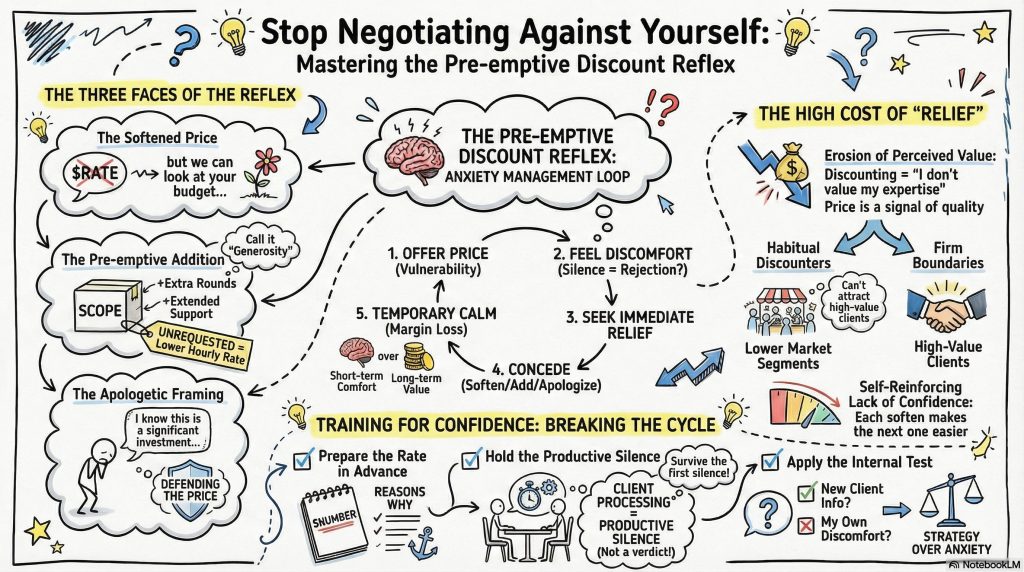
    The Nature of the Pre-emptive Discount

    The pre-emptive discount is an unsolicited softening of terms that occurs before any commercial pressure has been applied. It is characterised by the service provider negotiating against themselves from a position they chose voluntarily.

    The Three Forms of the Reflex

    The reflex typically manifests in one of three ways:

    The Softened Price: Naming a figure but immediately qualifying it with phrases regarding budget flexibility or “looking at what works.” The client learns the stated rate is not the “real” rate and that terms are unstable.

    The Pre-emptive Addition: Adding unrequested scope, such as extra review rounds or extended support, to justify the rate. The client views these extras as the baseline expectation for all future work.

    Apologetic Framing: Using language that communicates discomfort (e.g., “I know this might seem like a significant investment”). The client sees that the provider expects the price to be defended or rejected.

    The Psychological Mechanics: Anxiety Over Strategy

    While service providers often justify pre-emptive discounting as a rational response to a “tough market” or “price-sensitive clients,” the behaviour is fundamentally a tool for anxiety management.

    The Discomfort of Uncertainty: Naming a price involves the vulnerability of offering something of value and waiting for judgment. To avoid the tension of not knowing how the price will land, the provider reduces the price to achieve immediate relief.

    The Behavioural Loop: This relief reinforces the behavior. Because the relief is immediate and the commercial cost is delayed, the brain prioritizes the relief, making the reflex more likely to occur in future conversations.

    The Personalisation Bias: Service providers tend to fill the silence following a price quote with negative internal interpretations, assuming that a lack of immediate response indicates the price is too high or the client is seeking alternatives.

    The Long-Term Costs of Price Erosion

    The true cost of the pre-emptive discount extends far beyond the reduced margin of a single engagement.

    1. Perceived Value Signalling: Price serves as a signal of quality, exclusivity, and confidence. When a provider discounts readily, they inadvertently signal a lower assessment of their own value. This affects not only future negotiations but also the quality and enthusiasm of client referrals.

    2. Internal Confidence Erosion: Each pre-emptive concession provides evidence to the service provider that their own rate is not “firm.” This decreases internal confidence, making the provider more anxious during the next interaction and tightening the reflex loop.

    3. Market Misalignment: Habitual discounting forces providers into a lower market segment. They fail to attract high-value clients who seek practitioners who firmly hold their values, creating an “invisible” opportunity cost of better-fitted clients they never encounter.

    The Role of Silence in Pricing

    A central component of the reflex is an inability to tolerate the ensuing silence after a price proposal. Understanding the dual nature of this silence is essential for behavioural change:

    The Productive Silence (Client Side): For the client, silence is necessary for processing information, assessing budget, and weighing value. It is a sign of genuine consideration.

    The Suspended Judgment (Provider Side): For the provider, silence is often experienced as a period of judgment. The anxiety produced is proportional to the provider’s uncertainty about their rate and their attachment to the outcome.

    Distinguishing Strategy from Anxiety

    Not all price adjustments are pathological. The distinction lies in the **motivation** behind the movement:

    Strategic Adjustment: Driven by external information provided by the client (e.g., specific budget constraints, scope requirements, or competitive comparisons). This is a grounded commercial calculation.

    Anxiety Response: Driven by the internal experience of uncertainty or the desire to fill a silence. This is a reaction to an internal state rather than a commercial reality.

    Path to Behavioural Change

    The pre-emptive discount is a trainable behaviour. While the underlying anxiety may never fully disappear, the behavioural loop can be interrupted through specific practices:

    1. Preparation and Pre-decision: Decide the rate and the rationale in advance. Commit to naming the price as a statement rather than an apology.
    2. Permission to be Uncomfortable: Accept that silence will be uncomfortable. Reframe the discomfort as the experience of “holding the line” rather than a signal that the price is wrong.
    3. Accumulating Data Points: Each time a provider holds a silence and survives without making a concession, they gain a “data point” proving the discount was unnecessary. This evidence gradually diminishes the reflex’s automaticity.
    4. Honesty in Real-Time: Developing pricing confidence requires a high degree of self-awareness to distinguish between responding to a client’s needs and reacting to one’s own internal discomfort.

    P.S. The book ‘Hold the Line: The Psychology of Pricing, Boundaries, and Business Confidence’ is out now. Buy Hold the Line

  • The Client Who Was Right (And the Consultant Who Couldn’t Hear It)

    The Client Who Was Right (And the Consultant Who Couldn’t Hear It)

    The feedback that stings is usually the most accurate feedback you’ll ever get.

    The meeting had been going well. The recommendation was solid, well-evidenced, clearly structured, the product of six weeks of careful analysis. And then a client stakeholder pushed back. Not aggressively. Not unreasonably. She said, calmly, that she wasn’t sure the approach accounted for something the team had tried eighteen months ago, and asked whether that had been factored in.

    It hadn’t. Not fully.

    The consultant’s response was immediate and instinctive. He explained why the previous attempt was different. He walked through the evidence again, more thoroughly this time. He noted that the methodology was robust. He did everything, in short, except engage with what she’d actually said. By the time the meeting ended, the recommendation was still standing. So was the gap in the analysis. And the stakeholder had quietly stopped engaging.

    Six weeks later, the implementation ran into exactly the problem she’d identified.

    This is not a story about a bad consultant. It’s a story about a very common one, technically capable, genuinely experienced, and in possession of a blind spot so well-disguised as expertise that he couldn’t see it himself.

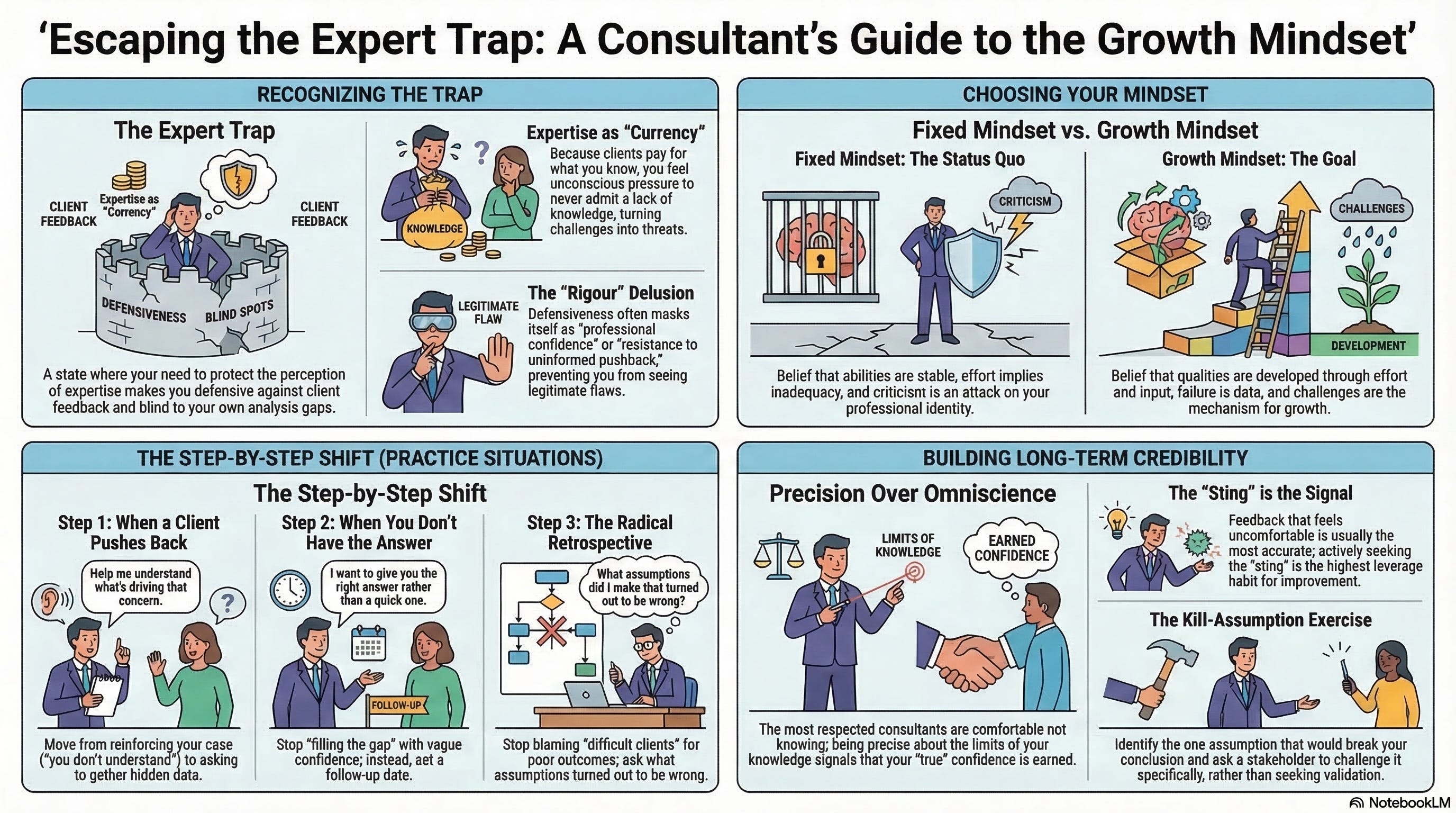
    The expert trap

    There is a version of fixed mindset that consulting culture actively builds and rewards. Call it the expert trap, and understanding it is worth the discomfort it requires.

    Your value as a consultant is predicated on expertise. Clients engage you because you know things they don’t. That expertise is your currency, your competitive advantage, and a significant part of your professional identity. This creates enormous, and often entirely unconscious, pressure to protect the perception of that expertise at all costs.

    When your recommendation is challenged, the instinct is not to examine the challenge. The instinct is to defend the recommendation. When a client suggests an approach you hadn’t considered, the instinct is not curiosity. It’s a quiet, almost reflexive assessment of whether the suggestion is less valid than what you’d already concluded. When feedback arrives that suggests your analysis had a gap, the instinct is not to learn from it. It’s to explain why the gap doesn’t matter, or why the person who identified it has misunderstood the problem.

    None of this feels like defensiveness from the inside. From the inside, it feels like rigour. Like professional confidence. Like the appropriate resistance to uninformed pushback that experienced consultants learn to maintain.

    But here is what it produces over time: a consultant who cannot be wrong in front of a client stops being genuinely challenged. A consultant who stops being challenged stops developing. And a consultant who stops developing becomes brittle, precisely when the landscape shifts and the expertise they’ve been protecting becomes less relevant.

    The expert trap is not a character flaw. It is a structural consequence of a career where reputation is tied to being right. Understanding that doesn’t make it less costly. It makes it addressable.

    What the research actually says

    Carol Dweck’s research on mindset at Stanford identified something deceptively simple: people hold one of two fundamental beliefs about their own abilities. Those with a fixed mindset believe their qualities are essentially stable, you either have them or you don’t. Those with a growth mindset believe their qualities can be developed through effort, strategy, and input from others.

    The fixed mindset creates a powerful incentive to appear capable at all times and avoid situations where you might be exposed as lacking. Challenges become threats. Effort implies inadequacy. Criticism is an attack on identity rather than information about performance.

    The growth mindset treats the same situations entirely differently. Failure is not a verdict on ability, it’s data on what needs improvement. Criticism is useful because it points precisely to where development is needed. Challenges are welcome because they are the mechanism through which growth actually happens.

    What makes Dweck’s research particularly important for consultants is this: the mindset itself is developable. People who understand the distinction and deliberately practise growth-oriented thinking show measurable improvements in both performance and resilience. This is not about attitude adjustment. It is about a specific set of behaviours that, applied consistently, produce genuine development over time.

    Three places the expert trap shows up most in consulting practice

    Knowing the pattern intellectually and recognising it in real time are different things. Here are the three situations where fixed mindset operates most reliably, and what the growth mindset response looks like in each.

    When a client pushes back on your recommendation.

    The fixed mindset response is to reinforce the case. More evidence. Clearer explanation. A more thorough walk-through of the methodology. The implicit message to the client is: you haven’t fully understood yet.

    The growth mindset response starts with a question. “Help me understand what’s driving that concern” is not a concession. It’s information-gathering. In a significant number of cases, what you hear next will reveal something genuinely useful, a constraint you hadn’t fully weighted, a political dynamic that affects implementation, a previous attempt that failed for reasons directly relevant to yours. In the remaining cases, you’ll be better equipped to respond to the actual objection rather than the one you assumed they were making.

    The consultant in the opening story knew his methodology was sound. What he didn’t do was treat the pushback as data. That’s where the engagement started to go wrong, not in the analysis, but in the response to the challenge.

    When you don’t know the answer in a senior meeting.

    The fixed mindset response is to fill the gap. To give an answer that sounds confident enough to satisfy the question without being quite specific enough to be checked. Experienced consultants become very good at this, which is precisely why it’s dangerous.

    The growth mindset response is to be precise about what you know and what you don’t. “I want to give you the right answer on that rather than a quick one, I’ll come back to you by end of week” is not weakness. It is the kind of precision that experienced stakeholders trust more than omniscience. The consultant who claims to know everything is less credible than the one who knows exactly where their knowledge ends.

    When an engagement produces feedback you’d rather not examine.

    The fixed mindset post-project retrospective concludes that the client was difficult and the scope was unrealistic. Both things may be true. They are also perfectly designed to assign all the causal weight to external factors and extract nothing useful from the experience.

    The growth mindset retrospective asks a harder set of questions. What would I have done differently at week two? At week six? What assumption did I make in the scoping phase that turned out to be wrong? What did I notice but not act on? These questions are uncomfortable precisely because they locate some part of the outcome within your control, which is exactly where the learning is.

    The counterintuitive truth about expertise

    The most technically respected consultants in any field share a quality that sounds like it should undermine their authority but consistently reinforces it: they are exceptionally comfortable with not knowing.

    They distinguish clearly between what they know and what they infer. They say “I’m not certain about that, let me come back to you with a firmer answer” without visible discomfort. They treat a client’s pushback as potentially containing information rather than reflexively classifying it as uninformed.

    Clients trust them more, not less, because of this. Precision about the limits of your knowledge is a form of expertise, arguably one of the most sophisticated forms available. It signals that when you do commit to a recommendation, the confidence behind it is genuine rather than performed.

    The expert trap inverts this. It produces performed confidence at the cost of genuine credibility. And the longer it operates unexamined, the harder it becomes to distinguish one from the other, especially from the inside.

    A practical starting point

    Before your next significant engagement milestone, a client presentation, a recommendation, a project review, try this.

    Identify the one assumption in your current analysis that, if wrong, would most significantly change your conclusion. Not the assumption you’re least confident about across the board. The one whose failure would matter most to the outcome.

    Then ask a trusted peer, or a client stakeholder you have enough of a relationship with, to push on that assumption specifically. Not for validation. For challenge.

    What you’re looking for is not agreement. You’re looking for the thing you haven’t seen, the constraint, the context, the previous attempt that the stakeholder on the other side of the table might already know about.

    The feedback that stings is usually the most accurate feedback you’ll ever receive. Building the habit of seeking it out, rather than waiting for it to arrive unsolicited, is one of the highest-leverage things you can do for the long-term quality of your work.

    Phil Charles The Smart Consultant

    PS The Consultant’s Edge covers the full growth mindset framework, including the expert trap, how to build deliberate feedback loops, and the quarterly development audit that keeps your capability growing rather than calcifying.

  • Stop selling your services. Start selling your ‘Why’

    Stop selling your services. Start selling your ‘Why’

    When someone at a networking event asks, “What do you do?” what’s your answer?

    If you’re like most independent consultants, you probably answer with your service:

    • “I’m a project management consultant.”
    • “I’m an engineering data analyst.”
    • “I develop business cases.”

    This answer is logical, accurate… and a strategic mistake.

    It immediately makes you a commodity. You are one of a dozen project managers or analysts that person could find on LinkedIn. You’ve positioned yourself in a “vendor” box, forcing you to compete on price and experience.

    What if your answer was different? What if you answered with your purpose?

    This is the “Consultant’s Why,” and it is the single most important asset for your brand and your business. It’s the difference between being a “vendor” and becoming a “trusted advisor.”

    Your ‘Why’ Isn’t a Fluffy Mission Statement

    Let’s be clear: this isn’t a “live, laugh, love” poster for your office. For a solo consultant, your ‘Why’ is a powerful strategic tool. It’s the engine that drives your business.

    Here’s how it works.

    1. Your ‘Why’ is Your Niche

    Generalists compete on price. Specialists compete on value. Your ‘Why’ is the fastest way to move from the first category to the second.

    Your ‘Why’ shifts the conversation from what you do (your task) to the problem you solve (your value).

    • Vendor (What): “I’m a data consultant who knows Python and SQL.”
    • Advisor (Why): “I help e-commerce brands stop guessing. I believe that every marketing decision should be backed by clear data, so I build systems that give leaders the exact numbers they need to grow profitably.”

    See the difference? The first is a service. The second is a purpose. It instantly defines your niche (e-commerce brands), the problem you solve (uncertainty, guesswork), and the value you provide (profitability). Clients don’t buy “Python scripts”; they buy “the end of guesswork.”

    2. Your ‘Why’ is Your Client Filter

    Are you tired of “difficult” clients? The ones who question your invoices, drain your energy, and don’t value your expertise?

    A “difficult client” is almost always a “bad-fit client.” And you attract bad-fit clients when you don’t have a clear ‘Why’.

    Your ‘Why’ is a “velvet rope” for your business. It’s magnetic to your ideal clients and (just as importantly) a polite repellent to the wrong ones.

    • If your ‘Why’ is “I believe in sustainable, long-term growth,” you will automatically repel clients looking for “get-rich-quick” hacks.
    • If your ‘Why’ is “I only work with leaders who are serious about building a high-trust culture,” you will filter out the micromanaging-tyrant bosses.

    This makes your “sales” process feel less like selling and more like qualifying. You’re not trying to convince them; you’re diagnosing a mutual fit based on a shared purpose.

    3. Your ‘Why’ is Your Marketing Message

    For most consultants, the hardest part of marketing is staring at a blank page. “What do I post on LinkedIn?” “What should I write for my newsletter?”

    When you are clear on your ‘Why’, you never run out of things to say.

    You’re no longer just “making content.” You are articulating your core belief in a dozen different ways:

    • “Here’s the biggest mistake I see companies make when…”
    • “A principle that guides all my client work is…”
    • “You don’t need another tool. You need a better way of thinking about…”

    Your ‘Why’ is the central theme of your articles, your conference talks, and your client proposals. It’s authentic, it’s powerful, and it’s consistent—because it’s true.

    Finding Your Foundation

    Your ‘Why’ isn’t just a “nice-to-have.” It is the foundation of your practice. It defines your niche, filters your clients, and fuels your marketing.

    But finding it takes more than a 10-minute brainstorming session. It’s a process of introspection—of excavating the realreason you started this journey in the first place.

    This process is the most critical strategic work you can do for your business. It’s the foundation for a practice that is not only profitable but also deeply fulfilling.

    That’s why I wrote Find Your Purpose, the first book in “The Smart Professional’s Short Guide Series.” It’s a practical guide designed to help you move from a vague idea of what you do to a powerful, clear statement of purpose that can become your brand’s greatest asset.

  • The Art of StorySelling

    The Art of StorySelling

    Technical expertise alone is no longer enough. Clients don’t just buy solutions; they buy from consultants they trust, understand, and connect with on a human level. The difference between struggling to find clients and building a thriving practice lies in your ability to tell compelling stories that resonate, persuade, and convert.

    Why Stories Are Your Most Powerful Business Tool

    Facts tell, but stories sell. While your competitors rely on dry proposals and generic pitches, you’ll learn to craft narratives that cut through the noise, build instant rapport, and demonstrate your unique value in ways that data alone never could. This isn’t about becoming an entertainer; it’s about becoming a master communicator who can articulate complex solutions through relatable, memorable stories.

    What You’ll Master by reading this book:

    • Your Origin Story: Transform your professional journey into a compelling narrative that builds credibility and explains your “why”
    • Client Success Stories: Convert case studies into engaging proof points that showcase your impact and methodology
    • Problem-Solution Narratives: Help prospects see themselves in your stories and understand how you solve their specific challenges
    • Vision Stories: Paint vivid pictures of what’s possible, inspiring clients to take action toward their desired future.

    A Complete System for Every Stage of Your Client Journey:

    • Awareness Stage: Attract ideal clients through blog posts, social media, and networking with curiosity-sparking stories
    • Consideration Stage: Build trust in consultations and presentations with detailed success narratives
    • Decision Stage: Convert prospects by addressing objections and reinforcing benefits through strategic storytelling
    • Retention & Referral: Nurture long-term relationships and generate referrals by celebrating client wins.

    Practical Tools You Can Use Immediately:

    ✓ Step-by-step templates for structuring compelling narratives

    ✓ Platform-specific guidance for deploying stories across websites, proposals, and presentations

    ✓ Delivery techniques for confident, authentic verbal storytelling

    ✓ A complete “StorySelling Action Plan” to integrate these strategies into your weekly routine

    Perfect for Solo Consultants and Independent Professionals Who Want To:

    • Stand out in competitive markets without competing on price
    • Build deeper client relationships based on trust and understanding
    • Communicate their value clearly and memorably
    • Generate more referrals through authentic relationship building
    • Transform their expertise into compelling business narratives

    Click the button to learn more👇