Category: Position

The Confident Consultant

  • Consulting Is Not a Job Title. It’s a Way of Thinking.

    Consulting Is Not a Job Title. It’s a Way of Thinking.

    Many people call themselves consultants. Far fewer actually think like one.

    In practice, a large proportion of consultants carry their old employee mindset into a new context. The environment changes, but their approach to work does not.

    They focus on responsiveness, execution, and visible effort. They wait for direction. They define success by how much they deliver rather than by the clarity they create. And then they are surprised when clients treat them as interchangeable resources rather than trusted advisors.

    The difference between a consultant who is hard to replace and one who is easy to substitute has very little to do with credentials. It has everything to do with how they think.

    Consulting is not a label you adopt or a role you are given. It is a discipline expressed through judgment, framing, and decision support.

    Most technical professionals enter consulting with an employee-shaped mental model. That model rewards accuracy, diligence, and compliance. It teaches you to respond to requirements rather than shape them. Inside organisations, this works. The system is designed to value delivery against defined tasks.

    In consulting, that same mindset quietly undermines credibility.

    When consultants approach work as a series of tasks to be completed, they default to asking what needs to be done rather than what needs to change. They accept vague briefs at face value. They overproduce detail to demonstrate value. They respond quickly instead of thoughtfully. None of these signals authority to senior decision-makers.

    Clients do not hire consultants to increase activity. They hire consultants to gain clarity.

    A consulting mindset begins with a fundamental shift in purpose. The consultant’s role is not to execute work, but to improve decisions. That shift changes how conversations unfold from the very first interaction.

    Instead of asking what the client wants done, the consultant seeks to understand what decision is at stake. Instead of diving straight into analysis, they pause to define the real problem. Instead of presenting information, they synthesise insight.

    This does not mean dominating the conversation or projecting certainty. It means taking responsibility for sense-making.

    Clients respond differently to consultants who think this way. Meetings become more focused. Discussions move up a level. The consultant is invited in earlier, when choices are still open, rather than later, when options are already constrained. Trust develops not because the consultant claims expertise, but because they demonstrate judgment.

    Over time, these behaviours compound. The consultant becomes known for making complex situations feel manageable. Their value is experienced rather than explained. They are no longer competing on availability or effort. They are sought out for perspective.

    The uncomfortable truth is that many consultants never make this shift. They accumulate years of experience and impressive credentials, yet remain trapped in a delivery mindset. As a result, they struggle with pricing, influence, and positioning. They work hard, but remain replaceable.

    The consultants who rise above that trap are not louder or more promotional. They are clearer. They understand that consulting is not about doing more work. It is about helping others think better.

    Consulting is not a job title. It is a way of thinking you choose to practise.

  • The Consulting Jumpstart Blueprint

    The Consulting Jumpstart Blueprint

    Most mid to late career technical professionals who move into consulting do not fail because of their skills.

    They stumble because they bring the wrong assumptions with them.

    The result:

    • Months without paid work
    • Undercharging that quietly eats into savings
    • Going from respected expert to feeling like an invisible amateur.

    To help with this, I have put together a short, focused 5-day email course: The Consulting Jumpstart Blueprint

    The 5 Biggest Mistakes Mid- to Late-Career Technical Professionals Make When Moving From Employee to Consultant (and How to Fix Them Fast)

    Over 5 days, we cover:

    • Day 1: Bringing an employee mindset into consulting
    • Day 2: Positioning yourself too broadly
    • Day 3: Pricing based on time instead of value
    • Day 4: Selling your technical expertise instead of your advisory judgment
    • Day 5: Relying on your old network instead of building a visibility engine

    It is designed specifically for engineers, scientists, and other technical professionals who are:

    • Considering going solo in the next 6–12 months, or
    • Already consulting but not seeing the momentum or fees they expected.

    If that is you, this course will help you avoid some expensive early mistakes and move faster toward a sustainable consulting practice.

  • Are you the CEO of your business, or its lowest-paid employee?

    Are you the CEO of your business, or its lowest-paid employee?

    How to escape the ‘admin trap’ (and start growing)

    Let’s do a quick audit of your last 8-hour workday.

    How many of those hours were spent on high-value, billable client work?

    How many were spent on high-value business-building work, like prospecting, strategic planning, or creating a new service offering?

    And how many were spent…

    • Updating your website plugins?
    • Sending invoices?
    • Chasing late payments?
    • Playing email ping-pong to schedule one meeting?
    • Figuring out why your formatting is weird on LinkedIn?

    If you’re like most solo consultants, you’re spending a terrifying amount of time on $50/hr “admin” work, instead of the $500/hr “expert” or “CEO” work that actually grows your business.

    This is the Productivity Trap. You’re incredibly busy, but you’re not profitable.

    You didn’t leave the 9-to-5 grind just to become your own, underpaid, overworked administrative assistant.

    To build a successful practice, you must stop being your business’s Admin and start acting like its CEO.

    The Three Hats You Wear (and the One That’s Sinking You)

    As a solo entrepreneur, you have to wear three hats:

    1. The CEO: This is the strategist. The CEO works ON the business. They ask: “What’s our revenue goal for this quarter?” “Who is our most profitable client type?” “What is our marketing strategy?”
    2. The Technician: This is the expert. The Technician works IN the business. This is the billable work you’re famous for—the deep analysis, the strategic advice, the project delivery. This is your primary revenue engine.
    3. The Admin: This is the support staff. The Admin works FOR the business. They handle invoicing, scheduling, IT support, and bookkeeping. This work is necessary, but it is not valuable (in the sense that it doesn’t directly generate revenue).

    The Productivity Trap is when the Admin (Hat #3) eats all the time meant for the CEO (Hat #1) and the Technician (Hat #2).

    Your entire job is to protect your CEO and Technician time from your Admin. Here’s how.

    1. Pay Your CEO First

    We all know “pay yourself first” for personal finance. The same applies to your time. Your CEO-time is the most important investment in your business’s future.

    The Fix: Schedule a recurring, non-negotiable “CEO block” on your calendar.

    Make it every Friday morning from 9 AM to 12 PM. This time is sacred. No client calls. No email. No admin. This is when you review your finances, follow up with high-value leads, outline a new article, or map out your strategy for the next 90 days.

    This is the time you dedicate to building your purpose-driven career, not just managing a to-do list.

    2. Create ‘Billable Blocks’ for Your Technician

    Your expert work requires deep, uninterrupted focus. You can’t deliver $500/hr value when you’re being “dinged” by emails and Slack messages every 10 minutes.

    The Fix: Block “Technician Time” on your calendar for all your deep client work.

    If you estimate a project needs 10 hours, put five 2-hour blocks on your calendar right now. Treat this time like a meeting with your most important client. When you’re in a Billable Block, you are 100% focused on delivering value.

    3. Tame the Admin (Automate, Batch, Delegate)

    You can’t eliminate admin, but you can stop it from taking over your day.

    The Fix: Give your Admin one hour, and one hour only.

    1. Batch It: Don’t do admin “as it comes.” Create one “Admin Block” at the end of every day (e.g., 4 PM to 5 PM). All invoicing, scheduling, and email filing happen only in this window.
    2. Automate It: Your Admin should be a robot where possible. Use Calendly for scheduling (stops email ping-pong). Use QuickBooks/Stripe for automated invoicing and payment reminders.1 Use tools like Make or Zapier to connect your systems.
    3. Delegate It: As soon as you are profitable, your first hire should be a Virtual Assistant (VA) for 5-10 hours a week. For $300, you can buy back 10 hours of your life and spend them on $5,000 of billable work. It is the single best investment you will make in your business.

    From Admin to CEO

    Building a system to escape the “admin trap” isn’t just about “time management,” it’s about business design.

    It’s about building a practice that serves you, not the other way around.

    When you create a system for your daily work, you finally create the space to define your long-term vision.

    This is a one-two punch. My book, Next-Level Productivity, gives you the complete system for managing your time and tasks effectively. And The Purpose Driven Career provides the framework for defining that “CEO vision” for your practice.

    They are part of “The Smart Professional’s Short Guide Series,” designed to help you build a solo business that is not just productive, but purposeful.

  • The Unwritten Rules of Consulting: 4 Mindset Shifts to Go From Employee to Advisor

    The Unwritten Rules of Consulting: 4 Mindset Shifts to Go From Employee to Advisor

    The Identity Crisis of the New Consultant

    Most technically trained professionals believe consulting is simply about applying their existing skills in a new context.

    In my early consulting days, I carried the same assumption, along with the habits of a long career as an employee. On one project, I spent days waiting for a clearer brief, believing I needed more information before moving forward. When the partner finally asked for an update, my careful preparation landed flat. I had done a lot of work, but not the right work. What he really wanted was my view, not my analysis.

    That moment made it uncomfortably clear that I was still thinking like an employee. The real challenge of consulting is not technical; it’s a transformation of your professional identity.

    The habits that lead to success as an employee, following processes, seeking permission, and delivering detailed work, can be disastrous in consulting. To succeed as an advisor, you must consciously shed the identity of an employee and adopt a new way of thinking, operating, and communicating.

    This article breaks down the four most critical mindset shifts you must make to bridge the gap between executing tasks and providing true counsel.

    1. From Waiting for Direction to Creating Clarity

    The first shift involves moving from a passive to a proactive stance. An employee often waits for instructions, while a consultant’s primary job is to create clarity where none exists.

    The Employee Habit: Years in technical roles condition professionals to seek permission. It feels safe to ask for approval, follow established procedures, and wait for a detailed brief before starting work. This permission-seeking mindset is often driven by a fear of making the wrong choice, showing up in subtle ways, such as asking for excessive detail or hesitating to offer a point of view without exhaustive analysis. While this approach minimizes risk in an internal role, it erodes a client’s trust in a consultant.

    The Consultant Mindset: A consultant is a “leader of thinking.” Your role is not to receive instructions but to propose a path forward, even with incomplete information. You are hired to remove ambiguity and advance the work. This requires reframing how you communicate:

    • Instead of asking: “Can you tell me exactly what you would like me to do?”
    • Say this: “To keep this moving, here is how I understand the objective. I will proceed on that basis unless you prefer a different approach.”

    Consultants step forward. They do not ask for permission to contribute. This shift is the very essence of the advisory role.

    “Consulting begins the moment you stop waiting to be told what to do.”

    2. From Completing Tasks to Driving Outcomes

    The second critical shift is moving from a task-driven to an outcome-driven orientation. Your value is measured not by your activity, but by the progress you enable.

    The Employee Habit: Employees are often evaluated on their activity—the tasks they complete, the reports they write, and the evidence of their effort. This leads to a focus on production and volume. In consulting, however, being busy is not the same as being effective. A consultant who delivers a five-page summary that enables a decision has delivered more value than one who produces a fifty-page report that leaves the client uncertain.

    The Consultant Mindset: A consultant is evaluated on the clarity they create and the decisions they facilitate. Before beginning any analysis or task, you must first ask: “What decision or outcome does this piece of work support?” If you can’t answer this, the work shouldn’t begin. To go deeper, always ask these three diagnostic questions:

    • What is the purpose of this work?
    • How will it be used?
    • What does the client need to know now, not eventually?

    Shifting your focus to outcomes reduces wasted effort, uncovers what truly matters to the client, and helps you think strategically rather than mechanically.

    “It is better to be directionally correct and useful than perfectly detailed and irrelevant.”

    3. From Delivering Information to Delivering Insight

    Many new consultants mistakenly believe their job is to prove they are the smartest person in the room with exhaustive analysis. The reality is that clients don’t want more information; they want insight.

    The Employee Habit: Rooted in the myth that you must prove your value through the depth of your analysis, the employee habit is to “drown in detail” or “over-explain instead of concluding.” This approach overwhelms clients with data they don’t have time to process, ultimately delaying progress.

    The Consultant Mindset: Your client is already overwhelmed with data and complexity. They hire you to simplify, not complicate. Your job is not to provide a tour of your analytical process, but to deliver the headline first. The most valuable consultants are not the ones who know the most, but the ones who can tell the client what matters most with the greatest clarity.

    “Consulting is about being the clearest. Clients do not judge you by the depth of your technical explanations. They judge you by your ability to simplify complexity and communicate clearly.”

    4. From Seeking Permission to Taking Ownership

    The final shift is from an employee who requires management to an advisor who takes ownership. Clients hire you for your independent thinking and expect you to drive the work forward.

    The Employee Habit: In many corporate or technical roles, asking for direction is an appropriate and expected behavior. In consulting, however, it can be a warning sign that you are uncertain and lack initiative. Relying on the client to guide your work makes them wonder why they hired you in the first place.

    The Consultant Mindset: In a consulting context, ownership means taking full responsibility for advancing the work. It involves seeing problems before they become urgent, offering solutions instead of just reporting issues, and operating as if the outcome is your personal responsibility. This requires independence—the ability to make progress when information is incomplete. Consultants rarely receive perfect briefs or all the data they want. Waiting for certainty is a luxury consulting does not allow.

    A core behavior of ownership is the No Surprises Principle. This is the practice of keeping the client proactively informed at all times. You must flag risks early, communicate timeline shifts immediately, and ask for guidance before an issue becomes a crisis. Silence destroys trust; proactive communication builds it. Clients want advisors who bring order to uncertainty, not assistants who require constant direction.

    Conclusion: Your Identity is Your Greatest Asset

    The transition from a technical professional to a trusted consultant is not about learning new technical skills; it is a fundamental identity upgrade. The most common mistakes—waiting for instructions, drowning in detail, and confusing activity with impact—all stem from operating with an employee identity in a consulting role.

    To become a high-value advisor, you must internalize a new identity. Consultants take initiative. They shape work rather than wait for instruction. They focus on outcomes rather than tasks. They interpret data rather than present it. They communicate early, think ahead, and operate independently. This new identity is the foundation upon which all other consulting skills are built.

    As you think about your own work, which single employee habit is holding you back the most?

  • Are You a Cost Centre or a Value-Multiplier?

    Are You a Cost Centre or a Value-Multiplier?

    Consulting is much more than completing assigned tasks; it’s about helping clients solve the problems that keep them up at night and guiding organisations toward better decisions. At its core, consulting begins in ambiguity and ends in insight.

    From this moment on, I want you to see your career through this lens.

    Cost Centre is a pair of hands. They are an expense on a project’s budget. They take instructions, execute tasks, and check boxes. They are reliable but replaceable.

    While technical skills matter, being indispensable is about framing, communication, and focus on why and outcomes.

    Value-Multiplier is a problem-solver. They are an investment that delivers a return. They don’t just take tasks; they take responsibility. They own outcomes, link their work to the client’s goals, and proactively find ways to drive value.

    When a project budget gets cut, the cost centres are the first to go. The value-multipliers are the ones the firm protects at all costs. Your mission is to prove you are a value-multiplier.

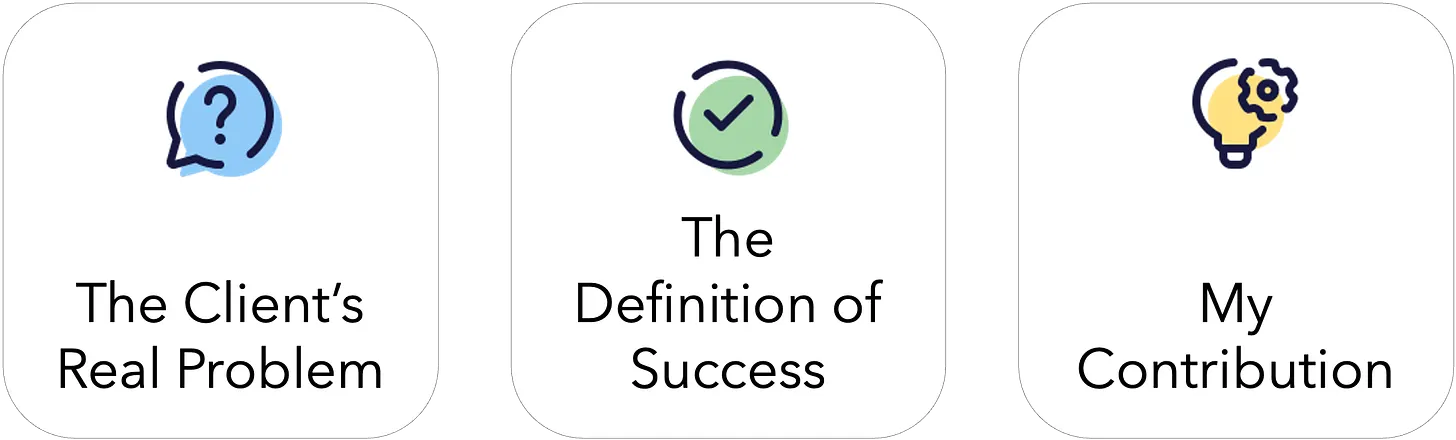
    How do you do that? You start by gaining absolute clarity.

    1. The Client’s Real Problem (Not Your Task)

    The real problem is never your task. Your task is just the symptom. You have to dig one level deeper.

    2. The Definition of Success (What’s the “Win”?)

    This is the so what? What does a win look like for the client? If you deliver your work and the client says, “Thanks, this is interesting,” you have failed. If they say, “Great, now I know exactly what to do,” you have won.

    3. My Contribution (How My Work Links to the “Win”)

    This is where you draw a straight, unbroken line from your keyboard to the client’s success. This is how you prove you are a value-multiplier.

  • The #1 mistake consultants make in a ‘sales’ call

    The #1 mistake consultants make in a ‘sales’ call

    Stop ‘selling.’ Start influencing

    Does the word “sales” make you cringe?

    For most independent consultants, “selling” is the worst part of the job. It feels pushy, inauthentic, and desperate. They are experts in their field, not “closers.”

    We just want to do the work. But to get the work, we’re told we have to sell.

    This creates a painful dynamic. We show up to a prospect meeting, put on our “salesperson” hat, and pitch our services. We talk about our experience, our methodology, and our credentials.

    In doing so, we make a critical mistake: We position ourselves as a vendor.

    We’re just a pair of hands for hire. The client holds all the power, and their only real variable for deciding is price.

    The most successful consultants I know have a secret: They never “sell.”

    They don’t pitch. They don’t persuade. They don’t “handle objections.”

    Instead, they influence. They use their expertise to reframe the client’s problem and guide them to a solution. This is the art of “Quiet Influence,” and it’s a game-changer for winning high-value clients.

    Here are three ways to stop selling and start influencing in your very next prospect call.

    1. The Power of the ‘Diagnostic’

    A vendor takes an order. An advisor writes a prescription.

    When a prospect tells you what they “need” (e.g., “We need you to build us a new dashboard”), a vendor says, “Okay, I can do that.”

    An advisor says, “Tell me more. Why a dashboard? What problem are you trying to solve that you can’t solve now? What decision will this dashboard allow you to make?”

    This is the ‘Diagnostic’ phase. Your goal is not to talk about yourself. It is to become obsessively curious about their problem. By asking insightful, expert questions, you are doing two things:

    1. Uncovering the real, high-value problem (which is often not what they first asked for).
    2. Proving your expertise without ever having to say, “I’m an expert.”

    Your questions are the demo.

    2. Lead from Behind (Let Them Have the Idea)

    When you’re a subject-matter expert, it’s tempting to jump in and say, “I see the problem. Here’s what you need to do.”

    The moment you do that, you invite resistance. The client’s ego kicks in. “What if that doesn’t work?” “Who are you to tell me how to run my business?”

    “Quiet Influence” means guiding the conversation so the client “discovers” the solution themselves.

    • Don’t say: “You need to fix your onboarding process first.”
    • Instead, ask: “It sounds like you’re losing all your new hires in the first 90 days. What do you think would happen to your retention goals if we focused all our energy on that one problem first?”

    By framing the path forward as a question, you’re not issuing a command; you’re inviting collaboration. You’re letting them “have” the idea. And people always support a solution they helped create.

    3. Sell the Diagnosis, Not the Cure

    The most valuable thing you offer a client isn’t the final deliverable. It’s your thinking. It’s your ability to see their problem more clearly than they can.

    So, in the “sales” process, give your thinking away.

    Instead of sending a proposal that just lists “50 hours of work,” send a document that diagnoses their problem.

    • “Here is my understanding of your situation.”
    • “Here is the core problem I’ve identified, which is costing you [X].”
    • “Here are the three options I see for solving it.”

    This document (or presentation) proves you’re the right person for the job before they’ve even seen the price. You’re not selling your time; you’re selling your clarity.

    The Advisor is the One Who Asks the Questions

    This trust-based, diagnostic approach is the core of Quiet Influence. It’s what moves you from “vendor” to “trusted advisor.”

    When you’re an advisor, you’re not “selling.” You’re consulting. The sales call is the work. Clients stop haggling over your hourly rate because they’ve already experienced the value of your mind.

    This is how you win better clients, at higher fees, with zero “salesy” tactics.

    If you’re a professional who wants to win clients authentically, this framework is for you. I’ve detailed the entire step-by-step process in my book, Quiet Influence.

    It’s one of the five guides in “The Smart Professional’s Short Guide Series,” designed to give you the exact skills you need to build a thriving, authentic practice.

    You can find it on Amazon: https://mybook.to/quietinfluence

  • Welcome to the Danger Zone

    Welcome to the Danger Zone

    A reflection on the 3-6 month mark, and the two mindsets that define your career.

    Let’s talk about a phase in every new job that nobody prepares you for.

    It’s not the first 30 days: that’s all about high-energy, onboarding, and “great-to-meet-you”s.

    No, I’m talking about the 3-6 month mark.

    I call this the “Danger Zone.”

    The “new job” shine has worn off. The overwhelm is real. You’re now part of the machine, and your entire focus narrows to a single, panicked thought: “Just tell me what to do.”

    This is the moment you become a “Doer.”

    The Doer is a task-taker. Their to-do list is their compass, and their greatest fear is getting a task wrong. They ask “What?” and “When?” They’re a “cost centre,” a pair of hands. And honestly, it’s where most of us live most of the time.

    But there’s another path. It’s the path of the “Advisor.”

    The Advisor is a problem-solver. They see the same to-do list, but they treat it as a set of clues, not a set of instructions. They’re not afraid to pause and ask the most powerful, and most dangerous, question: “Why?”

    • “Why are we doing this?”
    • “Why is this the most important thing?”
    • “Why are we doing it this way?”

    The Advisor understands what the Doer doesn’t: the “why” is the only question that matters. As Peter Drucker famously wrote, “There is nothing so useless as doing efficiently that which should not be done at all.”

    This is the entire game. The Doer is terrified of looking stupid, so they just do the work. The Advisor is terrified of wasting time, so they risk looking stupid for 60 seconds to make sure the work is worth doing.

    This shift, from Doer to Advisor, isn’t about your title, your tenure, or your salary. It’s a choice. It’s a new “Operating System” you have to install.

    When in your career have you been caught in the “Doer” trap? And what did it take to get you out?

  • Thinking of Going Solo? Your Skills Aren’t the Real Question

    Thinking of Going Solo? Your Skills Aren’t the Real Question

    Before you worry about clients, pricing, or your niche, the first question you must answer is internal: “Is solo consulting really right for me?

    Your expertise gets you in the game. But your temperament is what lets you finish.

    It’s not about what you do. It’s about how you operate.

    Self-Discipline: Can you be your own boss, manager, and administrator every day? Can you do the “business building” work even when you don’t feel like it? No manager is chasing you for deliverables. No corporate rhythm to carry you forward. You set the pace, or nothing moves.

    Motivation: When you hit a roadblock, will you be driven from within to find a solution, or will you wait for direction that never comes? Employees can escalate problems. Solo consultants solve them or live with them. Internal drive isn’t optional.

    Uncertainty: Can you handle the financial and emotional ambiguity of a lumpy pipeline? Can you sleep at night without the “guarantee” of a regular paycheck? Revenue fluctuates. Deals fall through. The safety net you’re used to doesn’t exist anymore.

    The tactics of consulting are learnable. The temperament for autonomy and uncertainty is where the real self-assessment lies.

    You can master positioning, proposals, and pricing. But if you can’t operate in ambiguity, thrive without structure, and sustain yourself through rejection, no amount of technical skill will save you.

    What’s your take? Is temperament more important than experience for a new solo consultant?

  • Your most important business asset (it’s not your website)

    Your most important business asset (it’s not your website)

    When someone at a networking event asks, “What do you do?” what’s your answer?

    If you’re like most independent consultants, you probably answer with your service:

    • “I’m a project management consultant.”
    • “I’m a data analyst.”
    • “I build custom software.”

    This answer is logical, accurate… and a strategic mistake.

    It immediately makes you a commodity. You are one of a dozen project managers or analysts that person could find on LinkedIn. You’ve positioned yourself in a “vendor” box, forcing you to compete on price and experience.

    What if your answer was different? What if you answered with your purpose?

    This is the “Consultant’s Why,” and it is the single most important asset for your brand and your business. It’s the difference between being a “vendor” and becoming a “trusted advisor.”

    Your ‘Why’ Isn’t a Fluffy Mission Statement

    Let’s be clear: this isn’t a “live, laugh, love” poster for your office. For a solo consultant, your ‘Why’ is a powerful strategic tool. It’s the engine that drives your business.

    Here’s how it works.

    1. Your ‘Why’ is Your Niche

    Generalists compete on price. Specialists compete on value. Your ‘Why’ is the fastest way to move from the first category to the second.

    Your ‘Why’ shifts the conversation from what you do (your task) to the problem you solve (your value).

    • Vendor (What): “I’m a data consultant who knows Python and SQL.”
    • Advisor (Why): “I help e-commerce brands stop guessing. I believe that every marketing decision should be backed by clear data, so I build systems that give leaders the exact numbers they need to grow profitably.”

    See the difference? The first is a service. The second is a purpose. It instantly defines your niche (e-commerce brands), the problem you solve (uncertainty, guesswork), and the value you provide (profitability). Clients don’t buy “Python scripts”; they buy “the end of guesswork.”

    2. Your ‘Why’ is Your Client Filter

    Are you tired of “difficult” clients? The ones who question your invoices, drain your energy, and don’t value your expertise?

    A “difficult client” is almost always a “bad-fit client.” And you attract bad-fit clients when you don’t have a clear ‘Why’.

    Your ‘Why’ is a “velvet rope” for your business. It’s magnetic to your ideal clients and (just as importantly) a polite repellent to the wrong ones.

    • If your ‘Why’ is “I believe in sustainable, long-term growth,” you will automatically repel clients looking for “get-rich-quick” hacks.
    • If your ‘Why’ is “I only work with leaders who are serious about building a high-trust culture,” you will filter out the micromanaging-tyrant bosses.

    This makes your “sales” process feel less like selling and more like qualifying. You’re not trying to convince them; you’re diagnosing a mutual fit based on a shared purpose.

    3. Your ‘Why’ is Your Marketing Message

    For most consultants, the hardest part of marketing is staring at a blank page. “What do I post on LinkedIn?” “What should I write for my newsletter?”

    When you are clear on your ‘Why’, you never run out of things to say.

    You’re no longer just “making content.” You are articulating your core belief in a dozen different ways:

    • “Here’s the biggest mistake I see companies make when…”
    • “A principle that guides all my client work is…”
    • “You don’t need another tool. You need a better way of thinking about…”

    Your ‘Why’ is the central theme of your articles, your conference talks, and your client proposals. It’s authentic, it’s powerful, and it’s consistent—because it’s true.

    Finding Your Foundation

    Your ‘Why’ isn’t just a “nice-to-have.” It is the foundation of your practice. It defines your niche, filters your clients, and fuels your marketing.

    But finding it takes more than a 10-minute brainstorming session. It’s a process of introspection—of excavating the real reason you started this journey in the first place.

    This process is the most critical strategic work you can do for your business. It’s the foundation for a practice that is not only profitable but also deeply fulfilling.

    That’s why I wrote Finding Your Purpose, the first book in “The Smart Professional’s Short Guide Series.” It’s a practical guide designed to help you move from a vague idea of what you do to a powerful, clear statement of purpose that can become your brand’s greatest asset.

  • Why Skilled Experts Get Stuck—And How to Break Free

    Why Skilled Experts Get Stuck—And How to Break Free

    Many technical professionals reach a point where their expertise, once highly valued, feels boxed in by routine, bureaucracy, or diminishing opportunities for growth. 

    If you’re respected for your skills but sensing a lack of autonomy, purpose, or challenge, you’re not alone, and you haven’t failed. 

    You’re simply at a career crossroads common in high-performing careers.

    Expert stagnation isn’t about a lack of ability; it’s about outgrowing your role or system. 

    You may notice the signs: repetitive work, unchallenged ideas, or being overlooked despite years of contribution. 

    The structure that supported your professional growth can eventually restrict your freedom and impact.

    So, how do you break free? The answer isn’t to quit impulsively but to act strategically. 

    First, name what’s no longer working: get clear on the real sources of dissatisfaction. 

    Next, define what freedom means for you, whether it’s more control over your time, choice of projects, or a voice in the work you do.

    Test small steps: assist a past client on the side, join a consulting forum, or volunteer your expertise. 

    Track insights, strengths, and fears in a decision journal

    Clarity emerges through action, not endless planning.

    When experts take decisive, small steps, going from burnt-out senior professional to thriving consultant, they rediscover engagement and control.

    Feeling stuck is feedback, not failure. 

    Breaking free starts with honest self-reflection, strategic planning, and using your hard-won skills to build a future you own. 

    Your next chapter is waiting, clarity comes when you act on it.