Category: Position

The Confident Consultant

  • Pricing Confidence Gap Assessment

    Pricing Confidence Gap Assessment

    Every pricing problem is a psychology problem in disguise.

    There is a gap between what we know we should charge and what we actually hold when pressure arrives. For technical professionals, this gap isn’t usually a lack of market data; it’s an identity struggle.

    The “Audition” vs. The “Assessment”

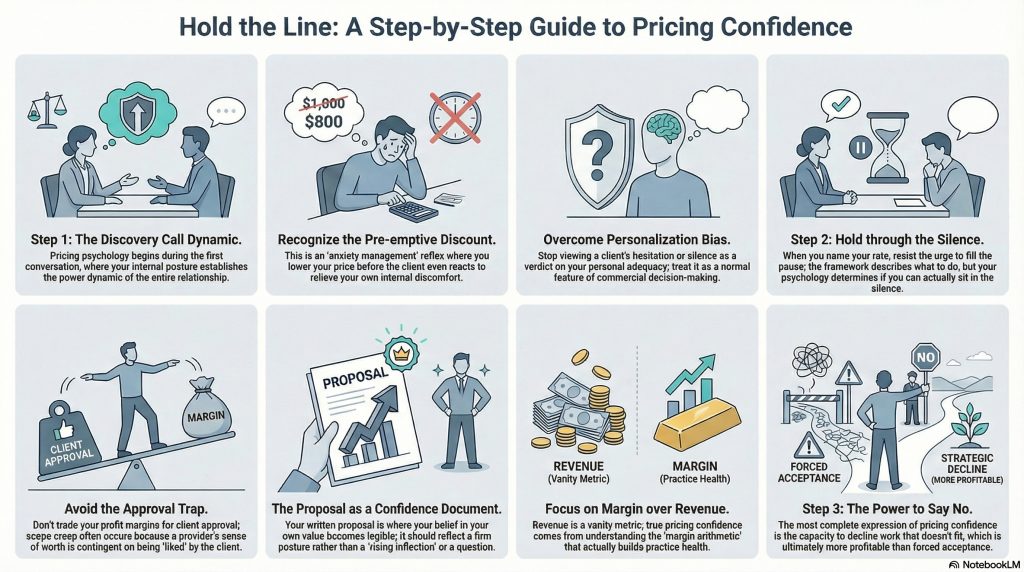
    Most of us enter commercial conversations in an Audition Frame. We view the client as an authority figure and ourselves as performers waiting for a verdict.

    When you “audition,” you:

    • Over-explain your methodology to “prove” you’re enough.
    • Give away detailed advice for free to manage your own anxiety.
    • Soften your rates pre-emptively because naming a firm number feels “unkind” or “transactional”.

    The shift happens when you move to an Assessment Frame. Here, you are a peer evaluating mutual fit. You aren’t asking “Will they choose me?” but “Is this project a good fit for the work I do best?”

    The Approval Trap

    This identity struggle follows us into the project itself through Scope Creep. We absorb extra revisions or “quick calls” because we need the client’s approval to feel our work is legitimate.

    But remember: Unlimited generosity is not a strategy; it’s an expectation. Clarity is the most professional gift you can give. A client who knows your boundaries knows exactly what they are paying for, and that creates more trust, not less.

    Building Your Practice on Margin, Not Vanity

    We often use revenue as a proxy for success, but revenue is a vanity metric. A high-revenue project with a “chronic negotiator” who erodes your scope and demands constant reassurance often results in a negative margin once your time is properly accounted for.

    True pricing confidence is the capacity to say “no” to the wrong client so you have the capacity for the right one.

    Is your practice leaking margin through these psychological patterns? I’ve designed a diagnostic tool to help you find out. Take the free The Pricing Confidence Gap Assessment to see if you’re operating as an Anxious Generalist, an Emerging Peer, or a Confident Authority.

    Take Assessment

    What You’ll Get:

    1. The Diagnostic Assessment

    Identify your specific “margin leaks” across four key territories:

    • The Behavioural Audit: Pinpoint the reflexes that change your price before it leaves your mouth.
    • The Framework Diagnostic: Determine if you are “auditioning” or “assessing”.
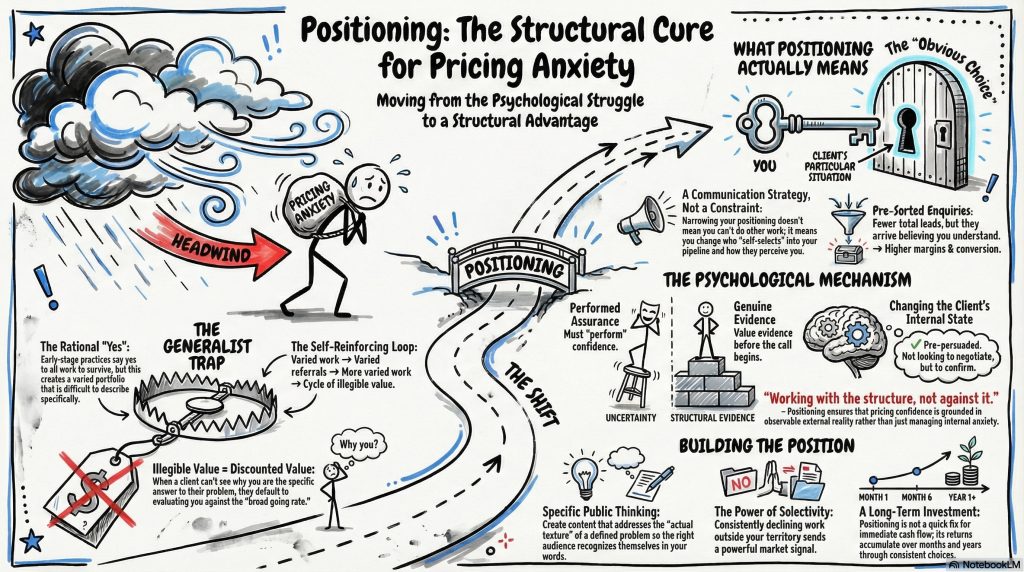
    • Architecture Check: Evaluate if your proposals and positioning support or undermine your value.
    • The Margin Reality: Calculate your true “effective hourly rate”.

    2. The 5-Day Line-Holding Intensive (Email Course)

    A daily deep dive into the core frameworks of Hold the Line:

    • Day 1: The Call Before the Call. Shifting your internal state before the first dial.
    • Day 2: Silence is a Tool. Learning to inhabit the pause after the price is named.
    • Day 3: Interrupting the Reflex. Stopping the unsolicited softening of your terms.
    • Day 4: Escaping the Approval Trap. How to set boundaries that actually increase client trust.
    • Day 5: Revenue vs. Margin. Shifting your focus to the only metric that matters for a sustainable practice.

    Stop Managing Your Anxiety. Start Managing Your Value.

    Get the Audit & 5-Day Intensive

    This assessment and email course is based on the frameworks in Hold the Line: The Psychology of Pricing, Boundaries, and Business Confidence.

  • The consultant’s invisible margin problem

    The consultant’s invisible margin problem

    There’s a number most consultants track carefully: revenue. Proposals sent, contracts signed, monthly billings. It’s the number that goes in the report, comes up in conversations, and tends to define how a good month feels.

    There’s another number most consultants significantly underestimate: margin. What actually remains after time, scope creep, unpaid revisions, and the extras added to keep a client comfortable.

    The gap between those two numbers is often larger than people want to look at closely.

    Part of this is structural, consulting engagements are difficult to scope precisely, and some overage is inevitable. But a significant part is psychological, and it follows a predictable pattern.

    A client pushes back, or hesitates, or simply goes quiet.

    Something in that moment gets interpreted as dissatisfaction, and the response is to add something. Another call. An extra deliverable. A revised scope at the original price. The immediate anxiety eases. The relationship feels safe again. And somewhere in the background, the effective hourly rate just dropped.

    What makes this pattern particularly difficult to address is that it feels like good client management. Attentive. Flexible. Going above and beyond. Which it is, except when it’s habitual, unreciprocated, and slowly eroding the financial foundation of the practice.

    The distinction worth making is between strategic generosity, a deliberate choice to invest in a relationship that will return value, and anxiety-driven generosity, which is a reflex to relieve discomfort that gets dressed up as client care.

    One is a business decision. The other is an emotional one with business consequences.

    The practical question is simple even if the answer isn’t: when you last added scope without charging for it, which one was it?

  • Why The Most Visible Consultant Wins (Not The Most Qualified)

    Why The Most Visible Consultant Wins (Not The Most Qualified)

    The uncomfortable truth about how clients actually choose.

    Early in my consulting career I lost a project I should have won.

    The client chose someone less experienced, less qualified, and I was quietly certain, less capable of delivering what they needed.

    It stung.

    But looking back, the client made a completely rational decision.

    They chose the consultant they knew.

    Not the best one. The most visible one.

    After decades in engineering, management, consulting and academia I’ve watched this pattern repeat itself more times than I can count. And I’ve come to accept an uncomfortable truth:

    Expertise gets you in the room. Visibility gets you the work.

    The Invisible Expert Problem

    Most technical consultants build their reputation the same way, through exceptional delivery, word of mouth, and a network cultivated over decades.

    This works. Until it doesn’t.

    Referrals are relationship-dependent. They dry up when your network retires, changes industry, or simply forgets to mention your name in the right room.

    Visibility is different. It compounds.

    A consultant with a strong online presence, a clear point of view, consistent content, a body of work that speaks before they do, gets found by people who’ve never met them.

    That’s not marketing. That’s infrastructure.

    What Visible Consultants Do Differently

    They don’t post more. They post with purpose.

    Three things separate visible technical consultants from invisible ones:

    1. They have a consistent point of view: Not opinions on everything, one clear perspective on the problems their ideal clients face. Repeated consistently until it becomes what they’re known for.
    2. They share their thinking, not just their credentials: Credentials tell clients what you’ve done. Thinking shows them how you work. Technical buyers trust process. Showing yours builds deeper credibility than any CV.
    3. They make it easy to find them: A LinkedIn profile that speaks to client outcomes, not career history. A newsletter that delivers value before any transaction. A body of content that answers the questions their ideal clients are already asking.

    The Compounding Effect

    Here’s what most consultants miss about visibility: It doesn’t work immediately. It works eventually, and then it works continuously.

    The consultant who starts building their online presence today won’t see dramatic results in week one. But in month three, six, twelve, they become the name that keeps coming up.

    The one who gets recommended by people who’ve never actually worked with them.

    The one whose next client found them through a post written two years ago.

    That’s not luck. That’s a system.


    Your technical expertise took decades to build.

    Your visibility can be built in months.

    The question isn’t whether you have something worth saying.

    After everything you’ve learned in your career: you absolutely do.

    The question is whether the right people can find you when they need you most.

    Phil Charles is the founder of The Smart Consultant and author of The Consultant’s Edge. Every week he shares practical strategies to help technical consultants build visibility, win better clients, and grow on their own terms.

  • The Consultant’s Hidden Brake (And Why Most of Us Never Name It)

    The Consultant’s Hidden Brake (And Why Most of Us Never Name It)

    You knew what to do. You just didn’t do it.

    The risk had been visible for weeks. The timeline was unrealistic and you knew it. The client’s favoured approach had a structural flaw you’d identified in month one. The conversation needed to happen, you’d drafted it in your head a dozen times, but there was always a reason to wait. A better moment. A less charged week. A version of the situation in which raising it would feel less risky than it did right now.

    And then the window closed. The project slid. The client felt blindsided. And somewhere in the aftermath you found yourself wondering not whether you’d seen it coming, you had but why you hadn’t said something sooner.

    This is not a story about incompetence. It’s a story about fear. And in consulting careers, it’s one of the most common stories there is.

    The problem with consulting fear is that it doesn’t look like fear

    Panic is easy to recognise. Paralysis is visible. But the version of fear that operates most persistently in consulting careers looks nothing like either of those things. It looks like professionalism.

    It looks like the risk you’ve documented but not escalated. The deliverable framed carefully enough to be technically accurate while avoiding the conclusion that would create friction. The difficult client dynamic you’re managing rather than addressing. The recommendation you’ve softened, not because the evidence was weak, but because you weren’t entirely sure how it would land.

    None of this announces itself as fear. It announces itself as caution. As judgement. As reading the room. And because it wears that disguise so well, most consultants never examine it directly. They experience the consequences, the relationship that quietly degraded, the project that slid further than it needed to, the client who eventually said “why didn’t you tell me this sooner?” without ever connecting them to the thing that actually caused them.
    The first step is naming it. So let’s name it precisely.

    The five fears that act as hidden brakes

    Technical consultants face a specific flavour of professional fear, one that is not about physical risk but about exposure. About being seen to not know something. About losing something you’ve spent years building. Here are the five versions that show up most often.

    1. Fear of being wrong in public. Giving a recommendation that is later challenged, questioned, or shown to be incorrect, in front of stakeholders, in front of the client’s leadership, in a room where everyone is watching. This fear is particularly acute for technical consultants because expertise is the product you sell. The perceived cost of being wrong isn’t just embarrassment. It feels like an attack on the thing your entire professional value rests on.
    2. Fear of the difficult conversation. Telling a client their timeline is unrealistic. Telling a senior stakeholder their preferred approach won’t work. Telling a sponsor, clearly and on the record, that the project has already failed even if nobody has said so. You know the conversation is necessary. The clarity is not the problem. The reluctance to have it is fear, wearing the costume of timing.
    3. Fear of losing the relationship. The belief, often unexamined, that honesty, a hard boundary, or an uncomfortable truth will cost you a client or a referral relationship you’ve invested heavily in building. This one is particularly insidious because it frames itself as strategic thinking. I’m protecting the long-term relationship. I’m reading the politics carefully. In practice, it usually produces the opposite of what it intends.
    4. Impostor fear. The persistent sense that in the next meeting, on the next engagement, you will be exposed as less capable, less certain, or less qualified than your clients currently believe. What makes this one particularly difficult is that it doesn’t diminish with experience. Consultants with twenty years in the field feel it as reliably as those with two. The context changes; the fear doesn’t.
    5. Fear of outcomes you can’t control. Projects that might fail despite your best work. Proposals that might not win despite being excellent. Client relationships that might end for reasons entirely unrelated to your performance. The energy spent worrying about these outcomes is energy that isn’t available for the things that are actually within your control. Which is precisely the problem.

    What these fears produce

    Left unexamined, each of these fears produces a predictable pattern of behaviour. Delay. Softened advice. Avoided conversations. Decisions deferred past the point where they can be made at full value.

    The result isn’t dramatic. Nobody burns the project down. Nobody loses their composure in a client meeting. Instead, the engagement slowly accumulates small compromises, small moments where the professional judgement that was needed was replaced by the response that was most immediately comfortable, until the small compromises become a large problem.

    Here is the part worth sitting with: in most of these cases, the consultant knew what the right thing to do was. The knowledge was not the limiting factor. What was missing was the internal capacity to act on that knowledge, under the specific conditions consulting creates, conditions of sustained pressure, uncertain outcomes, and significant professional exposure.

    That capacity is trainable. But training it requires first being honest about where fear, not judgement, is shaping your behaviour.

    A practical starting point: Fear Setting

    Before your next difficult conversation, the one you’ve been finding reasons to defer, try this.

    Write down every specific negative outcome you can imagine if you address the situation directly. Not vague catastrophes. Specific ones. The client becomes defensive and escalates. The engagement gets scoped down. The relationship becomes difficult. Write them down.

    Then, for each one, write down two things. First, what you could do to reduce the probability of that outcome occurring, most feared outcomes are not inevitable, they are probabilities, and many can be significantly reduced by preparation, framing, or process. Second, what you would actually do if it occurred anyway. How you would manage it. What the realistic path back to a stable position looks like.

    The act of writing down “how would I repair this” is where the value lies. Most feared outcomes, when examined this way, turn out to be recoverable. The engagement ends badly but your reputation remains intact. The client loses confidence but the relationship can be rebuilt. The conversation goes badly but you’re on the record as having had it, which is a very different position from having stayed silent.
    Catastrophe is rarer than fear suggests. The examination makes that visible.

    The distinction that matters most

    There is a difference between productive caution and fear-driven avoidance, and it’s worth drawing clearly because they can look identical from the outside.
    Productive caution is taking the time to ensure a recommendation is well-founded before you deliver it. It’s asking for a day to think through a complex question rather than speculating under pressure. It serves the quality of the work and the client’s interests.

    Fear-driven avoidance is delaying a difficult conversation until the window for it has closed. It’s softening findings to the point where they no longer communicate the actual risk. It serves only one thing: your immediate comfort.
    The test is simple. Ask yourself honestly: is this delay improving the work? Or is it just making me more comfortable?

    If it’s the latter, you’ve found your hidden brake. Naming it is the first step to releasing it.

  • 5 Pricing Mistakes That Keep Technical Consultants Earning Less Than They Should

    Most technical consultants are brilliant at solving complex problems.

    But terrible at getting paid what they’re worth.

    Here are 5 pricing mistakes keeping technical consultants stuck: earning far less than they should.

    Engineering skills are rare. Your time solves problems most people can’t.

    But when it comes to pricing, most consultants default to an hourly rate pulled from thin air: usually their old salary divided by 2,000.

    That’s not a pricing strategy. That’s leaving money on the table.

    Here are the 5 mistakes costing you income.

    Mistake #1: You’re pricing by the hour instead of by the outcome.

    Clients don’t care how long it takes. They care what they get. When you bill hourly, you:

    • Punish yourself for being fast and efficient
    • Invite clients to micromanage your time
    • Cap your income at hours-in-a-day

    Project-based pricing ties your fee to value delivered, not time spent.

    Mistake #2: You benchmarked your rate against other consultants, not against client ROI.

    Your rate should reflect the value you create, not the market average. If your recommendation prevents $500K in downtime or rework, charging $15K isn’t bold, it’s modest. Anchor your price to their outcome. Suddenly, your number feels small to them, not large.

    Mistake #3: You’re not charging for scope creep.

    Scope creep is the silent killer of consulting margins. Fix it with:

    • A clear written scope in every contract
    • A defined change-order process
    • A standard rate for out-of-scope requests

    One undocumented “quick favor” can unravel a profitable project fast.

    Mistake #4: You discounted your rate to win the first client.

    This sets a dangerous precedent. Clients talk. The rate you accept today becomes the ceiling they expect tomorrow. Instead, offer a smaller engagement, a paid discovery call, or a scoped audit at your full rate. It builds trust without training clients to expect discounts.

    Mistake #5: You never revisit your rates.

    Your skills compound. Your rates should too. Review your pricing:

    • Every 6 months minimum
    • After each major project win
    • Whenever demand exceeds your capacity

    If every prospect says yes immediately, you’re underpriced.


    Your technical expertise is rare. Price it like it is.

  • Delaying Automation Costs Extra Time and Money

    This article reveals how postponing the automation of your business systems can lead to significant time and financial losses.

    The costs associated with delays in implementing efficient systems are often underestimated.

    You’ll find 9 essential tips for understanding these costs, 3 actionable steps to get started, and a list of highly recommended books for further reading on systems and automation.

    Top Tips

    1. Understanding the Hidden Costs

    Delaying automation has hidden costs that go beyond immediate financial impact. Every moment spent on manual processes is a diversion of valuable resources.

    As operations remain manual, the risk of human error increases, leading to further financial implications. These errors might require additional time and money to correct, compounding the issue.

    Recognising these hidden costs early can help in making well-informed decisions about automation.

    2. Time Efficiency Benefits

    Automating systems in your organisation significantly improves time efficiency.

    Manual processes are time-consuming and prone to delays, whereas automated systems streamline tasks. This efficiency contributes to increased productivity without enlarging staff.

    Furthermore, time saved through automation can be redirected to strategic initiatives, enhancing overall business growth. Embracing automation early positions your business to better compete in the market.

    3. Financial Savings Through Automation

    Implementing automation systems saves money over time by reducing labor costs.

    Automated processes require minimal supervision and maintenance once established. This allows for a smaller workforce or reallocation of employees to more profitable activities.

    Additionally, automation minimises the risk of costly errors, which can save considerable sums. Investing in automation early can provide a significant return on investment.

    4. Improved Accuracy and Reliability

    Automated systems enhance accuracy and reliability in business processes.

    Manual operations are vulnerable to mistakes, resulting in inaccurate data and reports. Automation ensures consistency and dependability, leading to informed decision-making.

    Improved accuracy also boosts client trust and reduces costs associated with mistakes. When systems are reliable, businesses can focus on scaling operations rather than mitigating errors.

    5. Streamlining Repetitive Tasks

    Repetitive tasks are ideally suited for automation, as these processes benefit greatly from consistency.

    Delegating these tasks to automated systems frees up human resources. Employees can then concentrate on more complex and impactful projects. This improves overall job satisfaction and fosters innovation.

    Early adoption of automation for such tasks reduces operational bottlenecks and enhances efficiency.

    6. Scalability Advantages

    Automation supports scalability, a crucial factor for growing businesses.

    As demand increases, automated systems can handle larger volumes of work without additional personnel. This flexibility allows firms to expand without the usual constraints of scaling manually.

    The immediate availability of automated solutions enables businesses to seize opportunities with agility. Systems positioned for growth create a formidable competitive advantage.

    7. Competitive Edge Maintenance

    Businesses that adopt automation early gain a competitive edge.

    Efficiency, cost savings, and enhanced capabilities create a robust market position. Companies delaying automation may struggle to keep up with fast-moving competitors.

    The advantages of staying ahead include better resource allocation and staying adaptable to market changes. An early transition to automated systems is pivotal for long-term success.

    8. Enhancing Customer Experience

    Automation enhances customer experience by ensuring quick, accurate service delivery.

    Systems can manage customer queries efficiently, resulting in higher satisfaction rates. Timely assistance and error-free transactions foster customer loyalty. Focusing on customer experience through automation can differentiate a business in competitive landscapes.

    Start automating to ensure that customer needs are met consistently and reliably.

    9. Proactive Resource Management

    Effective resource management is crucial, and automation aids significantly in this area.

    By automating inventory management, scheduling, and other resource-intensive tasks, businesses can optimise their use of materials and time. This proactive approach reduces waste and improves strategic planning.

    In adopting automation, companies can better manage resources, which supports both cost savings and increased operational efficiency.

    Fast Action Steps

    1. Identify Key Areas for Automation

    Start by identifying areas where automation could have the most significant impact.

    Focus on repetitive, time-consuming processes that suffer from inefficiencies. Evaluate departments like customer service, data entry, or supply chain management.

    Prioritise these areas based on their potential to improve efficiency and reduce costs. This initial step is vital to ensure that the transition to automation is strategic and impactful.

    2. Assess Available Automation Technologies

    Research and evaluate the automation technologies available to your industry.

    Consider solutions that integrate seamlessly with your existing systems. Software and tools should match your business requirements and allow for scalability. Assess their cost, ease of implementation, and long-term benefits.

    Consulting with industry experts or vendors can provide insights into the best options for your specific needs.

    3. Develop a Transition Plan

    Craft a detailed plan to guide your transition to automation.

    Set clear objectives, timelines, and benchmarks. Involve key stakeholders and ensure that team members are prepared for the change. Training programs are essential to equip staff with necessary skills.

    Regular reviews will ensure the project stays on track. A well-executed transition plan minimises disruptions and supports a smooth shift to automated systems.

    Further Reading

    • The Lean Startup by Eric Ries
    • Automate This by Christopher Steiner
    • The Goal by Eliyahu M. Goldratt
    • The Phoenix Project by Gene Kim, Kevin Behr, and George Spafford
    • Automation and Society by Rajiv Biswas
  • Unaddressed Risks That Drain Your Monthly Cash

    Every month, individuals and businesses face the challenge of managing their cash flow effectively.

    Often, this involves overlooked risks that, if left unattended, can gradually drain financial resources.

    Ignoring these risks can have a significant impact on both short-term and long-term financial health.

    By proactively identifying and addressing these vulnerabilities, you can take control of your financial situation.

    This article delves into specific unaddressed risks that can silently drain your monthly cash and offers insights on how to mitigate them for better financial management.

    The Consequences of Ignoring Risk Assessments

    Risk assessments form the backbone of sound financial management. However, many individuals and businesses postpone or overlook this crucial process.

    By neglecting to evaluate potential risks, you expose yourself to unforeseen financial difficulties. These issues can range from sudden increases in operational costs to unpredictable market shifts.

    It’s essential to be aware of the full spectrum of risks you might face so you can devise effective strategies to handle them.

    Timely risk assessments can help you anticipate potential pitfalls and provide a roadmap for minimising their impact on your finances.

    Moreover, neglecting risk assessments means you’re less prepared to take advantage of positive opportunities. By not understanding your financial environment thoroughly, you could miss out on beneficial adjustments that could significantly boost your monthly cash flow.

    Ensuring you regularly evaluate and update your risk management practices is a crucial step in staying ahead of potential financial troubles.

    Common Financial Risks and Their Impact

    Several financial risks, if left unaddressed, can gradually erode your monthly cash flow.

    One of the most common is fluctuating expenses. Whether it’s unexpected repairs or price hikes, not accounting for these variables can severely disrupt your month-end balances.

    Identifying trends in your expenses can help you anticipate and manage these changes more effectively.

    • Unforeseen personal or business expenses
    • Changes in market demand for services or products

    Another significant risk is the lack of a financial buffer to manage temporary cash flow shortages.

    This absence can lead to over-reliance on credit lines and loans, which could increase financial pressure significantly over time.

    Understanding these common risks allows you to plan for emergencies with confidence and security.

    Strategic Financial Risk Mitigation

    Mitigating financial risks requires a proactive approach. Start by conducting regular financial audits to identify potential vulnerabilities.

    Reviewing your budgeting and expense records is a practical strategy to spot irregularities before they become severe issues. This ongoing vigilance allows you to make adjustments that accommodate shifts in your financial landscape.

    Additionally, building a contingency plan to address sudden expenses can alleviate stress and reduce dependency on debt solutions.

    Establishing a savings strategy aimed at creating an emergency fund can protect your cash flow from unpredictable disruptions.

    By incorporating these measures, you can create a resilient financial framework capable of withstanding various challenges.

    The Benefits of Regular Risk Management

    Integrating risk management into your routine financial practices can transform your financial stability. By addressing potential cash flow disruptions before they occur, you can maintain a steady financial course.

    Continuously updating your risk management strategies not only safeguards your finances but also empowers you to seize opportunities that may have appeared too risky before.

    Risk management isn’t solely about avoiding setbacks; it’s about enhancing your financial resilience, allowing you to navigate uncertainties with confidence.

    Regularly reflecting on and adjusting your approach ensures that you are always prepared for whatever financial challenges come your way, leading to improved business continuity and personal financial peace.

    In summary, unaddressed financial risks can quietly sap your monthly cash unless managed proactively.

    By understanding the importance of regular risk assessments, identifying common threats, and implementing strategic mitigation tactics, you can better control your financial destiny.

    Remember, effective risk management is not just about defense: it’s a vital component of creating sustainable financial growth.

  • Ignoring Client Follow-Up Jeopardises Sustained Income

    This article focuses on the critical importance of client follow-up in maintaining a stable income stream.

    Consistent engagement with clients is a key factor in building enduring business relationships and ensuring repeat business.

    Included in this report are 9 essential tips, 3 actionable steps you can take immediately, and further reading suggestions to deepen your understanding of effective client communication.

    Top Tips

    1. Prioritise Client Communication

    Maintaining regular communication with clients is crucial. It shows that you value their business and are committed to meeting their needs.

    Regular follow-ups help in addressing any issues they may have before they escalate. This approach fosters trust and encourages clients to return for future services.

    By making client communication a top priority, you ensure their satisfaction and loyalty, which translates to sustained income.

    2. Understand Client Needs

    Understanding your client’s needs can create a strong foundation for long-term relationships. Taking time to listen and respond to their specific requirements demonstrates that you care about their success.

    This understanding enables you to offer tailored solutions, enhancing the client experience. When clients feel understood, they are more likely to continue doing business with you, ensuring consistent revenue streams.

    3. Build Strong Rapport

    Building rapport with clients can significantly boost your business. A strong connection encourages open communication and trust, leading to long-term partnerships.

    Rapport lays the groundwork for positive interactions, making clients more inclined to discuss their needs and feedback. This relationship strengthens business loyalty, ensuring clients prefer your services over competitors, thereby maintaining a steady income.

    4. Be Responsive

    Quick and effective responses to client inquiries show professionalism and respect for their time. Being responsive can prevent potential dissatisfaction and underscores your commitment to their needs.

    Prompt communication can address client concerns swiftly and assure them of your dedication. This level of service often translates into repeat business and helps stabilise your income base.

    5. Follow Up After Service

    Following up after providing a service can leave a lasting impression. It provides an opportunity to gather feedback and demonstrate ongoing support.

    Clients appreciate when businesses show genuine interest in their satisfaction, making them more likely to return.

    Effective follow-up can differentiate you from competitors and helps cement long-term business relationships, ensuring continuous income flow.

    6. Personalise Your Approach

    Personalising your interactions shows clients that you value them as individuals. A tailored approach can enhance the client experience, making them feel unique and respected.

    By remembering personal details or past interactions, you signal attentiveness and care. This personalised service can increase client loyalty, translating directly into sustained revenue.

    7. Monitor Client Feedback

    Regularly monitoring feedback helps in aligning your services with client expectations.

    Clients appreciate when their feedback leads to visible changes or improvements. It shows you are willing to adapt to their needs, keeping them satisfied and coming back.

    Actively engaging with feedback can turn potential issues into opportunities for strengthening client relationships, thus securing ongoing income.

    8. Offer Continuous Support

    Offering continuous support assures clients that help is always available when needed. This reassurance can enhance client confidence in your business.

    Continuous support often involves being proactive in addressing potential concerns and maintaining regular touchpoints. Such dedication is appreciated and can lead to steady client retention, ensuring predictable income.

    9. Encourage Client Engagement

    Encouraging clients to engage with your business through various channels fosters a sense of community. Interactive platforms and feedback options create space for client participation.

    Engagement keeps your brand at the forefront of clients’ minds, making them more likely to return. Promoting active client participation aids in building stronger relationships, contributing to consistent revenue.

    Fast Action Steps

    1. Set Automated Follow-Ups

    Implement automated follow-up messages to ensure consistent communication with clients. Automation tools can send reminders or thank-you notes post-service, maintaining contact.

    These tools help in not missing important client interactions. Automating follow-ups ensures that you never overlook a client, strengthening your relationship and fostering loyalty, which can directly impact your income positively.

    2. Regularly Assess Client Satisfaction

    Conduct regular assessments of client satisfaction through surveys or direct feedback requests. This practice allows you to identify areas for improvement and adapt your services accordingly.

    Understanding how clients perceive your offerings helps in making informed changes. By prioritising client satisfaction reviews, you can enhance service quality, leading to better client retention and stable revenue.

    3. Develop a Client Retention Strategy

    Create a strategic plan focused on retaining clients by offering loyalty programs or exclusive deals. Retention plans can include personalised touches or regular check-ins to show appreciation.

    These strategies make clients feel valued, reducing the likelihood of them switching to competitors. A robust retention strategy ensures a steady stream of income, supporting long-term business sustainability.

    Further Reading

    • How to Win Friends and Influence People by Dale Carnegie
    • The Thank You Economy by Gary Vaynerchuk
    • The 7 Habits of Highly Effective People by Stephen R. Covey
    • Never Lose a Customer Again by Joey Coleman
    • Influence: The Psychology of Persuasion by Robert B. Cialdini
  • Procrastinating on Priorities That Hurt Income Generation

    Procrastination is a common hurdle that many consultants face, particularly when it comes to tasks that directly influence their income.

    Delaying important decisions and actions can have a cascading effect on productivity and focus, which are critical to effective income generation.

    Not only does this behavior stall progress, but it can also create a cycle of stress and inefficiency.

    Understanding how procrastination affects income and taking steps to overcome it can lead to improved financial outcomes and a more robust business operation.

    The Impact of Procrastination on Earnings

    Procrastination often leads to missed opportunities, especially in fast-paced business environments where timing is critical.

    Delaying decisions can mean the difference between closing a lucrative deal or losing it to a more agile competitor.

    This inertia not only dampens immediate revenue prospects but can damage long-term relationships with clients.

    Consultants who master the art of decisive action are typically more successful in maximising their earning potential, as their promptness inspires confidence and reliability among clients and stakeholders.

    • Failing to follow up on client leads promptly
    • Postponing strategic planning and execution

    Behavioral Delays and Their Consequences

    Behavioral delays often manifest in the form of excessive planning or waiting for the ‘perfect’ moment.

    While preparation is important, overanalysing can be paralysing, preventing necessary action.

    These delays can lead to a backlog of uncompleted tasks, creating pressure and reducing efficiency.

    For example, deferring the development of a new product or ignoring emerging market trends can result in missed revenue streams and reduced competitiveness.

    By understanding these dynamics, individuals can recognise the need for a balanced approach, where decisiveness complements preparation.

    Strategies to Overcome Procrastination

    Implementing effective strategies can mitigate the impact of procrastination on income generation.

    One approach is to set clear, achievable goals with specific deadlines to create a sense of urgency and focus.

    Breaking down larger tasks into smaller, manageable steps can also alleviate feelings of overwhelm and enhance productivity.

    Additionally, leveraging technology, such as productivity apps, can provide reminders and streamline workflow.

    Building a habit of reflecting on daily achievements can boost motivation and encourage continued productivity by highlighting progress.

    Creating an accountability system where progress is regularly reviewed with a mentor or peer can further enhance commitment to goals.

    This social aspect adds an external layer of motivation, often proving effective in maintaining focus.

    Lastly, embracing a growth mindset and viewing setbacks as learning opportunities can stimulate resilience and perseverance, essential traits for overcoming procrastination.

    Cultivating Focus for Financial Success

    Developing a disciplined approach to focus can greatly enhance income generation.

    Prioritising tasks that have the highest impact on revenue will ensure time and energy are invested wisely.

    By adopting techniques like time-blocking and minimising distractions, individuals can maintain a sharp focus on revenue-driving activities.

    These practices not only promote efficiency but also lead to better decision-making, allowing for quicker, more effective responses to market opportunities.

    A focused mindset nurtures an environment where productivity thrives, ultimately translating into tangible financial benefits. Fostering such an environment requires commitment but yields rewarding results as both personal and business goals are achieved more consistently.

    Overcoming procrastination and enhancing focus are pivotal in elevating income generation.

    By acknowledging the impact of delays and implementing strategic changes, individuals can break free from the constraints of procrastination.

    This transformation not only improves monthly results but also fosters a more resilient and efficient business landscape, paving the way for sustained success and growth in income.

  • Fixing Pricing Mistakes That Drain Cash Flow

    Pricing can be a daunting task for many businesses, yet it’s crucial for maintaining healthy cash flow.

    Fear of losing customers or stepping outside market norms often leads consultants to hesitate in making necessary price adjustments.

    This indecision can significantly impact income stability, emphasising the need for confidence in pricing decisions.

    A proactive approach to pricing ensures that businesses not only cover operational costs but also gain the financial trust needed to prosper.

    In this article, we will explore key ways hesitation in pricing can drain cash flow and how to build confidence in pricing strategies.

    The Cost of Hesitation

    When businesses delay adjusting their prices, the immediate impact is often a reduction in cash flow.

    Without confidence in your pricing strategy, consultants might maintain outdated or underpriced products and services.

    This reluctance leaves money on the table, which could be invested back into the business to drive growth. Frequent underpricing also signals to potential customers a lack of value, leading to a skewed perception of quality.

    Moreover, waiting too long to adjust pricing might force a sudden, more drastic increase, prompting client dissatisfaction and potential loss.

    A strategic approach to pricing involves periodic review and adjustment based on market trends, costs, and customer feedback.

    Avoiding these adjustments due to hesitation can lead to missed opportunities and eroded profit margins. In turn, this creates a vicious cycle where tightened finances further inhibit necessary changes, putting additional strain on the business.

    Building Pricing Confidence

    Confidence in pricing comes from understanding both market dynamics and the intrinsic value of your offerings.

    Conducting thorough market analysis provides insights into competitor pricing and client expectations, which help in setting informed and competitive rates.

    Additionally, understanding the direct costs associated with providing your services or products ensures that pricing covers more than just the basics.

    • Regularly evaluate market conditions and competitor pricing.
    • Align pricing with the value and quality of your products.

    Engaging with clients directly to gauge their willingness to pay can also provide valuable feedback.

    Open communication channels allow consultants to adjust pricing in ways that maintain loyalty, while also ensuring future growth. Confidence stems from being well-prepared and knowing that any adjustments are in line with the market and customer demands.

    Overcoming Decision Delays

    Many consultants experience decision paralysis when it comes to pricing due to fear of negative client reactions or making the wrong move.

    To counter this, decision-makers should implement structured pricing review processes. This may involve setting specific intervals for reviewing pricing strategy to continuously assess adjustments.

    Furthermore, relying on data-driven insights can alleviate uncertainty. With access to quality financial data, consultants can identify patterns, forecast impacts, and make informed decisions swiftly.

    Proprietary research and client feedback tools also help in eliminating guesswork and reducing the emotional burden of pricing adjustments.

    The cost of delaying decisions in pricing can be managed through consistency and a clear understanding of the market. Structural discipline ensures that pricing remains flexible and adaptive, rather than stagnant and reactive.

    In the ever-evolving business landscape, maintaining cash flow and income stability through confident pricing is not just beneficial, but essential.

    While hesitation can lead to financial strain, a proactive approach can transform pricing into a powerful tool for growth.

    By leveraging data, market insights, and customer feedback, businesses can ensure their pricing reflects their value, distancing themselves from the pitfalls of indecision.

    Moving forward with confidence in pricing strategy is key to fostering long-term business success and stability.