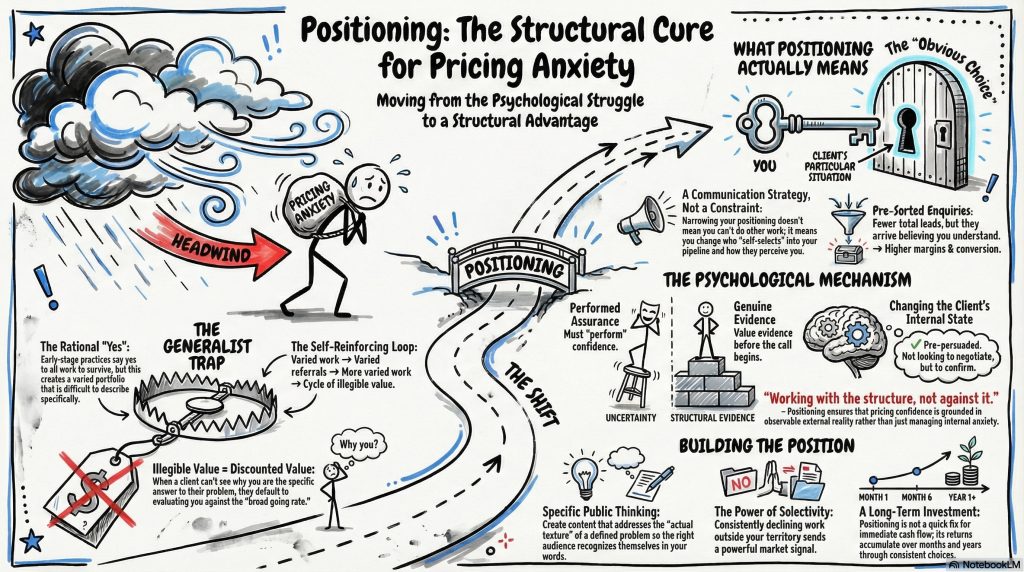
Every independent professional has felt the cold, familiar weight of “pricing anxiety.” It is that sudden, involuntary urge to offer a discount before the client has even raised an eyebrow. We are often told this is a mindset issue, a lack of internal conviction that requires “inner work” and affirmations of our own worth.
But for most consultants and agency owners, the struggle to hold a rate isn’t a psychological failing. It is a failure of architecture. When you operate as a generalist in a crowded market, you are working against an invisible environment of “commercial gravity.” No amount of internal confidence can fully overcome a market structure that views you as a commodity.
To fix your pricing, you must stop treating it as a battle of wills and start treating it as a matter of positioning. Positioning is the structural condition that either creates a grueling “commercial headwind” or allows your value to be recognised as a natural expression of your expertise.
Your Pricing Problem is Often Structural, Not Psychological
Most pricing advice focuses on what happens once you are in the room, how to name your rate, how to handle the silence, and how to stay firm. While these skills are necessary, they do not address the level of pre-existing commercial pressure present before the conversation even begins.
If you are a generalist competing against a dozen others offering similar services, your client has a genuine, ready alternative at a lower rate. In this scenario, your anxiety and “pre-emptive discount reflex” are actually rational responses to your environment. You feel the pressure because it’s real.
Positioning is the work of changing the room’s structure before you enter it. It isn’t a substitute for psychological work; it is the condition that makes that work effective. When you are the obvious choice for a specific problem, the “headwind” vanishes, and holding your price shifts from an act of disciplined effort to a simple statement of fact.
The “Generalist Trap” and the Cost of Illegibility
Few professionals choose to be generalists. Most fall into the “Generalist Trap” through a series of rational, survival-based decisions. Early in a practice, the opportunity cost of declining work is immediate, while the benefit of a focused position is distant. Saying yes to everything is often an act of commercial necessity.
The danger is that this survival strategy becomes a self-reinforcing cycle. A varied portfolio leads to varied referrals. Your network describes you in broad, non-specific terms, which brings in more varied, non-specific work. Eventually, your practice becomes “illegible” to the market.
“The cumulative effect is a practice that is genuinely difficult to describe specifically, difficult to refer to with precision, and difficult to price with authority. The value may be present in full. It is not legible. An illegible value is, in practice, a discounted value.” [Hold the Line]
When your value is illegible, the client defaults to the only metric they can understand: the market average. By failing to specify your territory, you force the client to treat you as a commodity, which in turn justifies your internal pricing anxiety.
Positioning is a Communication Strategy, Not a Legal Constraint
There is a common fear that narrowing your focus requires “commercial bravery” because it feels like you are shrinking your pool of opportunity. The logic seems sound: fewer potential clients must mean lower revenue.
From a strategic perspective, however, this is incorrect. Narrowing your positioning does not limit who you can serve; it changes who you explicitly address. Positioning is a communication strategy, not a legal constraint. Most specialists continue to accept a variety of work, but their public-facing identity is laser-focused.
By narrowing the territory you claim, you increase your conversion rates and margins. A specialist receives fewer inquiries than a generalist, but those inquiries arrive “pre-persuaded.” They aren’t looking for a vendor to audit; they are looking for the specific expert who understands their world. In the eyes of the right client, a specialist is never “expensive” compared to a generalist; they are simply the only viable option.
The Power of “Pre-Sorted” Enquiries
When a client finds a specialist, their internal state undergoes a fundamental shift. A client seeking a generalist is conducting a “competitive evaluation.” They are looking for reasons to negotiate and ways to drive the price down toward the mean.
Conversely, a client who seeks out a specialist is looking for “confirmation of a decision” they have already largely made. Because the specialist is perceived as the obvious fit, the “genuine alternative” for the client is no longer a cheaper version of the same thing; it is a less-fitted, inferior solution.
In this context, the pricing conversation loses its weight. The client arrives looking for reasons to proceed. The rate is evaluated against the cost of the problem, not the cost of the labor. This structural advantage is worth more than any negotiation tactic you could ever learn.
Building Authority Through Content and Selectivity
Positioning is not a one-time declaration; it is built through the “hidden architecture” of your daily choices. It is also important to distinguish positioning from reputation or “fame.” Positioning isn’t about being well-known in an abstract sense; it’s about a specific client recognising a specific solution. This is built through two primary levers:
- Specific, Public Thinking: Positioning is built by communicating with enough depth and precision that the right people recognise themselves in your work. A small amount of highly specific content is more powerful than a high volume of broad, “helpful” advice.
- The Signal of Selectivity: Selectivity is the act of declining work that falls outside your focus. This sends a powerful signal to your referral network. Consistency in what you reject defines your value more clearly than what you accept.
However, a necessary “reality check” is required: Positioning is a long-term investment.
“The service provider who is currently in a difficult commercial situation will not be rescued by positioning work begun today… What it is, over time, is the most durable structural improvement available to a service provider who wants to change the conditions under which pricing conversations take place.”
From Effortful Discipline to Natural Expression
Ultimately, internal psychology and structural positioning are complements. Internal work without structural change is a constant uphill battle. Structural change without internal work leaves you with a powerful advantage you are too afraid to use.
When your internal confidence is reinforced by a clear market position, pricing is no longer a struggle of “mindset.” It becomes a straightforward commercial exchange between two parties who both understand the value of the work. You no longer have to build the case for your value in real-time, because your positioning has already made the case in the client’s mind before they ever pick up the phone.
To diagnose your own structural position, ask yourself this:
“How would a prospective client who does not yet know you describe what you do, based only on what is publicly visible about your work?”
Is that description specific enough that the right client would recognize themselves in it, or is it broad enough that it could apply to almost anyone? If it’s the latter, your pricing problem isn’t in your head; it’s in your architecture.
Fix the position, and the confidence will follow.
P.S. This article is based on Hold the Line: The Psychology of Pricing, Boundaries, and Business Confidence. Buy Hold the Line