The Nature of the Pre-emptive Discount
The pre-emptive discount is an unsolicited softening of terms that occurs before any commercial pressure has been applied. It is characterised by the service provider negotiating against themselves from a position they chose voluntarily.
The Three Forms of the Reflex
The reflex typically manifests in one of three ways:
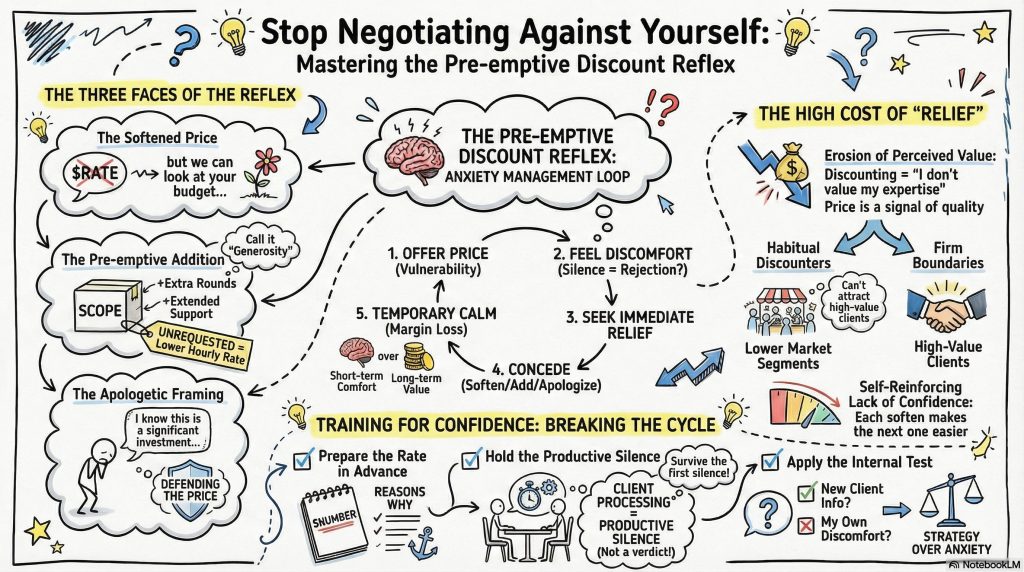
The Softened Price: Naming a figure but immediately qualifying it with phrases regarding budget flexibility or “looking at what works.” The client learns the stated rate is not the “real” rate and that terms are unstable.
The Pre-emptive Addition: Adding unrequested scope, such as extra review rounds or extended support, to justify the rate. The client views these extras as the baseline expectation for all future work.
Apologetic Framing: Using language that communicates discomfort (e.g., “I know this might seem like a significant investment”). The client sees that the provider expects the price to be defended or rejected.
The Psychological Mechanics: Anxiety Over Strategy
While service providers often justify pre-emptive discounting as a rational response to a “tough market” or “price-sensitive clients,” the behaviour is fundamentally a tool for anxiety management.
The Discomfort of Uncertainty: Naming a price involves the vulnerability of offering something of value and waiting for judgment. To avoid the tension of not knowing how the price will land, the provider reduces the price to achieve immediate relief.
The Behavioural Loop: This relief reinforces the behavior. Because the relief is immediate and the commercial cost is delayed, the brain prioritizes the relief, making the reflex more likely to occur in future conversations.
The Personalisation Bias: Service providers tend to fill the silence following a price quote with negative internal interpretations, assuming that a lack of immediate response indicates the price is too high or the client is seeking alternatives.
The Long-Term Costs of Price Erosion
The true cost of the pre-emptive discount extends far beyond the reduced margin of a single engagement.
1. Perceived Value Signalling: Price serves as a signal of quality, exclusivity, and confidence. When a provider discounts readily, they inadvertently signal a lower assessment of their own value. This affects not only future negotiations but also the quality and enthusiasm of client referrals.
2. Internal Confidence Erosion: Each pre-emptive concession provides evidence to the service provider that their own rate is not “firm.” This decreases internal confidence, making the provider more anxious during the next interaction and tightening the reflex loop.
3. Market Misalignment: Habitual discounting forces providers into a lower market segment. They fail to attract high-value clients who seek practitioners who firmly hold their values, creating an “invisible” opportunity cost of better-fitted clients they never encounter.
The Role of Silence in Pricing
A central component of the reflex is an inability to tolerate the ensuing silence after a price proposal. Understanding the dual nature of this silence is essential for behavioural change:
The Productive Silence (Client Side): For the client, silence is necessary for processing information, assessing budget, and weighing value. It is a sign of genuine consideration.
The Suspended Judgment (Provider Side): For the provider, silence is often experienced as a period of judgment. The anxiety produced is proportional to the provider’s uncertainty about their rate and their attachment to the outcome.
Distinguishing Strategy from Anxiety
Not all price adjustments are pathological. The distinction lies in the **motivation** behind the movement:
Strategic Adjustment: Driven by external information provided by the client (e.g., specific budget constraints, scope requirements, or competitive comparisons). This is a grounded commercial calculation.
Anxiety Response: Driven by the internal experience of uncertainty or the desire to fill a silence. This is a reaction to an internal state rather than a commercial reality.
Path to Behavioural Change
The pre-emptive discount is a trainable behaviour. While the underlying anxiety may never fully disappear, the behavioural loop can be interrupted through specific practices:
- Preparation and Pre-decision: Decide the rate and the rationale in advance. Commit to naming the price as a statement rather than an apology.
- Permission to be Uncomfortable: Accept that silence will be uncomfortable. Reframe the discomfort as the experience of “holding the line” rather than a signal that the price is wrong.
- Accumulating Data Points: Each time a provider holds a silence and survives without making a concession, they gain a “data point” proving the discount was unnecessary. This evidence gradually diminishes the reflex’s automaticity.
- Honesty in Real-Time: Developing pricing confidence requires a high degree of self-awareness to distinguish between responding to a client’s needs and reacting to one’s own internal discomfort.
P.S. The book ‘Hold the Line: The Psychology of Pricing, Boundaries, and Business Confidence’ is out now. Buy Hold the Line