Author: philcharles

  • The Unwritten Rules of Consulting: 4 Mindset Shifts to Go From Employee to Advisor

    The Unwritten Rules of Consulting: 4 Mindset Shifts to Go From Employee to Advisor

    The Identity Crisis of the New Consultant

    Most technically trained professionals believe consulting is simply about applying their existing skills in a new context.

    In my early consulting days, I carried the same assumption, along with the habits of a long career as an employee. On one project, I spent days waiting for a clearer brief, believing I needed more information before moving forward. When the partner finally asked for an update, my careful preparation landed flat. I had done a lot of work, but not the right work. What he really wanted was my view, not my analysis.

    That moment made it uncomfortably clear that I was still thinking like an employee. The real challenge of consulting is not technical; it’s a transformation of your professional identity.

    The habits that lead to success as an employee, following processes, seeking permission, and delivering detailed work, can be disastrous in consulting. To succeed as an advisor, you must consciously shed the identity of an employee and adopt a new way of thinking, operating, and communicating.

    This article breaks down the four most critical mindset shifts you must make to bridge the gap between executing tasks and providing true counsel.

    1. From Waiting for Direction to Creating Clarity

    The first shift involves moving from a passive to a proactive stance. An employee often waits for instructions, while a consultant’s primary job is to create clarity where none exists.

    The Employee Habit: Years in technical roles condition professionals to seek permission. It feels safe to ask for approval, follow established procedures, and wait for a detailed brief before starting work. This permission-seeking mindset is often driven by a fear of making the wrong choice, showing up in subtle ways, such as asking for excessive detail or hesitating to offer a point of view without exhaustive analysis. While this approach minimizes risk in an internal role, it erodes a client’s trust in a consultant.

    The Consultant Mindset: A consultant is a “leader of thinking.” Your role is not to receive instructions but to propose a path forward, even with incomplete information. You are hired to remove ambiguity and advance the work. This requires reframing how you communicate:

    • Instead of asking: “Can you tell me exactly what you would like me to do?”
    • Say this: “To keep this moving, here is how I understand the objective. I will proceed on that basis unless you prefer a different approach.”

    Consultants step forward. They do not ask for permission to contribute. This shift is the very essence of the advisory role.

    “Consulting begins the moment you stop waiting to be told what to do.”

    2. From Completing Tasks to Driving Outcomes

    The second critical shift is moving from a task-driven to an outcome-driven orientation. Your value is measured not by your activity, but by the progress you enable.

    The Employee Habit: Employees are often evaluated on their activity—the tasks they complete, the reports they write, and the evidence of their effort. This leads to a focus on production and volume. In consulting, however, being busy is not the same as being effective. A consultant who delivers a five-page summary that enables a decision has delivered more value than one who produces a fifty-page report that leaves the client uncertain.

    The Consultant Mindset: A consultant is evaluated on the clarity they create and the decisions they facilitate. Before beginning any analysis or task, you must first ask: “What decision or outcome does this piece of work support?” If you can’t answer this, the work shouldn’t begin. To go deeper, always ask these three diagnostic questions:

    • What is the purpose of this work?
    • How will it be used?
    • What does the client need to know now, not eventually?

    Shifting your focus to outcomes reduces wasted effort, uncovers what truly matters to the client, and helps you think strategically rather than mechanically.

    “It is better to be directionally correct and useful than perfectly detailed and irrelevant.”

    3. From Delivering Information to Delivering Insight

    Many new consultants mistakenly believe their job is to prove they are the smartest person in the room with exhaustive analysis. The reality is that clients don’t want more information; they want insight.

    The Employee Habit: Rooted in the myth that you must prove your value through the depth of your analysis, the employee habit is to “drown in detail” or “over-explain instead of concluding.” This approach overwhelms clients with data they don’t have time to process, ultimately delaying progress.

    The Consultant Mindset: Your client is already overwhelmed with data and complexity. They hire you to simplify, not complicate. Your job is not to provide a tour of your analytical process, but to deliver the headline first. The most valuable consultants are not the ones who know the most, but the ones who can tell the client what matters most with the greatest clarity.

    “Consulting is about being the clearest. Clients do not judge you by the depth of your technical explanations. They judge you by your ability to simplify complexity and communicate clearly.”

    4. From Seeking Permission to Taking Ownership

    The final shift is from an employee who requires management to an advisor who takes ownership. Clients hire you for your independent thinking and expect you to drive the work forward.

    The Employee Habit: In many corporate or technical roles, asking for direction is an appropriate and expected behavior. In consulting, however, it can be a warning sign that you are uncertain and lack initiative. Relying on the client to guide your work makes them wonder why they hired you in the first place.

    The Consultant Mindset: In a consulting context, ownership means taking full responsibility for advancing the work. It involves seeing problems before they become urgent, offering solutions instead of just reporting issues, and operating as if the outcome is your personal responsibility. This requires independence—the ability to make progress when information is incomplete. Consultants rarely receive perfect briefs or all the data they want. Waiting for certainty is a luxury consulting does not allow.

    A core behavior of ownership is the No Surprises Principle. This is the practice of keeping the client proactively informed at all times. You must flag risks early, communicate timeline shifts immediately, and ask for guidance before an issue becomes a crisis. Silence destroys trust; proactive communication builds it. Clients want advisors who bring order to uncertainty, not assistants who require constant direction.

    Conclusion: Your Identity is Your Greatest Asset

    The transition from a technical professional to a trusted consultant is not about learning new technical skills; it is a fundamental identity upgrade. The most common mistakes—waiting for instructions, drowning in detail, and confusing activity with impact—all stem from operating with an employee identity in a consulting role.

    To become a high-value advisor, you must internalize a new identity. Consultants take initiative. They shape work rather than wait for instruction. They focus on outcomes rather than tasks. They interpret data rather than present it. They communicate early, think ahead, and operate independently. This new identity is the foundation upon which all other consulting skills are built.

    As you think about your own work, which single employee habit is holding you back the most?
  • Are You a Cost Centre or a Value-Multiplier?

    Are You a Cost Centre or a Value-Multiplier?

    Consulting is much more than completing assigned tasks; it’s about helping clients solve the problems that keep them up at night and guiding organisations toward better decisions. At its core, consulting begins in ambiguity and ends in insight.

    From this moment on, I want you to see your career through this lens.

    A Cost Centre is a pair of hands. They are an expense on a project’s budget. They take instructions, execute tasks, and check boxes. They are reliable but replaceable.

    While technical skills matter, being indispensable is about framing, communication, and focus on why and outcomes.

    A Value-Multiplier is a problem-solver. They are an investment that delivers a return. They don’t just take tasks; they take responsibility. They own outcomes, link their work to the client’s goals, and proactively find ways to drive value.

    When a project budget gets cut, the cost centres are the first to go. The value-multipliers are the ones the firm protects at all costs. Your mission is to prove you are a value-multiplier.

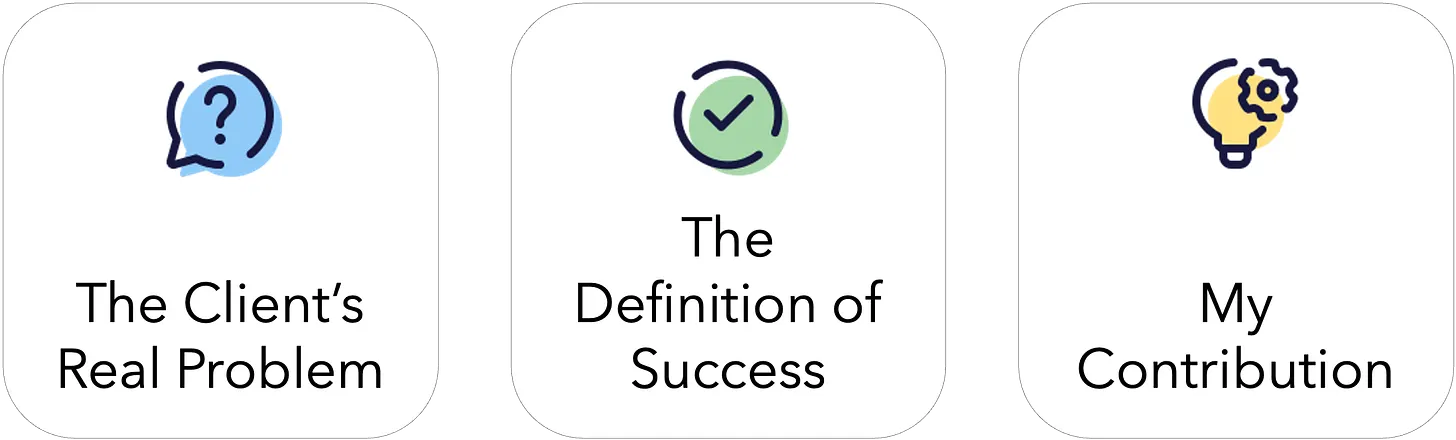
    How do you do that? You start by gaining absolute clarity.

    1. The Client’s Real Problem (Not Your Task)

    The real problem is never your task. Your task is just the symptom. You have to dig one level deeper.

    2. The Definition of Success (What’s the “Win”?)

    This is the so what? What does a win look like for the client? If you deliver your work and the client says, “Thanks, this is interesting,” you have failed. If they say, “Great, now I know exactly what to do,” you have won.

    3. My Contribution (How My Work Links to the “Win”)

    This is where you draw a straight, unbroken line from your keyboard to the client’s success. This is how you prove you are a value-multiplier.

  • The Indispensable Consultant

    The Indispensable Consultant

    Ready to move from just getting tasks done to truly solving problems and delivering lasting impact? The Indispensable Consultant is your 90-day guide to becoming the advisor every firm and client needs, but few can replace.

    If you’ve landed in consulting, are transitioning from a technical role, or simply feel stuck as a pair of hands in high-pressure projects, this book reframes your first months as the ultimate Opportunity Zone. Instead of drowning in ambiguity and endless to-do lists, you’ll discover the proven habits, mindsets, and tools that transform you into a value-multiplier who commands respect and trust.

    In this guide, you’ll find:

    • The five essential Advisor mindsets and how to build them into daily habits
    • Actionable tools for translating tasks into outcomes that matter
    • Powerful scripts and templates for building trust, managing up, and handling ambiguity
    • Step-by-step exercises, real-world scenarios, and your 90-day Mindset Contract to turn new skills into reputation
    • The keys to deliver velocity and quality; earning the trust that accelerates your career

    This isn’t theory, it’s a hands-on, practical roadmap designed for anyone in their first few months of consulting (or making the leap from specialist to advisor). Stop waiting for your career to happen. Own your outcomes, become the person managers rely on, and unlock the reputation that makes you indispensable.

    Are you ready to stop being a Doer and start being an Advisor? The next 90 days start now.

    Get your copy of The Indispensable Consultant

  • The #1 mistake consultants make in a ‘sales’ call

    The #1 mistake consultants make in a ‘sales’ call

    Stop ‘selling.’ Start influencing

    Does the word “sales” make you cringe?

    For most independent consultants, “selling” is the worst part of the job. It feels pushy, inauthentic, and desperate. They are experts in their field, not “closers.”

    We just want to do the work. But to get the work, we’re told we have to sell.

    This creates a painful dynamic. We show up to a prospect meeting, put on our “salesperson” hat, and pitch our services. We talk about our experience, our methodology, and our credentials.

    In doing so, we make a critical mistake: We position ourselves as a vendor.

    We’re just a pair of hands for hire. The client holds all the power, and their only real variable for deciding is price.

    The most successful consultants I know have a secret: They never “sell.”

    They don’t pitch. They don’t persuade. They don’t “handle objections.”

    Instead, they influence. They use their expertise to reframe the client’s problem and guide them to a solution. This is the art of “Quiet Influence,” and it’s a game-changer for winning high-value clients.

    Here are three ways to stop selling and start influencing in your very next prospect call.

    1. The Power of the ‘Diagnostic’

    A vendor takes an order. An advisor writes a prescription.

    When a prospect tells you what they “need” (e.g., “We need you to build us a new dashboard”), a vendor says, “Okay, I can do that.”

    An advisor says, “Tell me more. Why a dashboard? What problem are you trying to solve that you can’t solve now? What decision will this dashboard allow you to make?”

    This is the ‘Diagnostic’ phase. Your goal is not to talk about yourself. It is to become obsessively curious about their problem. By asking insightful, expert questions, you are doing two things:

    1. Uncovering the real, high-value problem (which is often not what they first asked for).
    2. Proving your expertise without ever having to say, “I’m an expert.”

    Your questions are the demo.

    2. Lead from Behind (Let Them Have the Idea)

    When you’re a subject-matter expert, it’s tempting to jump in and say, “I see the problem. Here’s what you need to do.”

    The moment you do that, you invite resistance. The client’s ego kicks in. “What if that doesn’t work?” “Who are you to tell me how to run my business?”

    “Quiet Influence” means guiding the conversation so the client “discovers” the solution themselves.

    • Don’t say: “You need to fix your onboarding process first.”
    • Instead, ask: “It sounds like you’re losing all your new hires in the first 90 days. What do you think would happen to your retention goals if we focused all our energy on that one problem first?”

    By framing the path forward as a question, you’re not issuing a command; you’re inviting collaboration. You’re letting them “have” the idea. And people always support a solution they helped create.

    3. Sell the Diagnosis, Not the Cure

    The most valuable thing you offer a client isn’t the final deliverable. It’s your thinking. It’s your ability to see their problem more clearly than they can.

    So, in the “sales” process, give your thinking away.

    Instead of sending a proposal that just lists “50 hours of work,” send a document that diagnoses their problem.

    • “Here is my understanding of your situation.”
    • “Here is the core problem I’ve identified, which is costing you [X].”
    • “Here are the three options I see for solving it.”

    This document (or presentation) proves you’re the right person for the job before they’ve even seen the price. You’re not selling your time; you’re selling your clarity.

    The Advisor is the One Who Asks the Questions

    This trust-based, diagnostic approach is the core of Quiet Influence. It’s what moves you from “vendor” to “trusted advisor.”

    When you’re an advisor, you’re not “selling.” You’re consulting. The sales call is the work. Clients stop haggling over your hourly rate because they’ve already experienced the value of your mind.

    This is how you win better clients, at higher fees, with zero “salesy” tactics.

    If you’re a professional who wants to win clients authentically, this framework is for you. I’ve detailed the entire step-by-step process in my book, Quiet Influence.

    It’s one of the five guides in “The Smart Professional’s Short Guide Series,” designed to give you the exact skills you need to build a thriving, authentic practice.

    You can find it on Amazon: https://mybook.to/quietinfluence

  • Welcome to the Danger Zone

    Welcome to the Danger Zone

    A reflection on the 3-6 month mark, and the two mindsets that define your career.

    Let’s talk about a phase in every new job that nobody prepares you for.

    It’s not the first 30 days: that’s all about high-energy, onboarding, and “great-to-meet-you”s.

    No, I’m talking about the 3-6 month mark.

    I call this the “Danger Zone.”

    The “new job” shine has worn off. The overwhelm is real. You’re now part of the machine, and your entire focus narrows to a single, panicked thought: “Just tell me what to do.”

    This is the moment you become a “Doer.”

    The Doer is a task-taker. Their to-do list is their compass, and their greatest fear is getting a task wrong. They ask “What?” and “When?” They’re a “cost centre,” a pair of hands. And honestly, it’s where most of us live most of the time.

    But there’s another path. It’s the path of the “Advisor.”

    The Advisor is a problem-solver. They see the same to-do list, but they treat it as a set of clues, not a set of instructions. They’re not afraid to pause and ask the most powerful, and most dangerous, question: “Why?”

    • “Why are we doing this?”
    • “Why is this the most important thing?”
    • “Why are we doing it this way?”

    The Advisor understands what the Doer doesn’t: the “why” is the only question that matters. As Peter Drucker famously wrote, “There is nothing so useless as doing efficiently that which should not be done at all.”

    This is the entire game. The Doer is terrified of looking stupid, so they just do the work. The Advisor is terrified of wasting time, so they risk looking stupid for 60 seconds to make sure the work is worth doing.

    This shift, from Doer to Advisor, isn’t about your title, your tenure, or your salary. It’s a choice. It’s a new “Operating System” you have to install.

    When in your career have you been caught in the “Doer” trap? And what did it take to get you out?

  • Thinking of Going Solo? Your Skills Aren’t the Real Question

    Thinking of Going Solo? Your Skills Aren’t the Real Question

    Before you worry about clients, pricing, or your niche, the first question you must answer is internal: “Is solo consulting really right for me?”

    Your expertise gets you in the game. But your temperament is what lets you finish.

    It’s not about what you do. It’s about how you operate.

    Self-Discipline: Can you be your own boss, manager, and administrator every day? Can you do the “business building” work even when you don’t feel like it? No manager is chasing you for deliverables. No corporate rhythm to carry you forward. You set the pace, or nothing moves.

    Motivation: When you hit a roadblock, will you be driven from within to find a solution, or will you wait for direction that never comes? Employees can escalate problems. Solo consultants solve them or live with them. Internal drive isn’t optional.

    Uncertainty: Can you handle the financial and emotional ambiguity of a lumpy pipeline? Can you sleep at night without the “guarantee” of a regular paycheck? Revenue fluctuates. Deals fall through. The safety net you’re used to doesn’t exist anymore.

    The tactics of consulting are learnable. The temperament for autonomy and uncertainty is where the real self-assessment lies.

    You can master positioning, proposals, and pricing. But if you can’t operate in ambiguity, thrive without structure, and sustain yourself through rejection, no amount of technical skill will save you.

    What’s your take? Is temperament more important than experience for a new solo consultant?

  • Your most important business asset (it’s not your website)

    Your most important business asset (it’s not your website)

    When someone at a networking event asks, “What do you do?” what’s your answer?

    If you’re like most independent consultants, you probably answer with your service:

    • “I’m a project management consultant.”
    • “I’m a data analyst.”
    • “I build custom software.”

    This answer is logical, accurate… and a strategic mistake.

    It immediately makes you a commodity. You are one of a dozen project managers or analysts that person could find on LinkedIn. You’ve positioned yourself in a “vendor” box, forcing you to compete on price and experience.

    What if your answer was different? What if you answered with your purpose?

    This is the “Consultant’s Why,” and it is the single most important asset for your brand and your business. It’s the difference between being a “vendor” and becoming a “trusted advisor.”

    Your ‘Why’ Isn’t a Fluffy Mission Statement

    Let’s be clear: this isn’t a “live, laugh, love” poster for your office. For a solo consultant, your ‘Why’ is a powerful strategic tool. It’s the engine that drives your business.

    Here’s how it works.

    1. Your ‘Why’ is Your Niche

    Generalists compete on price. Specialists compete on value. Your ‘Why’ is the fastest way to move from the first category to the second.

    Your ‘Why’ shifts the conversation from what you do (your task) to the problem you solve (your value).

    • Vendor (What): “I’m a data consultant who knows Python and SQL.”
    • Advisor (Why): “I help e-commerce brands stop guessing. I believe that every marketing decision should be backed by clear data, so I build systems that give leaders the exact numbers they need to grow profitably.”

    See the difference? The first is a service. The second is a purpose. It instantly defines your niche (e-commerce brands), the problem you solve (uncertainty, guesswork), and the value you provide (profitability). Clients don’t buy “Python scripts”; they buy “the end of guesswork.”

    2. Your ‘Why’ is Your Client Filter

    Are you tired of “difficult” clients? The ones who question your invoices, drain your energy, and don’t value your expertise?

    A “difficult client” is almost always a “bad-fit client.” And you attract bad-fit clients when you don’t have a clear ‘Why’.

    Your ‘Why’ is a “velvet rope” for your business. It’s magnetic to your ideal clients and (just as importantly) a polite repellent to the wrong ones.

    • If your ‘Why’ is “I believe in sustainable, long-term growth,” you will automatically repel clients looking for “get-rich-quick” hacks.
    • If your ‘Why’ is “I only work with leaders who are serious about building a high-trust culture,” you will filter out the micromanaging-tyrant bosses.

    This makes your “sales” process feel less like selling and more like qualifying. You’re not trying to convince them; you’re diagnosing a mutual fit based on a shared purpose.

    3. Your ‘Why’ is Your Marketing Message

    For most consultants, the hardest part of marketing is staring at a blank page. “What do I post on LinkedIn?” “What should I write for my newsletter?”

    When you are clear on your ‘Why’, you never run out of things to say.

    You’re no longer just “making content.” You are articulating your core belief in a dozen different ways:

    • “Here’s the biggest mistake I see companies make when…”
    • “A principle that guides all my client work is…”
    • “You don’t need another tool. You need a better way of thinking about…”

    Your ‘Why’ is the central theme of your articles, your conference talks, and your client proposals. It’s authentic, it’s powerful, and it’s consistent—because it’s true.

    Finding Your Foundation

    Your ‘Why’ isn’t just a “nice-to-have.” It is the foundation of your practice. It defines your niche, filters your clients, and fuels your marketing.

    But finding it takes more than a 10-minute brainstorming session. It’s a process of introspection—of excavating the real reason you started this journey in the first place.

    This process is the most critical strategic work you can do for your business. It’s the foundation for a practice that is not only profitable but also deeply fulfilling.

    That’s why I wrote Finding Your Purpose, the first book in “The Smart Professional’s Short Guide Series.” It’s a practical guide designed to help you move from a vague idea of what you do to a powerful, clear statement of purpose that can become your brand’s greatest asset.

  • Stop selling your services. Start selling your ‘Why’

    Stop selling your services. Start selling your ‘Why’

    When someone at a networking event asks, “What do you do?” what’s your answer?

    If you’re like most independent consultants, you probably answer with your service:

    • “I’m a project management consultant.”
    • “I’m an engineering data analyst.”
    • “I develop business cases.”

    This answer is logical, accurate… and a strategic mistake.

    It immediately makes you a commodity. You are one of a dozen project managers or analysts that person could find on LinkedIn. You’ve positioned yourself in a “vendor” box, forcing you to compete on price and experience.

    What if your answer was different? What if you answered with your purpose?

    This is the “Consultant’s Why,” and it is the single most important asset for your brand and your business. It’s the difference between being a “vendor” and becoming a “trusted advisor.”

    Your ‘Why’ Isn’t a Fluffy Mission Statement

    Let’s be clear: this isn’t a “live, laugh, love” poster for your office. For a solo consultant, your ‘Why’ is a powerful strategic tool. It’s the engine that drives your business.

    Here’s how it works.

    1. Your ‘Why’ is Your Niche

    Generalists compete on price. Specialists compete on value. Your ‘Why’ is the fastest way to move from the first category to the second.

    Your ‘Why’ shifts the conversation from what you do (your task) to the problem you solve (your value).

    • Vendor (What): “I’m a data consultant who knows Python and SQL.”
    • Advisor (Why): “I help e-commerce brands stop guessing. I believe that every marketing decision should be backed by clear data, so I build systems that give leaders the exact numbers they need to grow profitably.”

    See the difference? The first is a service. The second is a purpose. It instantly defines your niche (e-commerce brands), the problem you solve (uncertainty, guesswork), and the value you provide (profitability). Clients don’t buy “Python scripts”; they buy “the end of guesswork.”

    2. Your ‘Why’ is Your Client Filter

    Are you tired of “difficult” clients? The ones who question your invoices, drain your energy, and don’t value your expertise?

    A “difficult client” is almost always a “bad-fit client.” And you attract bad-fit clients when you don’t have a clear ‘Why’.

    Your ‘Why’ is a “velvet rope” for your business. It’s magnetic to your ideal clients and (just as importantly) a polite repellent to the wrong ones.

    • If your ‘Why’ is “I believe in sustainable, long-term growth,” you will automatically repel clients looking for “get-rich-quick” hacks.
    • If your ‘Why’ is “I only work with leaders who are serious about building a high-trust culture,” you will filter out the micromanaging-tyrant bosses.

    This makes your “sales” process feel less like selling and more like qualifying. You’re not trying to convince them; you’re diagnosing a mutual fit based on a shared purpose.

    3. Your ‘Why’ is Your Marketing Message

    For most consultants, the hardest part of marketing is staring at a blank page. “What do I post on LinkedIn?” “What should I write for my newsletter?”

    When you are clear on your ‘Why’, you never run out of things to say.

    You’re no longer just “making content.” You are articulating your core belief in a dozen different ways:

    • “Here’s the biggest mistake I see companies make when…”
    • “A principle that guides all my client work is…”
    • “You don’t need another tool. You need a better way of thinking about…”

    Your ‘Why’ is the central theme of your articles, your conference talks, and your client proposals. It’s authentic, it’s powerful, and it’s consistent—because it’s true.

    Finding Your Foundation

    Your ‘Why’ isn’t just a “nice-to-have.” It is the foundation of your practice. It defines your niche, filters your clients, and fuels your marketing.

    But finding it takes more than a 10-minute brainstorming session. It’s a process of introspection—of excavating the realreason you started this journey in the first place.

    This process is the most critical strategic work you can do for your business. It’s the foundation for a practice that is not only profitable but also deeply fulfilling.

    That’s why I wrote Find Your Purpose, the first book in “The Smart Professional’s Short Guide Series.” It’s a practical guide designed to help you move from a vague idea of what you do to a powerful, clear statement of purpose that can become your brand’s greatest asset.

  • Why Skilled Experts Get Stuck—And How to Break Free

    Why Skilled Experts Get Stuck—And How to Break Free

    Many technical professionals reach a point where their expertise, once highly valued, feels boxed in by routine, bureaucracy, or diminishing opportunities for growth. 

    If you’re respected for your skills but sensing a lack of autonomy, purpose, or challenge, you’re not alone, and you haven’t failed. 

    You’re simply at a career crossroads common in high-performing careers.

    Expert stagnation isn’t about a lack of ability; it’s about outgrowing your role or system. 

    You may notice the signs: repetitive work, unchallenged ideas, or being overlooked despite years of contribution. 

    The structure that supported your professional growth can eventually restrict your freedom and impact.

    So, how do you break free? The answer isn’t to quit impulsively but to act strategically. 

    First, name what’s no longer working: get clear on the real sources of dissatisfaction. 

    Next, define what freedom means for you, whether it’s more control over your time, choice of projects, or a voice in the work you do.

    Test small steps: assist a past client on the side, join a consulting forum, or volunteer your expertise. 

    Track insights, strengths, and fears in a decision journal. 

    Clarity emerges through action, not endless planning.

    When experts take decisive, small steps, going from burnt-out senior professional to thriving consultant, they rediscover engagement and control.

    Feeling stuck is feedback, not failure. 

    Breaking free starts with honest self-reflection, strategic planning, and using your hard-won skills to build a future you own. 

    Your next chapter is waiting, clarity comes when you act on it.

  • Beyond the Resume: Building Human Connections in Consulting Through Storyselling

    Beyond the Resume: Building Human Connections in Consulting Through Storyselling

    In today’s rapidly evolving consulting landscape, technical expertise and an impressive resume are simply the starting point.

    Success now springs from the ability to forge genuine human connections; deep, trust-driven relationships where clients view you as a partner, not just a provider.

    The Shift from Transactional to Relational Consulting

    Traditional consulting once revolved around cold deliverables, meticulously crafted reports, and the clear-cut exchange of expertise for fees. That model is fading fast.

    Today’s clients are looking for more than just skills or a completed project. They want collaborators who understand their culture and long-term goals and who can journey with them through complexity and change.

    In this new era, successful consultants build trust, anticipate future needs, and become indispensable extensions of their clients’ teams; not just short-term fixers.

    Several factors fuel this shift:

    • Market saturation: Technical skills are table stakes.
    • Commoditisation: Many traditional consulting services are no longer differentiators.
    • Client evolution: Businesses now seek holistic, integrated solutions anchored in partnership and empathy.

    The consultant who succeeds today is the one who prioritizes human connection, empathy, and mutual understanding; qualities best expressed through the art of storytelling.

    Why Facts Tell, but Stories Sell and Connect

    Facts matter. They build credibility and establish your baseline of competence. But on their own, facts rarely spark emotion, inspire action, or create lasting memory.

    For example, stating the following is impressive on paper but does little to win hearts or loyalty:

    • “Our process reduces operational costs by 15%.”
    • “We implement a proprietary framework.”
    • “We serve Fortune 500 clients.”

    Contrast this with the story:

    Just last year, I worked with a manufacturing client, XYZ Corp, who was bleeding money due to outdated supply chain processes. Their team was overwhelmed, and their profit margins were shrinking. We implemented our efficiency framework, and within six months, not only did they see a 15% cost reduction, but morale and productivity were transformed. The CEO told me it felt like they’d finally gotten their business back on track.

    What changes with a story?

    • Emotion & empathy: Humanizes the challenge and victory.
    • Memorability: The narrative—and the result—sticks with your listener.
    • Context: Facts gain meaning when they impact real lives.
    • Trust: Specific, authentic experiences build rapport.
    • Clarity: Complex ideas are easier to grasp through vivid real-world examples.

    While your resume unlocks the door, your stories build the relationship that sustains your practice.

    The Psychological Power of Narrative

    Our brains are wired for story. Since the dawn of civilization, stories have been our primary means of understanding the world, connecting with others, and passing on knowledge.

    Storytelling’s business edge is scientifically grounded:

    • Empathy: Stories activate brain regions that let listeners “relive” experiences, helping them feel the challenges and triumphs described. This creates the sense of “You get it. I trust you.”
    • Memory: People tend to forget facts and bullet points, but they often remember stories. Our brains encode information more effectively when it’s presented in a narrative context and accompanied by emotion.
    • Persuasion: While data triggers logic and often resistance, a good story allows listeners to arrive at their own conclusions—an indirect persuasion far more effective than a direct sales pitch.

    Stories are how you transform expertise into persuasion, understanding, and trust, a connection that goes far beyond your resume.

    Practical Example: From Expert to Trusted Advisor

    Instead of listing skills or results, share a client transformation. Example:

    “When an overwhelmed project manager at a government agency reached out, she wasn’t just looking for workflow optimization—she needed a partner who’d navigate complexity with her. Through weekly check-ins and tailored solutions, we not only streamlined her team’s reporting process but also helped her regain confidence and control. Months later, she became a champion for our work across her entire department.”

    Reflection Exercise: Harnessing the Power of Story in Your Decisions

    Think back:

    • When did a story, not just facts, influence an important decision for you?
    • What details or emotions made that story stick?
    • How would your decision have changed if you’d only had the facts?

    Reflecting on your own experience demonstrates how stories already shape your choices—and, by extension, your clients’ decisions.

    Action Steps: Integrating Storyselling Into Your Practice

    • Identify real, emotive moments in your past work that reflect your values and unique approach.
    • Connect performance outcomes to actual people and organizational shifts, not just numbers.
    • Practice sharing concise, impactful stories in proposals, pitches, and meetings.
    • Encourage clients to see themselves within your stories, helping them visualize their journey with you.

    Conclusion

    Technical skills will always matter. But in today’s consulting world, your stories are your greatest asset. Your process opens the door; your narratives forge the relationships that drive business growth. Make storyselling an intentional part of your client engagement and watch your network and influence expand.