Author: philcharles

  • 5 Pricing Mistakes That Keep Technical Consultants Earning Less Than They Should

    Most technical consultants are brilliant at solving complex problems.

    But terrible at getting paid what theyโ€™re worth.

    Here are 5 pricing mistakes keeping technical consultants stuck: earning far less than they should.

    Engineering skills are rare. Your time solves problems most people canโ€™t.

    But when it comes to pricing, most consultants default to an hourly rate pulled from thin air: usually their old salary divided by 2,000.

    Thatโ€™s not a pricing strategy. Thatโ€™s leaving money on the table.

    Here are the 5 mistakes costing you income.

    Mistake #1: Youโ€™re pricing by the hour instead of by the outcome.

    Clients donโ€™t care how long it takes. They care what they get. When you bill hourly, you:

    • Punish yourself for being fast and efficient
    • Invite clients to micromanage your time
    • Cap your income at hours-in-a-day

    Project-based pricing ties your fee to value delivered, not time spent.

    Mistake #2: You benchmarked your rate against other consultants, not against client ROI.

    Your rate should reflect the value you create, not the market average. If your recommendation prevents $500K in downtime or rework, charging $15K isnโ€™t bold, itโ€™s modest. Anchor your price to their outcome. Suddenly, your number feels small to them, not large.

    Mistake #3: Youโ€™re not charging for scope creep.

    Scope creep is the silent killer of consulting margins. Fix it with:

    • A clear written scope in every contract
    • A defined change-order process
    • A standard rate for out-of-scope requests

    One undocumented โ€œquick favorโ€ can unravel a profitable project fast.

    Mistake #4: You discounted your rate to win the first client.

    This sets a dangerous precedent. Clients talk. The rate you accept today becomes the ceiling they expect tomorrow. Instead, offer a smaller engagement, a paid discovery call, or a scoped audit at your full rate. It builds trust without training clients to expect discounts.

    Mistake #5: You never revisit your rates.

    Your skills compound. Your rates should too. Review your pricing:

    • Every 6 months minimum
    • After each major project win
    • Whenever demand exceeds your capacity

    If every prospect says yes immediately, youโ€™re underpriced.


    Your technical expertise is rare. Price it like it is.

  • Delaying Automation Costs Extra Time and Money

    This article reveals how postponing the automation of your business systems can lead to significant time and financial losses.

    The costs associated with delays in implementing efficient systems are often underestimated.

    Youโ€™ll find 9 essential tips for understanding these costs, 3 actionable steps to get started, and a list of highly recommended books for further reading on systems and automation.

    Top Tips

    1. Understanding the Hidden Costs

    Delaying automation has hidden costs that go beyond immediate financial impact. Every moment spent on manual processes is a diversion of valuable resources.

    As operations remain manual, the risk of human error increases, leading to further financial implications. These errors might require additional time and money to correct, compounding the issue.

    Recognising these hidden costs early can help in making well-informed decisions about automation.

    2. Time Efficiency Benefits

    Automating systems in your organisation significantly improves time efficiency.

    Manual processes are time-consuming and prone to delays, whereas automated systems streamline tasks. This efficiency contributes to increased productivity without enlarging staff.

    Furthermore, time saved through automation can be redirected to strategic initiatives, enhancing overall business growth. Embracing automation early positions your business to better compete in the market.

    3. Financial Savings Through Automation

    Implementing automation systems saves money over time by reducing labor costs.

    Automated processes require minimal supervision and maintenance once established. This allows for a smaller workforce or reallocation of employees to more profitable activities.

    Additionally, automation minimises the risk of costly errors, which can save considerable sums. Investing in automation early can provide a significant return on investment.

    4. Improved Accuracy and Reliability

    Automated systems enhance accuracy and reliability in business processes.

    Manual operations are vulnerable to mistakes, resulting in inaccurate data and reports. Automation ensures consistency and dependability, leading to informed decision-making.

    Improved accuracy also boosts client trust and reduces costs associated with mistakes. When systems are reliable, businesses can focus on scaling operations rather than mitigating errors.

    5. Streamlining Repetitive Tasks

    Repetitive tasks are ideally suited for automation, as these processes benefit greatly from consistency.

    Delegating these tasks to automated systems frees up human resources. Employees can then concentrate on more complex and impactful projects. This improves overall job satisfaction and fosters innovation.

    Early adoption of automation for such tasks reduces operational bottlenecks and enhances efficiency.

    6. Scalability Advantages

    Automation supports scalability, a crucial factor for growing businesses.

    As demand increases, automated systems can handle larger volumes of work without additional personnel. This flexibility allows firms to expand without the usual constraints of scaling manually.

    The immediate availability of automated solutions enables businesses to seize opportunities with agility. Systems positioned for growth create a formidable competitive advantage.

    7. Competitive Edge Maintenance

    Businesses that adopt automation early gain a competitive edge.

    Efficiency, cost savings, and enhanced capabilities create a robust market position. Companies delaying automation may struggle to keep up with fast-moving competitors.

    The advantages of staying ahead include better resource allocation and staying adaptable to market changes. An early transition to automated systems is pivotal for long-term success.

    8. Enhancing Customer Experience

    Automation enhances customer experience by ensuring quick, accurate service delivery.

    Systems can manage customer queries efficiently, resulting in higher satisfaction rates. Timely assistance and error-free transactions foster customer loyalty. Focusing on customer experience through automation can differentiate a business in competitive landscapes.

    Start automating to ensure that customer needs are met consistently and reliably.

    9. Proactive Resource Management

    Effective resource management is crucial, and automation aids significantly in this area.

    By automating inventory management, scheduling, and other resource-intensive tasks, businesses can optimise their use of materials and time. This proactive approach reduces waste and improves strategic planning.

    In adopting automation, companies can better manage resources, which supports both cost savings and increased operational efficiency.

    Fast Action Steps

    1. Identify Key Areas for Automation

    Start by identifying areas where automation could have the most significant impact.

    Focus on repetitive, time-consuming processes that suffer from inefficiencies. Evaluate departments like customer service, data entry, or supply chain management.

    Prioritise these areas based on their potential to improve efficiency and reduce costs. This initial step is vital to ensure that the transition to automation is strategic and impactful.

    2. Assess Available Automation Technologies

    Research and evaluate the automation technologies available to your industry.

    Consider solutions that integrate seamlessly with your existing systems. Software and tools should match your business requirements and allow for scalability. Assess their cost, ease of implementation, and long-term benefits.

    Consulting with industry experts or vendors can provide insights into the best options for your specific needs.

    3. Develop a Transition Plan

    Craft a detailed plan to guide your transition to automation.

    Set clear objectives, timelines, and benchmarks. Involve key stakeholders and ensure that team members are prepared for the change. Training programs are essential to equip staff with necessary skills.

    Regular reviews will ensure the project stays on track. A well-executed transition plan minimises disruptions and supports a smooth shift to automated systems.

    Further Reading

    • The Lean Startupย by Eric Ries
    • Automate Thisย by Christopher Steiner
    • The Goalย by Eliyahu M. Goldratt
    • The Phoenix Projectย by Gene Kim, Kevin Behr, and George Spafford
    • Automation and Societyย by Rajiv Biswas
  • Unaddressed Risks That Drain Your Monthly Cash

    Every month, individuals and businesses face the challenge of managing their cash flow effectively.

    Often, this involves overlooked risks that, if left unattended, can gradually drain financial resources.

    Ignoring these risks can have a significant impact on both short-term and long-term financial health.

    By proactively identifying and addressing these vulnerabilities, you can take control of your financial situation.

    This article delves into specific unaddressed risks that can silently drain your monthly cash and offers insights on how to mitigate them for better financial management.

    The Consequences of Ignoring Risk Assessments

    Risk assessments form the backbone of sound financial management. However, many individuals and businesses postpone or overlook this crucial process.

    By neglecting to evaluate potential risks, you expose yourself to unforeseen financial difficulties. These issues can range from sudden increases in operational costs to unpredictable market shifts.

    Itโ€™s essential to be aware of the full spectrum of risks you might face so you can devise effective strategies to handle them.

    Timely risk assessments can help you anticipate potential pitfalls and provide a roadmap for minimising their impact on your finances.

    Moreover, neglecting risk assessments means youโ€™re less prepared to take advantage of positive opportunities. By not understanding your financial environment thoroughly, you could miss out on beneficial adjustments that could significantly boost your monthly cash flow.

    Ensuring you regularly evaluate and update your risk management practices is a crucial step in staying ahead of potential financial troubles.

    Common Financial Risks and Their Impact

    Several financial risks, if left unaddressed, can gradually erode your monthly cash flow.

    One of the most common is fluctuating expenses. Whether itโ€™s unexpected repairs or price hikes, not accounting for these variables can severely disrupt your month-end balances.

    Identifying trends in your expenses can help you anticipate and manage these changes more effectively.

    • Unforeseen personal or business expenses
    • Changes in market demand for services or products

    Another significant risk is the lack of a financial buffer to manage temporary cash flow shortages.

    This absence can lead to over-reliance on credit lines and loans, which could increase financial pressure significantly over time.

    Understanding these common risks allows you to plan for emergencies with confidence and security.

    Strategic Financial Risk Mitigation

    Mitigating financial risks requires a proactive approach. Start by conducting regular financial audits to identify potential vulnerabilities.

    Reviewing your budgeting and expense records is a practical strategy to spot irregularities before they become severe issues. This ongoing vigilance allows you to make adjustments that accommodate shifts in your financial landscape.

    Additionally, building a contingency plan to address sudden expenses can alleviate stress and reduce dependency on debt solutions.

    Establishing a savings strategy aimed at creating an emergency fund can protect your cash flow from unpredictable disruptions.

    By incorporating these measures, you can create a resilient financial framework capable of withstanding various challenges.

    The Benefits of Regular Risk Management

    Integrating risk management into your routine financial practices can transform your financial stability. By addressing potential cash flow disruptions before they occur, you can maintain a steady financial course.

    Continuously updating your risk management strategies not only safeguards your finances but also empowers you to seize opportunities that may have appeared too risky before.

    Risk management isnโ€™t solely about avoiding setbacks; itโ€™s about enhancing your financial resilience, allowing you to navigate uncertainties with confidence.

    Regularly reflecting on and adjusting your approach ensures that you are always prepared for whatever financial challenges come your way, leading to improved business continuity and personal financial peace.

    In summary, unaddressed financial risks can quietly sap your monthly cash unless managed proactively.

    By understanding the importance of regular risk assessments, identifying common threats, and implementing strategic mitigation tactics, you can better control your financial destiny.

    Remember, effective risk management is not just about defense: itโ€™s a vital component of creating sustainable financial growth.

  • Ignoring Client Follow-Up Jeopardises Sustained Income

    This article focuses on the critical importance of client follow-up in maintaining a stable income stream.

    Consistent engagement with clients is a key factor in building enduring business relationships and ensuring repeat business.

    Included in this report are 9 essential tips, 3 actionable steps you can take immediately, and further reading suggestions to deepen your understanding of effective client communication.

    Top Tips

    1. Prioritise Client Communication

    Maintaining regular communication with clients is crucial. It shows that you value their business and are committed to meeting their needs.

    Regular follow-ups help in addressing any issues they may have before they escalate. This approach fosters trust and encourages clients to return for future services.

    By making client communication a top priority, you ensure their satisfaction and loyalty, which translates to sustained income.

    2. Understand Client Needs

    Understanding your clientโ€™s needs can create a strong foundation for long-term relationships. Taking time to listen and respond to their specific requirements demonstrates that you care about their success.

    This understanding enables you to offer tailored solutions, enhancing the client experience. When clients feel understood, they are more likely to continue doing business with you, ensuring consistent revenue streams.

    3. Build Strong Rapport

    Building rapport with clients can significantly boost your business. A strong connection encourages open communication and trust, leading to long-term partnerships.

    Rapport lays the groundwork for positive interactions, making clients more inclined to discuss their needs and feedback. This relationship strengthens business loyalty, ensuring clients prefer your services over competitors, thereby maintaining a steady income.

    4. Be Responsive

    Quick and effective responses to client inquiries show professionalism and respect for their time. Being responsive can prevent potential dissatisfaction and underscores your commitment to their needs.

    Prompt communication can address client concerns swiftly and assure them of your dedication. This level of service often translates into repeat business and helps stabilise your income base.

    5. Follow Up After Service

    Following up after providing a service can leave a lasting impression. It provides an opportunity to gather feedback and demonstrate ongoing support.

    Clients appreciate when businesses show genuine interest in their satisfaction, making them more likely to return.

    Effective follow-up can differentiate you from competitors and helps cement long-term business relationships, ensuring continuous income flow.

    6. Personalise Your Approach

    Personalising your interactions shows clients that you value them as individuals. A tailored approach can enhance the client experience, making them feel unique and respected.

    By remembering personal details or past interactions, you signal attentiveness and care. This personalised service can increase client loyalty, translating directly into sustained revenue.

    7. Monitor Client Feedback

    Regularly monitoring feedback helps in aligning your services with client expectations.

    Clients appreciate when their feedback leads to visible changes or improvements. It shows you are willing to adapt to their needs, keeping them satisfied and coming back.

    Actively engaging with feedback can turn potential issues into opportunities for strengthening client relationships, thus securing ongoing income.

    8. Offer Continuous Support

    Offering continuous support assures clients that help is always available when needed. This reassurance can enhance client confidence in your business.

    Continuous support often involves being proactive in addressing potential concerns and maintaining regular touchpoints. Such dedication is appreciated and can lead to steady client retention, ensuring predictable income.

    9. Encourage Client Engagement

    Encouraging clients to engage with your business through various channels fosters a sense of community. Interactive platforms and feedback options create space for client participation.

    Engagement keeps your brand at the forefront of clientsโ€™ minds, making them more likely to return. Promoting active client participation aids in building stronger relationships, contributing to consistent revenue.

    Fast Action Steps

    1. Set Automated Follow-Ups

    Implement automated follow-up messages to ensure consistent communication with clients. Automation tools can send reminders or thank-you notes post-service, maintaining contact.

    These tools help in not missing important client interactions. Automating follow-ups ensures that you never overlook a client, strengthening your relationship and fostering loyalty, which can directly impact your income positively.

    2. Regularly Assess Client Satisfaction

    Conduct regular assessments of client satisfaction through surveys or direct feedback requests. This practice allows you to identify areas for improvement and adapt your services accordingly.

    Understanding how clients perceive your offerings helps in making informed changes. By prioritising client satisfaction reviews, you can enhance service quality, leading to better client retention and stable revenue.

    3. Develop a Client Retention Strategy

    Create a strategic plan focused on retaining clients by offering loyalty programs or exclusive deals. Retention plans can include personalised touches or regular check-ins to show appreciation.

    These strategies make clients feel valued, reducing the likelihood of them switching to competitors. A robust retention strategy ensures a steady stream of income, supporting long-term business sustainability.

    Further Reading

    • How to Win Friends and Influence Peopleย by Dale Carnegie
    • The Thank You Economyย by Gary Vaynerchuk
    • The 7 Habits of Highly Effective Peopleย by Stephen R. Covey
    • Never Lose a Customer Againย by Joey Coleman
    • Influence: The Psychology of Persuasionย by Robert B. Cialdini
  • Procrastinating on Priorities That Hurt Income Generation

    Procrastination is a common hurdle that many consultants face, particularly when it comes to tasks that directly influence their income.

    Delaying important decisions and actions can have a cascading effect on productivity and focus, which are critical to effective income generation.

    Not only does this behavior stall progress, but it can also create a cycle of stress and inefficiency.

    Understanding how procrastination affects income and taking steps to overcome it can lead to improved financial outcomes and a more robust business operation.

    The Impact of Procrastination on Earnings

    Procrastination often leads to missed opportunities, especially in fast-paced business environments where timing is critical.

    Delaying decisions can mean the difference between closing a lucrative deal or losing it to a more agile competitor.

    This inertia not only dampens immediate revenue prospects but can damage long-term relationships with clients.

    Consultants who master the art of decisive action are typically more successful in maximising their earning potential, as their promptness inspires confidence and reliability among clients and stakeholders.

    • Failing to follow up on client leads promptly
    • Postponing strategic planning and execution

    Behavioral Delays and Their Consequences

    Behavioral delays often manifest in the form of excessive planning or waiting for the โ€˜perfectโ€™ moment.

    While preparation is important, overanalysing can be paralysing, preventing necessary action.

    These delays can lead to a backlog of uncompleted tasks, creating pressure and reducing efficiency.

    For example, deferring the development of a new product or ignoring emerging market trends can result in missed revenue streams and reduced competitiveness.

    By understanding these dynamics, individuals can recognise the need for a balanced approach, where decisiveness complements preparation.

    Strategies to Overcome Procrastination

    Implementing effective strategies can mitigate the impact of procrastination on income generation.

    One approach is to set clear, achievable goals with specific deadlines to create a sense of urgency and focus.

    Breaking down larger tasks into smaller, manageable steps can also alleviate feelings of overwhelm and enhance productivity.

    Additionally, leveraging technology, such as productivity apps, can provide reminders and streamline workflow.

    Building a habit of reflecting on daily achievements can boost motivation and encourage continued productivity by highlighting progress.

    Creating an accountability system where progress is regularly reviewed with a mentor or peer can further enhance commitment to goals.

    This social aspect adds an external layer of motivation, often proving effective in maintaining focus.

    Lastly, embracing a growth mindset and viewing setbacks as learning opportunities can stimulate resilience and perseverance, essential traits for overcoming procrastination.

    Cultivating Focus for Financial Success

    Developing a disciplined approach to focus can greatly enhance income generation.

    Prioritising tasks that have the highest impact on revenue will ensure time and energy are invested wisely.

    By adopting techniques like time-blocking and minimising distractions, individuals can maintain a sharp focus on revenue-driving activities.

    These practices not only promote efficiency but also lead to better decision-making, allowing for quicker, more effective responses to market opportunities.

    A focused mindset nurtures an environment where productivity thrives, ultimately translating into tangible financial benefits. Fostering such an environment requires commitment but yields rewarding results as both personal and business goals are achieved more consistently.

    Overcoming procrastination and enhancing focus are pivotal in elevating income generation.

    By acknowledging the impact of delays and implementing strategic changes, individuals can break free from the constraints of procrastination.

    This transformation not only improves monthly results but also fosters a more resilient and efficient business landscape, paving the way for sustained success and growth in income.

  • Fixing Pricing Mistakes That Drain Cash Flow

    Pricing can be a daunting task for many businesses, yet itโ€™s crucial for maintaining healthy cash flow.

    Fear of losing customers or stepping outside market norms often leads consultants to hesitate in making necessary price adjustments.

    This indecision can significantly impact income stability, emphasising the need for confidence in pricing decisions.

    A proactive approach to pricing ensures that businesses not only cover operational costs but also gain the financial trust needed to prosper.

    In this article, we will explore key ways hesitation in pricing can drain cash flow and how to build confidence in pricing strategies.

    The Cost of Hesitation

    When businesses delay adjusting their prices, the immediate impact is often a reduction in cash flow.

    Without confidence in your pricing strategy, consultants might maintain outdated or underpriced products and services.

    This reluctance leaves money on the table, which could be invested back into the business to drive growth. Frequent underpricing also signals to potential customers a lack of value, leading to a skewed perception of quality.

    Moreover, waiting too long to adjust pricing might force a sudden, more drastic increase, prompting client dissatisfaction and potential loss.

    A strategic approach to pricing involves periodic review and adjustment based on market trends, costs, and customer feedback.

    Avoiding these adjustments due to hesitation can lead to missed opportunities and eroded profit margins. In turn, this creates a vicious cycle where tightened finances further inhibit necessary changes, putting additional strain on the business.

    Building Pricing Confidence

    Confidence in pricing comes from understanding both market dynamics and the intrinsic value of your offerings.

    Conducting thorough market analysis provides insights into competitor pricing and client expectations, which help in setting informed and competitive rates.

    Additionally, understanding the direct costs associated with providing your services or products ensures that pricing covers more than just the basics.

    • Regularly evaluate market conditions and competitor pricing.
    • Align pricing with the value and quality of your products.

    Engaging with clients directly to gauge their willingness to pay can also provide valuable feedback.

    Open communication channels allow consultants to adjust pricing in ways that maintain loyalty, while also ensuring future growth. Confidence stems from being well-prepared and knowing that any adjustments are in line with the market and customer demands.

    Overcoming Decision Delays

    Many consultants experience decision paralysis when it comes to pricing due to fear of negative client reactions or making the wrong move.

    To counter this, decision-makers should implement structured pricing review processes. This may involve setting specific intervals for reviewing pricing strategy to continuously assess adjustments.

    Furthermore, relying on data-driven insights can alleviate uncertainty. With access to quality financial data, consultants can identify patterns, forecast impacts, and make informed decisions swiftly.

    Proprietary research and client feedback tools also help in eliminating guesswork and reducing the emotional burden of pricing adjustments.

    The cost of delaying decisions in pricing can be managed through consistency and a clear understanding of the market. Structural discipline ensures that pricing remains flexible and adaptive, rather than stagnant and reactive.

    In the ever-evolving business landscape, maintaining cash flow and income stability through confident pricing is not just beneficial, but essential.

    While hesitation can lead to financial strain, a proactive approach can transform pricing into a powerful tool for growth.

    By leveraging data, market insights, and customer feedback, businesses can ensure their pricing reflects their value, distancing themselves from the pitfalls of indecision.

    Moving forward with confidence in pricing strategy is key to fostering long-term business success and stability.

  • Consulting Is Not a Job Title. Itโ€™s a Way of Thinking.

    Consulting Is Not a Job Title. Itโ€™s a Way of Thinking.

    Many people call themselves consultants. Far fewer actually think like one.

    In practice, a large proportion of consultants carry their old employee mindset into a new context. The environment changes, but their approach to work does not.

    They focus on responsiveness, execution, and visible effort. They wait for direction. They define success by how much they deliver rather than by the clarity they create. And then they are surprised when clients treat them as interchangeable resources rather than trusted advisors.

    The difference between a consultant who is hard to replace and one who is easy to substitute has very little to do with credentials. It has everything to do with how they think.

    Consulting is not a label you adopt or a role you are given. It is a discipline expressed through judgment, framing, and decision support.

    Most technical professionals enter consulting with an employee-shaped mental model. That model rewards accuracy, diligence, and compliance. It teaches you to respond to requirements rather than shape them. Inside organisations, this works. The system is designed to value delivery against defined tasks.

    In consulting, that same mindset quietly undermines credibility.

    When consultants approach work as a series of tasks to be completed, they default to asking what needs to be done rather than what needs to change. They accept vague briefs at face value. They overproduce detail to demonstrate value. They respond quickly instead of thoughtfully. None of these signals authority to senior decision-makers.

    Clients do not hire consultants to increase activity. They hire consultants to gain clarity.

    A consulting mindset begins with a fundamental shift in purpose. The consultantโ€™s role is not to execute work, but to improve decisions. That shift changes how conversations unfold from the very first interaction.

    Instead of asking what the client wants done, the consultant seeks to understand what decision is at stake. Instead of diving straight into analysis, they pause to define the real problem. Instead of presenting information, they synthesise insight.

    This does not mean dominating the conversation or projecting certainty. It means taking responsibility for sense-making.

    Clients respond differently to consultants who think this way. Meetings become more focused. Discussions move up a level. The consultant is invited in earlier, when choices are still open, rather than later, when options are already constrained. Trust develops not because the consultant claims expertise, but because they demonstrate judgment.

    Over time, these behaviours compound. The consultant becomes known for making complex situations feel manageable. Their value is experienced rather than explained. They are no longer competing on availability or effort. They are sought out for perspective.

    The uncomfortable truth is that many consultants never make this shift. They accumulate years of experience and impressive credentials, yet remain trapped in a delivery mindset. As a result, they struggle with pricing, influence, and positioning. They work hard, but remain replaceable.

    The consultants who rise above that trap are not louder or more promotional. They are clearer. They understand that consulting is not about doing more work. It is about helping others think better.

    Consulting is not a job title. It is a way of thinking you choose to practise.

  • The Consulting Jumpstart Blueprint

    The Consulting Jumpstart Blueprint

    Most mid to late career technical professionals who move into consulting do not fail because of their skills.

    They stumble because they bring the wrong assumptions with them.

    The result:

    • Months without paid work
    • Undercharging that quietly eats into savings
    • Going from respected expert to feeling like an invisible amateur.

    To help with this, I have put together a short, focused 5-day email course: The Consulting Jumpstart Blueprint

    The 5 Biggest Mistakes Mid- to Late-Career Technical Professionals Make When Moving From Employee to Consultant (and How to Fix Them Fast)

    Over 5 days, we cover:

    • Day 1: Bringing an employee mindset into consulting
    • Day 2: Positioning yourself too broadly
    • Day 3: Pricing based on time instead of value
    • Day 4: Selling your technical expertise instead of your advisory judgment
    • Day 5: Relying on your old network instead of building a visibility engine

    It is designed specifically for engineers, scientists, and other technical professionals who are:

    • Considering going solo in the next 6โ€“12 months, or
    • Already consulting but not seeing the momentum or fees they expected.

    If that is you, this course will help you avoid some expensive early mistakes and move faster toward a sustainable consulting practice.

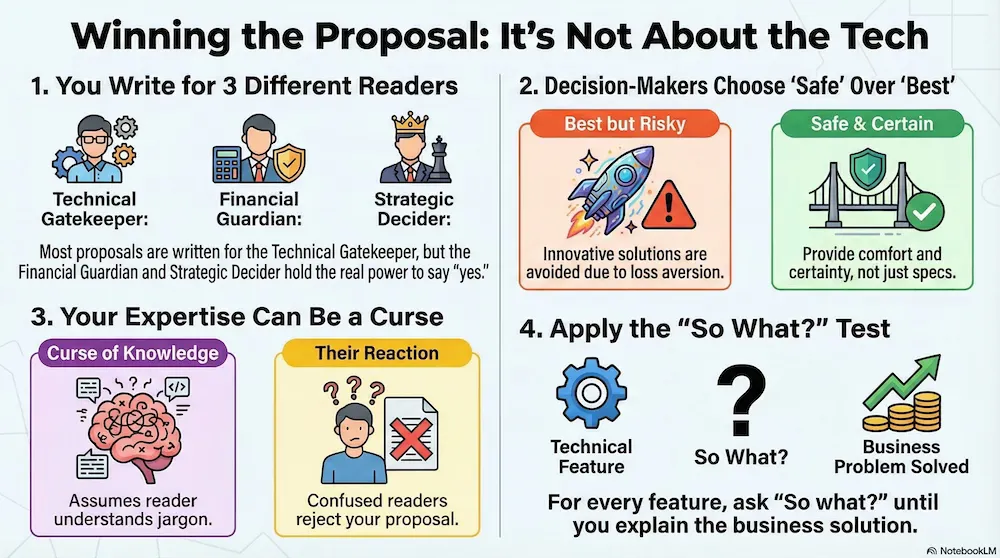
  • Your Technical Proposal is Flawless. Hereโ€™s Why It Failed.

    Your Technical Proposal is Flawless. Hereโ€™s Why It Failed.

    The Agony of the Expert

    You have spent weeks, maybe months, on the proposal. The technical specification is flawless, the methodology robust. Youโ€™ve double-checked every calculation and proofread every line. You hit โ€œsend,โ€ confident that your expertise will be recognized and rewarded.

    Then, silence. Or worse, a polite rejection. The frustration is immense. The problem, however, isnโ€™t the quality of your technical solution. Itโ€™s a fundamental misunderstanding of the audienceโ€™s psychology. You believe youโ€™re writing for experts who appreciate technical elegance, but the reality is far different.

    They donโ€™t want a drill; they want the hole. Better yet, they want the peace of mind that comes from knowing the hole will be drilled on time and on budget, without hitting a water pipe.

    1. Youโ€™re Writing for the Wrong Audience

    The single biggest mistake technical professionals make is writing for their peers. You feel comfortable with the details, specifications, and jargon of your field. But in any high-stakes decision, your peer is rarely the person with the final authority. Your proposal must successfully navigate a hierarchy of three very different readers.

    • The Technical Gatekeeper:ย This is your peer, the subject matter expert.
      • Their Goal:ย Compliance and feasibility.
      • Their Power:ย They can say โ€œNo,โ€ but rarely have the authority to say โ€œYesโ€ to a large expense.
      • What they need:ย Proof that your solution works and meets technical requirements.
    • The Financial Guardian:ย The CFO or procurement officer. They view your proposal as a financial instrument.
      • Their Goal:ย Value and risk control.
      • Their Power:ย They can kill a project if the numbers donโ€™t align with the budget.
      • What they need:ย Total cost of ownership, payment terms, and return on investment.
    • The Strategic Decider:ย The CEO, board member, or council member who signs the contract. They see the world through a wide-angle lens.
      • Their Goal:ย Outcomes and optics.
      • Their Power:ย Absolute authority.
      • What they need:ย Political wins, speed to market, and reputation management.

    The trap is focusing 90% of your effort on the Gatekeeper. They are a crucial first step, but they can only say โ€œNo.โ€ If your proposal doesnโ€™t speak directly to the goals of the Financial Guardian and Strategic Decider, it will die on their desk.

    2. They Donโ€™t Want the โ€˜Bestโ€™ Solutionโ€”They Want the โ€˜Safest.โ€™

    There is a fundamental psychological disconnect between how an expert and an executive view a proposal. The technical professional seeks the โ€œbestโ€ solution, the most innovative, efficient, and durable. The decision-maker, however, is looking for the โ€œsafestโ€ solution.

    The reason is a powerful cognitive bias called Loss Aversion. Psychologists have proven that the pain of losing is about twice as powerful as the pleasure of gaining. A City Manager who approves a revolutionary bridge design that fails gets fired. If they approve a standard, more expensive design that works perfectly, nobody notices. This is why the adage exists: Nobody ever got fired for hiring IBM.

    From the Decision Makerโ€™s perspective, โ€œInnovation = Risk.โ€ When you highlight your cutting-edge methodology, you think youโ€™re selling excitement. The person signing the check hears: โ€œUnproven. Experimental. Dangerous.โ€

    They want certainty, not novelty. Your task is to reframe your features in terms of risk reduction. For example:

    • Donโ€™t say:ย โ€œWe use a novel, experimental polymer.โ€
    • Do say:ย โ€œWe use a material proven to reduce maintenance calls by 40%, ensuring you meet your operational uptime targets.โ€

    Your job as a persuasive professional is not to dazzle them with your brilliance; it is to comfort them with certainty. You must translate your specs into safety.

    3. Your Expertise is Your Biggest Blind Spot

    It is exceptionally difficult for a subject matter expert to explain a complex concept to a non-technical stakeholder. This isnโ€™t a failure of intelligence; itโ€™s a consequence of being too smart. The cognitive bias at play is known as โ€œThe Curse of Knowledge.โ€

    Once you know something, it becomes almost impossible to remember what it felt like not to know it. In your writing, you inadvertently skip logical steps, use undefined acronyms, and assume a baseline of knowledge that your reader simply doesnโ€™t possess.

    This has a dangerous emotional impact. It makes the reader feel stupid. The fix is not to simplify your technology, but to clarify its purpose: you must explain the technologyโ€™s implications, not just the technology itself.

    When a Decision Maker feels stupid, they do not blame themselves. They blame you… They will reject your proposal not because it is wrong, but because it made them feel small.

    4. The Simple Test to Bridge the Gap: Ask โ€œSo What?โ€

    The practical solution to overcoming these psychological barriers is the โ€œSo What?โ€ Test. This simple tool helps you translate your technical features into benefits that resonate with the people who hold the budget.

    For every technical fact or feature you write, ask yourself, โ€œSo what?โ€ Keep asking until you arrive at an outcome that matters to a specific decision-maker.

    Consider this step-by-step example:

    • Fact:ย โ€œWe will use pre-fabricated concrete modules.โ€
    • So What?ย This allows us to install them at night.
    • So What?ย This means we wonโ€™t shut down a busy road during rush hour, preventing voter complaints and negative press.

    That final statement is what draws the Strategic Deciderโ€™s attention. It speaks directly to their world of optics and political wins, translating a technical detail into a tangible, valuable outcome.

    Conclusion: From Technical Exam to Human Connection

    A high-stakes proposal is not a technical exam designed to prove your intelligence. It is a risk-mitigation document designed to solve your readerโ€™s problems and quiet their anxieties. The person on the other end is stressed, risk-averse, and almost certainly not a technical expert. They donโ€™t care about your engineering prowess; they care about their own security and success.

    The next time you write, will you be selling your solution, or will you be selling peace of mind?

  • Are you the CEO of your business, or its lowest-paid employee?

    Are you the CEO of your business, or its lowest-paid employee?

    How to escape the โ€˜admin trapโ€™ (and start growing)

    Letโ€™s do a quick audit of your last 8-hour workday.

    How many of those hours were spent on high-value, billable client work?

    How many were spent on high-value business-building work, like prospecting, strategic planning, or creating a new service offering?

    And how many were spent…

    • Updating your website plugins?
    • Sending invoices?
    • Chasing late payments?
    • Playing email ping-pong to schedule one meeting?
    • Figuring out why your formatting is weird on LinkedIn?

    If youโ€™re like most solo consultants, youโ€™re spending a terrifying amount of time on $50/hr โ€œadminโ€ work, instead of the $500/hr โ€œexpertโ€ or โ€œCEOโ€ work that actually grows your business.

    This is the Productivity Trap. Youโ€™re incredibly busy, but youโ€™re not profitable.

    You didnโ€™t leave the 9-to-5 grind just to become your own, underpaid, overworked administrative assistant.

    To build a successful practice, you must stop being your businessโ€™s Admin and start acting like its CEO.

    The Three Hats You Wear (and the One Thatโ€™s Sinking You)

    As a solo entrepreneur, you have to wear three hats:

    1. The CEO:ย This is the strategist. The CEO worksย ONย the business. They ask: โ€œWhatโ€™s our revenue goal for this quarter?โ€ โ€œWho is our most profitable client type?โ€ โ€œWhat is our marketing strategy?โ€
    2. The Technician:ย This is the expert. The Technician worksย INย the business. This is the billable work youโ€™re famous forโ€”the deep analysis, the strategic advice, the project delivery. This is your primary revenue engine.
    3. The Admin:ย This is the support staff. The Admin worksย FORย the business. They handle invoicing, scheduling, IT support, and bookkeeping. This work isย necessary, but it isย notย valuableย (in the sense that it doesnโ€™t directly generate revenue).

    The Productivity Trap is when the Admin (Hat #3) eats all the time meant for the CEO (Hat #1) and the Technician (Hat #2).

    Your entire job is to protect your CEO and Technician time from your Admin. Hereโ€™s how.

    1. Pay Your CEO First

    We all know โ€œpay yourself firstโ€ for personal finance. The same applies to your time. Your CEO-time is the most important investment in your businessโ€™s future.

    The Fix: Schedule a recurring, non-negotiable โ€œCEO blockโ€ on your calendar.

    Make it every Friday morning from 9 AM to 12 PM. This time is sacred. No client calls. No email. No admin. This is when you review your finances, follow up with high-value leads, outline a new article, or map out your strategy for the next 90 days.

    This is the time you dedicate to building your purpose-driven career, not just managing a to-do list.

    2. Create โ€˜Billable Blocksโ€™ for Your Technician

    Your expert work requires deep, uninterrupted focus. You canโ€™t deliver $500/hr value when youโ€™re being โ€œdingedโ€ by emails and Slack messages every 10 minutes.

    The Fix: Block โ€œTechnician Timeโ€ on your calendar for all your deep client work.

    If you estimate a project needs 10 hours, put five 2-hour blocks on your calendar right now. Treat this time like a meeting with your most important client. When youโ€™re in a Billable Block, you are 100% focused on delivering value.

    3. Tame the Admin (Automate, Batch, Delegate)

    You canโ€™t eliminate admin, but you can stop it from taking over your day.

    The Fix: Give your Admin one hour, and one hour only.

    1. Batch It:ย Donโ€™t do admin โ€œas it comes.โ€ Create one โ€œAdmin Blockโ€ at the end of every day (e.g., 4 PM to 5 PM). All invoicing, scheduling, and email filing happenย onlyย in this window.
    2. Automate It:ย Your Admin should be a robot where possible. Use Calendly for scheduling (stops email ping-pong). Use QuickBooks/Stripe for automated invoicing and payment reminders.1ย Use tools like Make or Zapier to connect your systems.
    3. Delegate It:ย As soon as you are profitable, your first hire should be a Virtual Assistant (VA) for 5-10 hours a week. For $300, you can buy back 10 hours of yourย lifeย and spend them on $5,000 ofย billable work. It is the single best investment you will make in your business.

    From Admin to CEO

    Building a system to escape the โ€œadmin trapโ€ isnโ€™t just about โ€œtime management,โ€ itโ€™s about business design.

    Itโ€™s about building a practice that serves you, not the other way around.

    When you create a system for your daily work, you finally create the space to define your long-term vision.

    This is a one-two punch. My book, Next-Level Productivity, gives you the complete system for managing your time and tasks effectively. And The Purpose Driven Career provides the framework for defining that โ€œCEO visionโ€ for your practice.

    They are part of โ€œThe Smart Professionalโ€™s Short Guide Series,โ€ designed to help you build a solo business that is not just productive, but purposeful.