Ralph Freeman calculated every member of the Sydney Harbour Bridge. The client’s chief engineer said in print that he hadn’t designed it. What the fight teaches consultants about expertise, responsibility and credit.
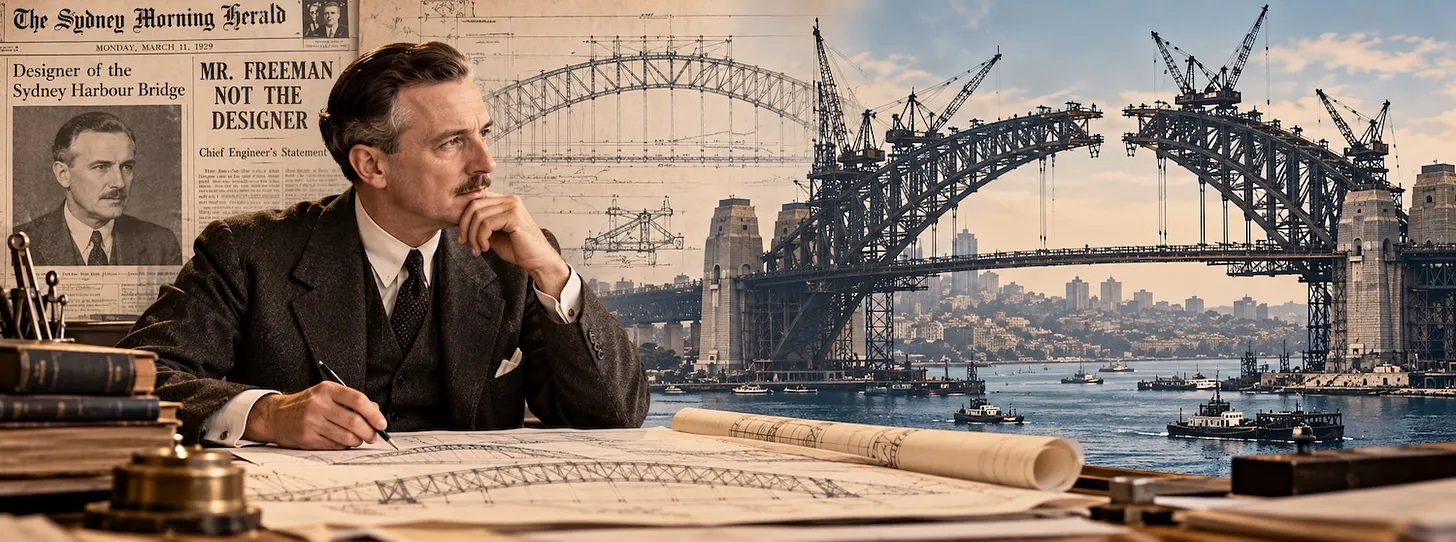
On the morning of 11 March 1929, Sydney commuters opened the Sydney Morning Herald on the ferries and found a long signed article on the history of the Harbour Bridge’s design. Beside it was a photograph of the author, with a caption the paper wrote itself:
“Designer of the Sydney Harbour Bridge, who writes on page 11 on the history of its design.”
A reader on the upper deck only had to lift his eyes to see what the caption meant. The two unfinished halves of the arch were reaching out over the water from each shore.
The man in the photograph was Ralph Freeman, a consulting engineer from London. Twelve days later the same paper ran a report from the state’s chief engineer, John Bradfield, under a headline in capitals:
“MR. FREEMAN NOT THE DESIGNER.”
Same newspaper, same month, opposite answers. Nearly a century on, the question still hasn’t been settled. If you sell expertise for a living, it’s the most useful argument in Australian engineering history.
The consultant
Freeman joined the London firm of Sir Douglas Fox and Partners in 1901, straight out of college. His first big job was helping design the steel arch over the Zambezi at Victoria Falls, finished in 1905. He became a partner in 1912 and senior partner in 1921.
In the early 1920s his firm was consulting to the Cleveland Bridge and Engineering Company, the contractor that had built the Victoria Falls arch. Cleveland was preparing a tender for Sydney, and Freeman led the design work.
Then, in 1923, Cleveland pulled out. Dorman Long of Middlesbrough took over the tender, and took Freeman and Cleveland’s chief engineer, G C Imbault, with it. The drawings went on being worked in the same London office, by the same people, for a client who hadn’t commissioned them.
In No Second Attempt I put it like this: Dorman Long bought the answer.
Dorman Long won the contract in March 1924 with a scheme its tender said was “prepared by Mr. Ralph Freeman and Mr. G. C. Imbault.” The company set up a design department in London and put Freeman in charge. He was never its employee. He was its consulting engineer, a man who could be found at another address when he wasn’t in the room.
Every chord, post and diagonal of the arch was calculated in that office. Each member had its own sheet of figures: the weight of the steel itself, the trains, the trams, the road traffic, the wind and the loads of erection, which in some members were the worst the bridge would ever see. The section was chosen from the worst case, the drawing came from the section, and the prints went out to the workshops in Sydney. Most of the men who drew the arch never saw the harbour it was built over.
The client’s engineer
Bradfield had spent most of his career arguing for a harbour crossing. He chose the arch, set the span and drew the outline. He wrote the specification the world tendered against, and he recommended Dorman Long. When Freeman’s articles appeared, he answered in a typed report to the Minister:
“I am solely responsible for the specification and plans upon which tenders were called, which governs the design of the details of the bridge. I wrote every word in the specification.”
He concluded that Freeman “can in no way be acclaimed as having conceived the Sydney Harbour Bridge or being its ‘designer.’”
The reply
Freeman wrote back to the Herald on 25 March 1929, five years and a day after the contract was signed. His letter is one of the best pieces of professional argument I’ve read.
The specification, he said, held an outline elevation of the arch and no design of any bridge. An outline elevation was no more the design of a bridge than a photograph of a liner was the design of a ship.
Then he found the hole in Bradfield’s own words. Bradfield had written every word of the specification, and clause 30 was one of them:
“It is to be expressly understood that the contractor undertakes the entire responsibility not only for the manufacture and construction of the bridge but also for the design, calculations, specifications, and plans furnished to or by him…”
The state had handed the design responsibility to the contractor in its own contract. Freeman quoted it straight back.
He also pointed out that Dorman Long’s tender had named him and Imbault as the designers, that the claim had stood under a large picture of the bridge at the Wembley Exhibition in 1924 and in advertisements around the world, and that nobody had challenged it in five years. He said why he was fighting:
“In justice to myself, my staff, and my profession I must do so.”
Who won?
Nobody, officially.
The Herald called it “a regrettable controversy.” When the bridge opened in 1932, Dorman Long threatened legal action if a plaque named Bradfield alone as designer. The Herald’s opening-day supplement dodged the question by giving three men three titles: Bradfield prepared the general design and specifications, Freeman was consulting and designing engineer for the contractors, and Lawrence Ennis was director of construction. The New South Wales department said Bradfield. The Institution of Civil Engineers in London recorded Freeman. Both records still stand.
The line I wrote in the book is the closest I’ll come to a verdict: each man was describing real work and calling it design.
What consultants can take from this
Most consultants won’t design a harbour bridge. All of us will hit some version of Freeman’s problem: we do the expert work, someone else’s name goes on it, and the contract never said who gets the credit.
1. Responsibility and credit are different things
Clause 30 settled responsibility completely. If the arch had failed, the design would have been Dorman Long’s problem, and so Freeman’s. It said nothing about credit. Bradfield could own the idea in the public mind while the contractor owned the risk on paper.
Your engagement letter probably works the same way. It defines scope, liability and fees, and it’s silent on attribution. Fix that. Write in how your work will be credited: in the report, in the client’s publicity and in your own portfolio. It costs one paragraph, and it’s far easier to agree before the work is famous.
2. Make your claim early, in writing, and in public
Freeman’s strongest evidence wasn’t his calculations. It was a sentence in a tender document, repeated under a picture at Wembley and never contradicted for five years. That was a documented, public, unchallenged claim, made before there was anything to fight about.
If you’re a subconsultant, the client may not know you exist. Get your name on the deliverable, in the tender and in the project record while the project is still dull. Once it’s a landmark, everyone will remember doing it.
3. Pick the right court
Freeman took the fight to a daily newspaper while the arch was half built and the client’s chief engineer was in the same city. It got him a caption, a rebuttal in capitals and an editorial calling the whole thing regrettable. The public never settled it.
The record that lasted was the one his peers kept. The profession argued it out in the Institution’s proceedings, in the same volumes as the calculations, and that’s where his name sits.
Your reputation as a consultant lives with the people who hire consultants: other engineers, other firms, the next client’s technical lead. If you have to defend your work, do it where they’ll read it, with documents, and leave the newspaper to the client.
4. Your expertise travels, so build it into your name
When Cleveland Bridge dropped out, Freeman didn’t lose the job. He walked across to Dorman Long with the work in his head and his team behind him. That’s the consultant’s advantage in one sentence: the client can change and the expertise goes with you.
He built on it. In 1935 his firm designed the Birchenough Bridge in what is now Zimbabwe, often described as a smaller replica of Sydney’s arch. In 1938 Sir Douglas Fox and Partners became Freeman Fox and Partners. He was knighted in 1947, and his son went on to lead the firm and design the Humber Bridge.
The argument over a single word didn’t decide his career. The body of work did.
Two shillings each
One more detail, because it says something about the kind of consultant Freeman was.
When the arch was locked in August 1930, Freeman gave every Dorman Long employee on the job an Australian florin, a two shilling coin. It went to the rivet gangs, the dogmen, the men at the cable drives, the workshop hands at Milsons Point and the masons at the Moruya quarry, men whose names went on no drawing. Some kept the coin in a drawer. One was worked into a brooch and inscribed to a Jim and an Emma.
The man who fought for nine years to be called the designer also made sure the people who built it got something to remember it by. Claim your work, and credit the people who carried it out. The two go together.
Has a client ever taken credit for your work? How did you handle it? Hit reply. I read every one.
Ralph Freeman, John Bradfield and the authorship fight run right through my new book, No Second Attempt: The Men Who Built the Sydney Harbour Bridge Out Over Open Water and Closed It in a Single Night, 1923 to 1932. It lays out both sides of the argument from the original documents and leaves the verdict to you. It also tells how the arch was actually built, out over open water with nothing underneath, and closed in a single night. I’m a civil engineer and a consultant, and I went back to the record to tell it the way it actually happened.
