Author: Phil Charles

  • How to Effectively Deliver Consulting Projects

    How to Effectively Deliver Consulting Projects

    Managing and Delivery of Projects as a Solo Consultant

    Launching a consulting business? Avoid rookie mistakes and set yourself up for success with these field-tested tips for flawlessly managing and delivering projects solo! 

    Taking on consulting projects as an independent or solo consultant requires careful planning and execution to ensure a successful business. 

    This article provides an overview of key considerations and best practices for managing and delivering consulting engagements efficiently as a solo practitioner.

    💡 Adopt a Suitable Framework

    As a solo consultant, it is essential to have a consulting methodology or approach that guides your work with clients. This methodology serves as a framework for how you approach projects, solve problems, and deliver results. 

    Well-established project management frameworks like the Problem-Solution-Implementation (PSI) model and Plan-Do-Check-Act (PDCA) cycle can provide a helpful structure for your consulting projects. These frameworks guide you through systematic problem diagnosis, solution development, execution, and continuous improvement and help to ensure consistent and effective project delivery. 

    However, flexibility is also important when applying frameworks to adapt to each client’s unique needs and objectives. Flexibility and agility in your approach will allow you to provide tailored solutions and address specific challenges effectively.

    📝 Invest in Thorough Project Planning

    Before diving in, investing time to thoroughly plan and scope a consulting project is crucial and will pay dividends. 

    Clarify project objectives, deliverables, and timelines in collaboration with your client. Conduct a comprehensive needs assessment to understand the client’s pain points, goals, and desired outcomes.

    Break the project into manageable tasks and create a plan outlining the activities, milestones, and dependencies. Estimate the resources required to complete the project, including time, budget, and team members.

    Ensure the project scope is well-defined and agreed upon by both parties to avoid misunderstandings or scope creep. Clearly communicate the boundaries of your services and set expectations regarding what is included and not included in the project scope.

    🕑 Set Realistic Project Deliverables

    Accurate project timelines and deliverables are crucial for managing client expectations and ensuring successful project delivery. 

    Work closely with your client to set realistic deadlines that consider the complexity of the project, availability of resources, and any external dependencies.

    Break the project into smaller milestones and deliverables, establishing clear deadlines for each. This enables you to track progress and lets clients see tangible results throughout the engagement.

    Regularly communicate with your client to update them on the project’s progress and address potential delays or roadblocks. Transparency and proactive communication are key to maintaining a positive client relationship and managing expectations effectively.

    Maintaining realistic timelines and keeping clients informed is critical to managing expectations.

    🗣️ Cultivate Strong Client Management Skills

    Effective communication is at the heart of successful consulting projects. 

    As a solo consultant, you will definitely benefit from strong communication and client management skills – to build trust and ensure client satisfaction with your work.

    Maintain open lines of communication with clients, providing regular updates on project progress, milestones achieved, and any challenges encountered. Be responsive to client inquiries, promptly addressing any concerns or questions they may have.

    Listen actively to your clients, demonstrating an understanding of their needs and desired outcomes. Seek feedback throughout the project to ensure you are on track and meeting their expectations. Carefully document agreements and decisions. 

    By actively engaging with clients and making them feel heard, you can strengthen the client-consultant relationship and increase the likelihood of repeat business or referrals.

    🤝 Manage Client Expectations 

    Managing client expectations is a critical aspect of delivering consulting projects successfully. 

    Clearly define what clients can expect from your services, especially deliverables, timelines, and communication channels. Be transparent about potential limitations or constraints impacting the project’s outcome or timeline.

    Inevitably, challenges may arise during consulting projects. It is essential to approach these challenges with a proactive and problem-solving mindset. 

    Communicate any issues to the client promptly, along with proposed solutions or alternative approaches. You can navigate obstacles and maintain project momentum by addressing challenges head-on and working collaboratively with clients.

    Document all agreements, decisions, and changes throughout the project to ensure clarity and avoid misunderstandings. This documentation serves as a reference point and can be invaluable in resolving disputes or addressing any scope-related concerns that may arise.

    By effectively managing and delivering consulting projects, you can establish a reputation for excellence and build long-term client relationships. 


    Mastering these areas of project planning, execution, and client service, solo consultants can deliver maximum value and build enduring client partnerships over time.

    What aspects of delivering consulting projects do you find most challenging as a solo consultant?

  • Realising Your Potential as an Independent Consultant

    Realising Your Potential as an Independent Consultant

    In my previous article, Unleash Your Potential, I outlined some of the key benefits technical professionals can gain by transitioning from employee to self-employed consultant. 

    However, this career shift also comes with very real challenges that must be addressed. 

    Here I want to provide more practical advice for realising your potential as an independent, solo consultant.

    💡 Making the Mindset Shift

    Firstly, you need to prepare yourself mentally for this career change. The mindset of a consultant is fundamentally different from that of an employee. 

    As an employee, your work life is generally predictable with a steady pay check. As a consultant, you give up that stability in exchange for autonomy. 

    Being comfortable with uncertainty and taking greater ownership over your career is essential. 

    Additionally, you now need to think like an entrepreneur, not just a technical expert. Things like marketing yourself, negotiating contracts, managing finances, and building networks become critical. Developing business acumen and perseverance will serve you well.

    🛠 Skill Development 

    Certain skills become even more vital as an independent consultant. 

    Communication and relationship building allows you to engage clients and collaborate effectively. Time and project management help ensure work gets delivered on time and on budget. Negotiation and business development enable you to set rates, sell your services, and sign contracts. 

    If you have gaps in any of these areas, dedicating time to improving is wise.

    Never stop adding capabilities. Learn new technical skills, tools and methodologies to stay competitive. 

    Expanding what you can offer means more opportunity. Ongoing learning is imperative. 

    🕸️ Creating Structure

    While autonomy can be great, too much flexibility can be challenging. 

    Create structure and routines for yourself that provide focus and productivity. Define your working hours and workspace. Set measurable goals and performance standards. Outline processes for completing projects smoothly. 

    Discipline and self-motivation are key.

    ⚖ Work-Life Balance

    Don’t overlook your personal needs. 

    With no office boundaries, it’s easy to overwork as a consultant. Make time for non-work activities, relationships, and self-care. Be vigilant of burnout. Get outdoors or exercise to stay physically and mentally healthy. Boundaries between work and life are important.

    Transitioning from employee to consultant gives you tremendous potential for career growth and fulfilment. But realising that potential requires forethought, diligence and a commitment to developing new skills and ways of working. 

    With openness to challenge yourself, and support from colleagues, you can thrive as an independent consultant.


    💬 Some Questions and Answers

    What are some of the main benefits of becoming a self-employed consultant rather than being an employee?

    The main benefits outlined in the article include greater control and flexibility over your work, higher earning potential without a salary cap, diversification of experiences and skills, increased job security by having multiple clients, a sense of fulfilment and achievement, and developing business skills like marketing and client relations.

    What are some of the challenges involved with becoming self-employed? 

    Some challenges mentioned are instability in income compared to a regular salary, administrative burdens like paperwork/accounts, and potential isolation without having colleagues or a workplace community.

    What skills are recommended to develop to be successful as a consultant?

    Develop skills in marketing yourself, financial management, negotiating contracts and building relationships with clients. Broadening your skillset beyond just technical/professional expertise is important.

    What are the three lenses the author suggests looking at your work through? 

    The three lenses are Freedom, Fortune, and Fame. Freedom relates to flexibility and work-life balance, Fortune to earnings potential, and Fame to recognition of your expertise and fulfilment.

    What does the author mean by ‘getting back on the tools as a benefit of consultancy?

    This refers to being able to directly apply your professional skills and expertise in projects, rather than being distracted by non-core tasks. As a consultant, you can spend more time ‘on the tools’ and practising your core competencies.

    What strategies suggested in the article on realising your potential are you going to action today?

  • Practical Tips for Developing a Growth Mindset

    Practical Tips for Developing a Growth Mindset

    In my previous article, I explored the importance of cultivating a growth mindset for solo consultants in technical fields as a key to success. A growth mindset enables you to see challenges as opportunities, embrace change and innovation, and believe in your ability to continuously expand your skills. 

    In this article, I will provide some practical tips and strategies for developing and strengthening a growth mindset in your day-to-day work as a solo consultant.

    Set Learning Goals

    In addition to business and revenue goals, set specific learning goals for yourself. These could involve learning a new technology, skillset, or methodology. Establish a learning plan and dedicate time each week to acquiring new knowledge. Celebrate when you achieve a learning milestone.

    Experiment and Get Outside Your Comfort Zone

    Don’t just stick with what you already know well. Take on occasional projects that require you to stretch beyond your current competencies. Experiment with new approaches and be willing to make mistakes to gain new skills. Expanding your comfort zone little by little will foster rapid growth.

    Reflect on Your Mindset Triggers 

    Notice when you have a fixed mindset reaction – for instance, wanting to give up after a setback or avoiding a daunting challenge. Reflect on what triggers this fixed mindset thinking. Is it fear of failure? Time pressure? Uncertainty? Knowing your triggers can help you consciously shift to a growth mindset next time you face a similar situation.

    Cultivate a Beginner’s Mindset

    Even if you have decades of experience, try to see each new project as an opportunity to learn with a beginner’s mind. Let go of preconceived notions, be open to new ways of doing things, and ask questions. Maintaining your curiosity will ensure you continue to grow.

    Value the Process Over Outcomes

    When you embark on challenging new projects, focus more on the process than the immediate outcomes. View mistakes and failures as integral steps in your learning process rather than indicators of your ability. Judge yourself based on your effort, willingness to learn, and behaviour – not just project results.

    Surround Yourself with Growth-Focused People

    Those around us heavily influence our mindsets. That’s why building connections with others who prioritise continuous learning, embrace challenges, and believe in human potential to grow is important. Their positive attitude will rub off on you.

    By implementing these tips, you can nurture a growth mindset that will supercharge your development as a solo consultant. Focusing on continuous learning, experimentation, and growth will enable you to thrive in our fast-changing knowledge economy.


    Quick Quiz: Are You Ready to Grow Your Mindset?

    Rate each answer on a scale: 1- Not like me at all, 2- Rarely like me, 3- Somewhat like me, 4- Often like me, 5- Very much like me

    1. When I encounter a challenging task at work, I view it as an opportunity for growth.
    2. I believe my technical skills can always be improved with effort and learning.
    3. I seek feedback regularly, regardless of whether it is positive or negative.
    4. I’m not deterred by failure; I see it as a stepping stone to success.
    5. I enjoy tackling new technical problems that stretch my abilities.
    6. I don’t shy away from difficult tasks because I fear not being able to complete them successfully.
    7. I am open to new methodologies and technologies, even if they challenge my current ways of doing things.
    8. I’m not threatened by colleagues who are more skilled than me; I see it as an opportunity to learn.
    9. I am motivated by the success of my colleagues, not discouraged or envious.
    10. When I find something difficult, I persist and try different strategies instead of giving up.

    Scoring: Add up your score, then check the interpretation below:

    10-20: Your mindset is more fixed. You see intelligence and talent as fixed traits. To foster a growth mindset, start by embracing challenges, seeing efforts as a path to mastery, and understanding that constructive criticism is a way to grow.

    21-30: You have a moderate growth mindset. You understand the benefits of a growth mindset but sometimes revert to a fixed mindset. Consider focusing more on learning from failures and seeking feedback.

    31-40: You have a good growth mindset, but there’s room for improvement. Continue seeking learning opportunities, not shying away from challenges, and embracing failures as learning opportunities.

    41-50: Congratulations, you have a strong growth mindset! You understand that talent can be developed, see effort as a path to mastery, learn from criticism, and find lessons and inspiration in the success of others. Keep fostering this mindset and encourage it in others too.


    To Learn More:


    What specific steps can you take to cultivate a growth mindset in your consulting business, and how can you use this mindset to navigate challenges and seize opportunities more effectively?

  • Strategies for Writing Proposals that Win Projects

    Strategies for Writing Proposals that Win Projects

    Proposals that Win Projects can seem like a daunting task. You may feel uncertain, not knowing what will be effective. 

    But here’s the deal … Nailing project proposals is what separates an average consultant from a successful one.

    If you’re not confident about writing proposals that win projects, you’ll probably struggle to make your consulting career successful. But you can learn how.

    A successful project proposal comprehends client needs, communicates solutions effectively, and is visually appealing. It includes a compelling executive summary, a comprehensive business model, and persuasive case studies.

    Keep in mind the three main types of proposals that will influence how you craft the proposal: solicited formally (requested by clients), solicited informally (proposals submitted in response to perceived needs), and unsolicited (proactive pitches). 

    Project proposals are the lifeblood of solo consultants. A well-crafted proposal can be the deciding factor in securing high-value projects or landing that dream client.

    Note that no two project proposals are the same – they vary based on the client’s challenges and specific needs.

    The Role of Case Studies In Proposal Writing

    1. Credibility Boost: Showcasing your past successes through case studies enhances credibility and instils confidence in potential clients about your capabilities. It demonstrates your past accomplishments, making it easier for customers to envision their success with you. They can be on any project, and not limited to consulting projects.
    2. Tailored Solutions: Each case study is unique; this allows prospective clients to see your adaptability when faced with different challenges or scenarios. Clients also get insights into how you approach problem-solving.
    3. Evidence-Based Claims: Instead of making vague promises about delivering results, case studies provide concrete evidence. They show rather than tell, making them an invaluable tool while pitching for new business. Potential clients also gain confidence seeing testimonials from satisfied clients included within these stories.

    When crafting high-value proposals, the strategic use of case studies can be instrumental in demonstrating your capabilities and past successes. 

    Understanding Client Needs in Proposal Writing

    Crafting a winning proposal begins with you clearly understanding your client’s needs. This is not just about what they say, but also about interpreting their underlying requirements and expectations.

    This requires active listening during meetings and calls; conducting surveys; asking open-ended questions; observing trends related to the client’s industry.

    The more accurately you understand a client’s needs, the better you are at proposing a solution that aligns with their objectives – thereby increasing the chances of securing high-value deals.

    Remember, a well-crafted proposal doesn’t merely outline what will be provided, it goes above and beyond by demonstrating how the proposal’s components address specific challenges the prospective client faces and will deliver the desired result.

    Avoid Late Submissions

    One crucial aspect often overlooked during the process of writing proposals is timing. Don’t be late in submitting your proposal!

    To avoid this pitfall, maintain a strict project schedule from the start. This ensures that you allocate sufficient time for each step involved in creating effective proposals – researching client needs, outlining proposed solutions, estimating project costs, and finalising details before the submission deadline.

    The Art of Writing Clear and Effective Proposals

    Mastering the art of writing clear, effective proposals is a game-changer for any technical professional.

    It’s not just about exhibiting your abilities or suggested answers but also about how you describe them.

    Avoid Jargon and Fluff

    Jargon can be confusing to clients (or the person responsible for evaluating your proposal) who aren’t familiar with industry-specific terms. To make your proposal more accessible, use plain language that anyone can understand.

    Simplify complex ideas without losing their essence. In addition to avoiding jargon, steer clear from fluff – unnecessary information that adds no value to your project proposal.

    Leverage Feedback

    Getting feedback on your draft is essential in enhancing clarity in writing proposals. Others may spot ambiguities or complexities you might have overlooked while drafting the document. Having an independent set of eyes review your proposal is invaluable.

    Utilise Project Management Software

    In the realm of proposal writing, project management software is a game-changer. Using this tool will streamline your process by providing an organised platform for tracking progress and managing deadlines. A well-planned project schedule is vital to ensure the timely submission of proposals. They also enable you to readily utilise elements from previously drafted proposals.

    Beyond individual use, these tools can also facilitate seamless collaboration among a consortium of consultants if you are part of a team involved in writing a proposal.

    Maintain Consistency Across Proposals

    Having all information centralised within one system is highly beneficial to maintain consistency across various types of proposals. It ensures that each proposed solution adheres to the approach discussed with clients.

    Bridging the Gap Between Promises and Proof

    A case study can be a powerful means of connecting the expectations expressed in a proposal with concrete proof. A well drafted case study includes:

    • An executive summary highlighting key achievements
    • A detailed description of challenges faced during the execution
    • Solutions implemented, and 
    • Outcomes achieved.

    Structuring Your Proposal For Success

    A well-structured project proposal can significantly enhance the persuasiveness of your pitch, setting you up for success.

    To win a consulting project, first understand the client’s needs thoroughly. Write clear proposals using plain language. Make it visually engaging and include relevant case studies to demonstrate your capabilities. The key components include:

    Executive Summary. An impactful executive summary is more than just an introduction; it’s your chance to make a strong first impression. This section should be concise yet compelling, highlighting key points that will pique the client’s interest and encourage them to read further.

    Approach. Your approach or solution model is about demonstrating capability and credibility. In this part of your project proposal, provide details on how you intend to deliver results while addressing potential risks and challenges.

    Showcase outcomes. To win projects, writing proposals effectively means showcasing what you aim to achieve and why clients should trust in your ability over others.

    We’ve covered some crucial elements in structuring successful project proposals; next, we’ll discuss strategies for closing deals with effective proposals.

    Closing Deals With Effective Proposals

    Mastering the art of proposal writing is critical to securing high-value projects. The effectiveness of your project proposals can make or break a deal with potential clients. But closing deals successfully includes the following:

    Maintain Communication. After submitting a proposal, maintaining communication with the client is crucial. Staying in contact with the client after submitting a proposal provides an opportunity to answer any queries regarding your proposed solution.

    Negotiate Terms. An effective negotiation strategy can significantly increase the chances of closing deals. This includes negotiating project costs, timelines, and deliverables based on what was outlined in the initial proposal.

    Leverage Testimonials. This helps build trust between you and prospective clients. References also further reinforce this trust by providing third-party validation for your work quality.

    Remember: The goal isn’t just winning one-off projects; it’s building long-term relationships. High-quality proposals lay strong foundations towards achieving this objective.


    In Summary:

    • It’s about understanding your client, their needs, and how to provide a solution. 
    • A clear and compelling proposal speaks volumes about your capabilities.
    • The use of project management software simplifies the process significantly. It keeps things organised and on track.
    • Incorporating case studies into your proposals? That’s a game-changer!
    • Structuring your proposal for success involves an impactful executive summary, comprehensive solution model description, and proposed solutions, among others, each section adding weight to winning high-value projects.
    • Closing deals with effective proposals doesn’t end at submission; it also extends to following up strategically after submission.

    Your journey towards crafting compelling project proposals starts now!

  • Setting Up as a Solo Consultant

    Setting Up as a Solo Consultant

    Important steps to take to set yourself up for success

    Becoming a solo consultant is an exciting endeavour that allows you to showcase your expertise and make a meaningful impact in your chosen field. However, before you can embark on this journey, several important steps must be taken to set yourself up for success.

    🔍 Identify Your Expertise

    The first step in setting up as a solo consultant is to identify and assess your expertise and skills.

    Take the time to reflect on your professional background, experiences, knowledge areas and any specialised training you have completed. Determine the specific areas where you can provide exceptional value to clients.

    Consider the unique combination of skills and knowledge that sets you apart from others in your industry – ask yourself these questions:

    • What are your core competencies? 
    • What problems can you solve better than anyone else? 

    While it’s essential to focus on your strengths, also be honest about your limitations. Acknowledging areas where you may need to upskill or gain more experience will help you make informed decisions about the types of projects and clients you can take on. 

    Conduct a thorough self-assessment to gain clarity on your unique value proposition as a solo consultant. By identifying your expertise, you can position yourself as a specialist and attract clients who are seeking your specific skills.

    It’s also important to assess the market demand for your expertise. Research industry trends, challenges, and opportunities relevant to your field. Identify the pain points that potential clients are facing and how your expertise can address those needs. This market research will help you align your services with the demands of the market and increase your chances of success.

    Read more about finding your niche: Finding Your Place in the Market.

    💥 Craft a Compelling Personal Brand

    As a solo consultant, your personal brand is crucial for establishing credibility, attracting clients, and differentiating yourself from competitors. 

    Your personal brand encompasses your reputation, values, expertise, and the unique skills you bring to the table. Building a strong personal brand will differentiate you from other consultants.

    Start by defining your unique value proposition and crafting a compelling brand message that communicates your expertise and the value you bring to clients. Read more about establishing your value proposition in: Establishing Your Value Proposition

    Develop a professional website that showcases your skills, experience, and past projects. Utilise social media platforms, such as LinkedIn, to build your professional network and share valuable insights and industry knowledge. 

    Start by defining your brand identity. Consider your objectives and the overarching message you want to convey. 

    • What do you want to be known for? 
    • What values do you want to align with your brand? 

    Develop a clear and compelling brand story that resonates with your target audience.

    Next, create a professional brand image. Design a visually appealing logo, choose a colour palette, and develop consistent branding elements that reflect your brand’s personality. These visual elements will create a memorable and cohesive brand identity across your marketing materials, website, and social media profiles.

    Remember, your personal brand extends beyond visuals. Consider creating thought leadership content by consistently sharing valuable insights, expertise, and relevant content through writing articles, posting podcasts, presenting seminars or publishing videos. 

    Position yourself as a trusted authority and go-to resource in your field. Sharing your expertise will not only establish your credibility but also help you attract potential clients who are seeking your specialised knowledge.

    Read more in Building Your Brand

    🕸️ Build a Professional Network

    Building a strong professional network is crucial for long-term success as a solo consultant. Networking provides opportunities for collaboration and referrals. It’s a way to connect with like-minded professionals, and mentors who can help you navigate the challenges of solo consulting.

    Start by attending industry events, conferences, and seminars where you can meet professionals in your field. Engage in conversations, exchange contact information, and follow up with meaningful connections. Join relevant industry associations and online communities where you can actively participate and contribute.

    Leverage social media platforms such as LinkedIn to expand your professional network. Connect and engage in discussions, and share valuable insights. Building a strong online presence will not only help you connect with potential clients but also enhance your credibility as an industry expert.

    Prioritise building a reputation for delivering exceptional results and providing outstanding client service. Satisfied clients are more likely to become repeat customers and refer you to others. Recommendations and positive testimonials can significantly contribute to the growth of your solo consulting business.

    🏡 Set Up Your Home Office

    As a solo consultant, your home office is where you will spend a significant amount of time. It is essential to create an environment that fosters productivity, creativity, and focus. Dedicate an area in your home or consider renting a co-working space if you prefer a separate work environment.

    Invest in the necessary equipment and tools for your consulting practice, particularly a reliable computer and software. Ensure you have a comfortable and an ergonomic setup to be able to work productively during long working hours. Establish a routine and boundaries to maintain a healthy work-life balance.

    ⚙️ Establish Systems and Processes

    Creating efficient systems through workflows, templates, and checklists is essential for solo consultants looking to maximise revenue generating activities and minimise administrative burden. 

    Develop standardised processes for repetitive activities such as using templates for proposals, contracts, invoices and other client documents to minimise the time spent customising each instance. Create checklists for project initiation, tracking progress and project closure to ensure consistency and quality across client engagements. 

    Leverage client management and project management software to automate routine tasks, provide visibility into client and project data, create reminders and alerts, streamline document storage, and facilitate internal communication and handoffs. 

    Utilising these productivity tools allows you to focus more time on high value activities like client interactions, business development, project delivery and new service offerings that drive growth and profitability. Reducing time spent on low value administrative work through systematic automation is a key competitive differentiator for successful solo consultants.

    Examples of workflows, systems and processes include:

    • Client onboarding: Have a clear process for accepting and scoping new projects, signing contracts, setting expectations, determining milestones, etc. Create templates to help maintain consistency.
    • Project management: Develop workflows for delivering client work. Use tools like checklists, spreadsheets, templates and project management software. This helps keep projects on track and ensure quality.
    • Scheduling: Set up a scheduling system for client meetings and internal tasks. This can be as simple as putting recurring meetings in your calendar, using dedicated scheduling software.
    • Document storage: Find a system for securely storing, organising and backing up client documents and materials. Consider cloud storage platforms or client management software with document storage features.
    • Time tracking: Implement a time tracking system from the very beginning. This makes invoicing easier and more accurate.
    • Invoicing: Set up invoice templates and automatic billing or scheduled invoicing. Track billable hours and expenses consistently so you can easily generate invoices.
    • Bookkeeping: Set up a system for tracking income, expenses and deductions related to your consulting business. Use accounting software or work with an accountant. Process invoices and receipts promptly.
    • Staying in touch: Set expectations with clients about communication methods and frequency. Schedule check-in calls, review meetings and project updates as needed. Send regular newsletters to stay top of mind with potential clients.
    • Evaluating clients: Develop key metrics to evaluate the profitability and sustainability of relationships with each client. Obtain feedback from clients and get testimonials (for successful projects!).

    Now take a few minutes to identify what actions from the above that will help you set up your solo consulting business.


  • Finding and Acquiring Clients

    Finding and Acquiring Clients

    A critical aspect of building a successful solo consulting business

    Finding and acquiring clients is a critical aspect of building a successful solo consulting business. You can have the best experience and expertise but if clients don’t know about you then you end up with no business. As a solo consultant, you are responsible for generating leads and converting them into paying clients.

    Let us explore strategies for finding and acquiring clients, including identifying potential clients, developing effective marketing strategies, building a strong client acquisition funnel, and leveraging online platforms and networking events.

    🔍 Identify Potential Clients and Target Market

    Before you can acquire clients, it’s essential to identify your target market and understand their needs, pain points, and preferences. Conduct market research to determine the businesses, or individuals that could benefit most from your consulting services. 

    Consider the specific challenges or opportunities that your expertise can address. Identify the characteristics of your ideal clients, such as their size, location, industry, or budget. By narrowing down your target market, you can tailor your marketing efforts to reach those who are most likely to engage with and invest in your services.

    In Finding Your Place in the Market, I discussed defining your niche.

    📢 Develop Effective Marketing Strategies

    Effective marketing is key to attracting potential clients and establishing your brand as a solo consultant. Consider the following strategies to promote your services and generate leads:

    • Content Marketing: Share valuable content through blog posts, articles, videos, or podcasts. Provide insights, tips, and solutions to the challenges faced by your target audience. This positions you as an industry expert and attracts potential clients who are seeking your expertise.
    • Social Media Marketing: Leverage social media platforms such as LinkedIn to connect with your target audience. Engage in discussions, share industry insights, and promote your content. Utilise paid advertising options to increase your reach and target specific demographics or interests.
    • Email Marketing: Build an email list and nurture relationships with potential clients. Offer valuable resources or exclusive content in exchange for email addresses. Use email marketing tools to send regular newsletters, updates, and personalised messages to your subscribers.
    • Networking: Attend industry events, conferences, or seminars to connect with potential clients and industry professionals. Engage in conversations, exchange business cards, and follow up with meaningful connections. Join industry associations and online communities to expand your network.
    • Referral Programs: Encourage satisfied clients to refer you to others by implementing a referral program. Offer incentives or discounts for successful referrals, and ensure you provide exceptional service to encourage positive word-of-mouth recommendations.

    Read more in How to Market Consulting Services Effectively

    🔨 Build a Strong Client Acquisition Funnel

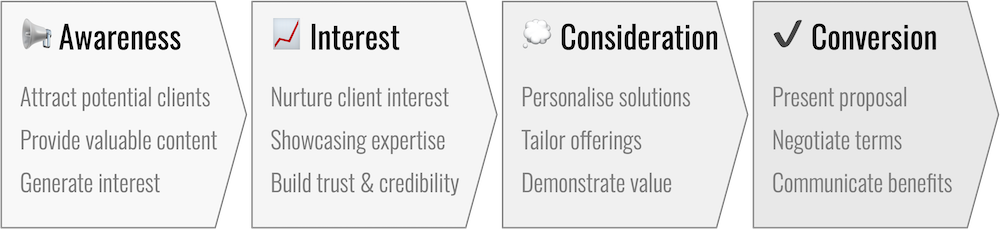
    A client acquisition funnel is a systematic process that guides potential clients through the stages of awareness, interest, consideration, and finally, conversion. Implementing a well-structured client acquisition funnel increases your chances of converting leads into paying clients. Consider the following stages:

    1. Awareness: Attract potential clients through marketing efforts such as content marketing, social media engagement, and search engine optimisation. Provide valuable content and insights to capture their attention and generate interest in your services.
    2. Interest: Once potential clients are aware of your brand, nurture their interest by providing additional valuable content, case studies, or testimonials. Showcasing your expertise and demonstrating the positive outcomes you can deliver will help build trust and credibility.
    3. Consideration: As potential clients move into the consideration stage, provide them with personalized solutions and proposals that address their specific needs. Tailor your offerings to their requirements and demonstrate how your services can add value to their business.
    4. Conversion: The final stage of the client acquisition funnel is converting potential clients into paying clients. Present your proposal, negotiate terms, and provide clear and concise agreements. Communicate the benefits and outcomes they can expect from working with you.

    🌐 Leverage Online Platforms and Networking Events

    In addition to your marketing strategies, leverage online platforms and networking events to reach potential clients. Utilise professional networking platforms such as LinkedIn to connect with industry professionals and engage in relevant discussions. Participate in online communities, forums, or groups where your target audience congregates.

    Attend networking events, seminars, workshops, or industry conferences to meet potential clients face-to-face. Engage in conversations, exchange business cards, and follow up with meaningful connections. Establishing personal connections and building relationships can lead to future client opportunities.

    By implementing these strategies and building a strong client acquisition funnel, you can increase your chances of finding potential clients, nurturing their interest, and converting them into satisfied clients.

    Now take a few minutes to identify what actions from the above you will take to acquire clients for your consulting services.

  • How to Market Consulting Services Effectively

    How to Market Consulting Services Effectively

    How to market technical consulting to potential clients

    Figuring out how to promote technical consulting services successfully to potential customers is essential for the prosperity and growth of your solo consultancy. 

    It requires a deep understanding of your target audience, developing an impactful value proposition, and crafting a strategic marketing plan that speaks directly to their needs.

    In this article, we’ll delve into strategies such as building an online presence where potential clients can find you. We will discuss how to offer e-mail marketing to work hand-in-hand with social media marketing to reach qualified prospects. We will also discuss lead generation tactics and ways businesspeople approach social media marketing specifically tailored for those in the consulting field. 

    By the end of this article, you should have a solid grasp of how to market technical consulting services to potential clients effectively.

    ⌖ Identify Your Target Audience

    In the consulting business, knowing your audience is key. Who are your ideal clients? Find out and reach them effectively.

    Who Are Your Ideal Clients?

    Your ideal clients in the consulting field aren’t just anyone with a wallet or credit card. You want highly qualified prospects who need the services and advice you provide.

    Finding The Right Channels To Reach Them

    Explore lead generation tactics that work best in your niche market to connect with these potential clients.

    • E-mail marketing: It works hand-in-hand with other digital strategies. Don’t underestimate its power. Capture email addresses at networking events and use free downloads of helpful information related to your services. Engage prospects and special interest groups directly and personally.
    • Use social media: Platforms like LinkedIn can be beneficial if used strategically. Remember, not all businesspeople approach social media marketing the same way. Post articles regularly, and comment on other relevant posts.

    The Importance of Market Research 

    Market research is crucial in identifying your target audience. It helps you understand where your audience hangs out online, their preferences, and what types of marketing they respond to. For example, you can use LinkedIn to help identify what your ideal clients are interested in. 

    Check out Finding Your Place in the Market for more information.

    Remember, know your customer before launching any campaign. Now, let’s move on to developing your unique value proposition.

    🌟 Develop a Unique Value Proposition

    You and your consulting business are unique, and it’s important to showcase that. The first step in your marketing plan should be developing a Unique Value Proposition (UVP). A UVP sets you apart from the competition. It outlines what makes you special within the consulting field and why potential clients should choose your services over others.

    Finding Your Niche. To craft an effective UVP, identify what areas of expertise set you apart from other technical professionals, ie your niche. Maybe it’s your data analysis experience or ability to simplify complex concepts for non-technical stakeholders. For more insights, read  Establishing Your Value Proposition.

    Crafting Your Message. Once identified, incorporate your UVP into clear marketing slogans. Remember: clarity trumps cleverness every time when communicating value.

    Incorporating Business Goals. Make sure your UVP aligns with your business goals and objectives of your business.

    Build an Online Presence. Your consulting business needs a solid online presence. It’s like having a digital billboard that attracts your ideal clients. Think of your website as the foundation of your business’s digital home. It’s where potential clients go to learn more about your services and how you can help them achieve their goals.

    Social media marketing, using your UVP, is a must-do for businesspeople. It’s about promoting content and engaging with prospects in special interest groups. Be prepared to network with those interested in your area of technical expertise.

    📣Leverage Content Marketing

    Communication is key in the consulting business. Let prospective customers understand what you can provide and how it could benefit them.

    The Power of Engaging Content. Content marketing is a great way to communicate this information. Create valuable content for your target audience – businesspeople interested in leveraging technology.

    Create a Winning Content Strategy. Understand your ideal client’s needs and interests. Participate in special interest groups or forums where they gather online – pose questions, gather feedback, and analyse common pain points. This insight will guide your content creation, showcasing your expertise as a solution provider and building trust with highly qualified prospects. Diversify your channels to reach a broader audience and increase your chances of success with lead generation tactics.

    Utilise SEO Strategies. Let’s get real. Your consulting business can have the most innovative solutions in your field, but without a solid Search Engine Optimisation (SEO) strategy, it might as well be invisible to potential clients online.

    The Power of Keywords. When used correctly, keywords act like magnets for search engines and highly qualified prospects. Potential customers searching for services you offer are more likely to find your business’s digital home if it contains relevant terms they’re looking for.

    Audit Your Website. Not only do you need a good website, but an essential part of any marketing plan is conducting an SEO audit. This helps identify areas where improvements could increase visibility and drive organic traffic from potential customers exploring lead generation tactics on search engines.

    Incorporate Backlinks. No matter how catchy your marketing slogans or ideas design choices may be, backlinks still hold significant weight in Google’s algorithm.


    This article has spilled the beans on marketing your technical consulting services like a boss. You’ll stand out and attract the right clients by pinpointing your target audience and crafting a killer value proposition. 

    Don’t forget to beef up your online presence with a great website and social media game – it’s the key to gaining credibility and reaching a wider audience. And why not flex your expertise by dishing out informative blog posts and case studies? That way, prove you’re the real deal and provide value to potential clients. 

    Now take a few minutes to identify what actions for the above that you will take to market your consulting services.

  • Exploring Pathways to Solo Consulting

    Exploring Pathways to Solo Consulting

    Alternative approaches to becoming self-employed

    Unleash your inner entrepreneur, break free from the chains of traditional employment, and explore the diverse pathways that lead to self-employment!

    The recent period of work-from-home led to the so-called  ‘Great Resignation.’ Self-employment became increasingly popular as professionals sought greater independence, adaptability, and control over their work lives.

    Why? You might ‘hate’ your work/long hours/boss/colleagues/commute/travel and need a change. 

    The road from employment to self-employment can be both stimulating and difficult. Fortunately, there are several routes you can take to make this adjustment. 

    Mark Twain once said, “To succeed in life, you need two things: ignorance and confidence.” 

    In this article, we’ll examine some of the pathways you can take to transition into self-employment as a solo consultant successfully.

    🧗Pathway 1. The Leap

    Some professionals possess an entrepreneurial spirit and are ready to take a bold leap into self-employment. 

    This approach involves leaving your current job and diving headfirst into your own venture. While risky, it allows for complete focus and dedication to your business idea. 

    Taking a leap requires careful preparation: planning, in-depth market research, and a strong network of contacts to support you during the initial stages. Having a financial buffer to allow a reasonable runway of six to twelve months of funds to cover living expenses is also important.

    By focusing entirely on your new venture, you may be able to accelerate the growth of your business, but you also face more immediate financial risks.

    Each individual’s experience with jumping directly into self-employment will differ based on their financial situation, risk tolerance, preparation, and the demand for their specific consulting services. You may find the benefits outweigh the risks, while others may prefer a more gradual transition into consulting.

    ✅ Advantages 

    • Total Focus: You can give your undivided attention and dedicate the necessary time, effort, and energy to your business.
    • Earning Potential: As a self-employed consultant, your earning potential isn’t limited by a salary cap. If your business is successful, you could potentially earn much more than you would as an employee. 
    • More Control: You have complete autonomy over your business, work, and time. This means you can shape the business in accordance with your values and work style. 
    • Greater Freedom: Self-employment provides a high degree of freedom and autonomy compared to traditional employment. You have the freedom to set your work hours and choose the projects you take on and the clients you work with.
    • Professional Development: Owning and managing your own business provides a broad range of experience that can significantly increase your skills in various areas, from sales and marketing to project management and customer relations.

    ❎ Disadvantages 

    • Financial Risk: There’s a significant financial risk as your income might be irregular, especially in the early days of your consulting business. You may also need to invest your own money to start the business, and profitability is not guaranteed.
    • Fewer Benefits: As a self-employed individual, you won’t receive benefits such as paid leave or a retirement plan unless you arrange these yourself.
    • Increased Responsibility: You’ll need to manage all aspects of your business, from marketing and sales to finances and customer service. This can be a lot of pressure and take away from the time you spend on actual consulting work.
    • Work-Life Balance: The lines between personal and professional life can blur, leading to potential burnout. It’s also harder to ‘leave work’ when you’re self-employed, as there’s always something more you could be doing for your business.
    • Lack Security: Without the stability of a regular salary and benefits, there may be significant financial stress if your business doesn’t take off as quickly as anticipated. There is always the potential for business downturns and loss of clients. 
    • Limited Support: You will need to develop a diverse skill set, such as managing finances, marketing, operations, and more, without support. 

    🏃Pathway 2. Transition – Part-Time

    For those who desire a more gradual shift, transitioning to part-time employment can be a viable option. This approach allows you to maintain a stable income while investing time and energy to grow your own business. 

    By reducing your work hours, you can explore and validate your business idea, establish a client base, and test the waters before fully committing to self-employment. You could start by taking on clients and gradually increase your consulting work as your client base grows. 

    Alternatives include getting consulting jobs through an agency that finds work for consultants or using an online platform such as Freelancer, Fiverr, or Upwork. 

    This pathway to solo consulting is beneficial for those who wish to gain experience in consulting without completely abandoning the safety of full-time employment. However, it requires effective time management and the ability to handle a significant workload, which can be challenging for some people.

    ✅ Advantages 

    • Smooth Transition: Provides a smoother and less abrupt change from being employed to becoming self-employed.
    • Financial Security: A gradual transition reduces the financial risk associated with moving straight into self-employment. Maintain a stable, though lesser income, while gradually building your own business.
    • Test Business: Mitigates some of the risks and allows you to test the viability of your business idea, refine your offerings, and assess market demand.
    • Build Clients: By starting your consulting work while still employed, you can begin to establish a network and reputation in consulting, which helps ensure steady work when you make the full transition.

    ❎ Disadvantages 

    • Time Challenges: Balancing part-time employment with your self-employed venture can be challenging. You might find yourself working long hours and weekends to manage both.
    • Slower Growth: While dividing time between your part-time job and self-employed business, the growth of your business will be slower.
    • Limited Availability: Part-time employment means having limited availability for client meetings, networking events, and other business-related activities.
    • Conflict of Interest: Depending on your full-time job and your consulting work, there may be a potential conflict of interest. Some employers have policies against side businesses, particularly if they are in a similar industry.
    • Limited Resources: Splitting your attention between two roles limits the energy and resources you can devote to your consulting business, potentially impacting the quality of your work or service. It can also lead to overwork and burnout if not managed carefully.

    🚶Pathway 3. Transition – Consulting Firm

    Working as an employee for a consulting firm can be a first step toward transitioning to solo consulting. This approach gives you a stable income while learning the consulting business. It allows you to gain industry knowledge, build your network, and understand the operational aspects of the consulting business. 

    ✅ Advantages 

    • Industry Exposure: Working for a consulting firm provides you with insights into the industry. You will learn about running a consulting business, such as client acquisition, project management, and business development strategies.
    • Smooth Transition: Provides a smoother and less abrupt change from employed to self-employed. Until you decide to go solo, working for a consulting firm provides financial security.
    • Build Networks: This will expose you to a broad network of potential clients. Building these relationships will be invaluable when you start your own consulting business. You can build a reputation in the industry, which enhances your credibility when you go solo.
    • Build Skills: Consulting firms provide training programs and skill development, including problem-solving, critical thinking, project management, and client relationship management.
    • Mentorship: Established consulting firms often have seasoned professionals who serve as mentors, providing guidance and advice that is beneficial for your own venture later.

    ❎ Disadvantages 

    • Limited Control: As an employee, you have less control over the projects and clients you work with. This can be frustrating if you have a clear vision of how you prefer to do things.
    • Demanding Workload: Consulting firms have high expectations, which leads to long hours and high stress. This leaves you little time and energy to plan and start your own business.
    • Non-compete Agreements: Some firms require you to sign non-compete agreements for a certain period or within the same industry, which limits your ability to start your own consulting business.
    • Dependency: There’s a risk of becoming too comfortable in the security of a full-time job, making it harder to move on to self-employment.

    This is the path I followed, transitioning from 20+ years as a public sector employee to a multi-nation consulting firm. Moving to consulting was a very steep learning curve for me; I had to constantly bring in new business and work long hours, which was very stressful. But I learned a lot.


    This is just a starting point to help you consider your options. By carefully weighing the advantages and disadvantages, you can make an informed choice that aligns with your ambitions and risk tolerance. A combination of these approaches may work best for you.

    It’s crucial to consider your personal situation, career goals, risk tolerance, and financial stability when deciding on your pathway to solo consulting. 

  • Laying the Essential Business Foundations 

    Laying the Essential Business Foundations 

    The Foundations of Solo Consulting

    In the previous article: The Foundations of Solo ConsultingI outlined five keys that form the foundation of a successful solo consultant business: defining your niche, establishing your value proposition, building your brand, cultivating a growth mindset, and laying the essential business foundations. This article delves deeper into the fifth foundation: ‘the essential business foundations’.

    Running a successful solo consulting practice, especially in technical fields, requires more than just technical expertise. I know from over twenty years of experience as a solo consultant!

    It necessitates a solid foundation in key business principles such as business planning, financial management, legal considerations, and risk management. This article explores these critical aspects and their importance in running a successful consulting practice. 

    By setting clear goals, developing a robust business plan, establishing appropriate pricing strategies, and ensuring compliance with relevant regulations, you can build a strong foundation for your consulting business.

    📋 Business Planning: Setting the Course

    The first step to establishing your consulting practice is creating a business plan. This serves as a roadmap for your business, outlining your mission, vision, services, target market, and marketing strategies. It should also include your financial goals and projections. 

    As a solo consultant, your business plan should include clear goals that guide your actions and decisions. These goals can relate to income, client acquisition, professional development, or other key aspects of your business.

    You will have done much of the hard work if you have completed the previous foundational elements: defining your nicheestablishing your value proposition,building your brand, and cultivating a growth mindset. It doesn’t have to be a large document – getting your business plan down to a page, or two is preferable.

    As a consultant, you will be paid for the skills, knowledge and abilities you’ve developed over your career, so these should feature in your plan.

    Remember, a business plan is not a static document. As your business grows and evolves, revisit and revise your plan to reflect new goals, challenges, and opportunities.

    💵 Financial Management: Fueling the Engine

    Proper financial management is crucial for the survival and growth of your consulting business. This involves tracking income and expenses and setting appropriate pricing strategies. 

    Pricing your services correctly is critical for profitability. Too low, and you risk undervaluing your services; too high, and you may deter potential clients. Starting out, you may need to set your hourly rate low to attract business, but over time you will be able to raise your prices as you become known and demonstrate your expertise. Consider the value you provide to clients, your expertise and experience, and the market rates for similar services when setting your prices. 

    In addition to pricing, create a budget to monitor your spending and make financial projections. When you start out, you don’t need a fancy office or expensive equipment or software – bootstrap your way through the initial stages. Consider investing in financial management software to ensure you’re on the right track (I use Xero, but many other options are available). You can always start with a spreadsheet!

    ⚖️ Legal Considerations: Protecting Your Business

    As a solo consultant, you must understand the legal aspects of your business. This includes selecting the right business structure (whether a sole proprietorship or a company), understanding contracts and agreements, and being aware of any licenses or certifications required in your field. 

    Moreover, it’s important to familiarise yourself with the regulations and laws applicable to your services. 

    A key consideration is the protection of your assets. A primary reason for establishing your business in a legal entity such as a company is being able to protect your assets through limited liability – only those assets within the entity will be at risk – your personal assets will be separated from the business assets.

    Consult with a professional (legal, business and/or accounting) to ensure you understand the costs, benefits and risks involved and comply with relevant regulations.

    ⚠️ Risk Management: Preparing for the Unexpected

    Every business faces risks, and solo consultants are no exception. Risk management involves identifying potential risks and developing strategies to eliminate or mitigate them. 

    This includes professional liability and public liability insurance to protect against claims when dealing with clients and interacting with the public – in many cases, clients require them.

    Conclusion

    Running a successful solo consulting business by technical professionals requires a keen understanding of key business principles. 

    By setting clear goals, crafting a business plan, managing your finances effectively, addressing legal considerations, and implementing risk management strategies, you can lay a solid foundation for your consulting practice. 

    While this may seem daunting, remember that each of these aspects is a piece of the puzzle that, when put together, can create a successful and sustainable consulting business.


    Reflect on this question: “Which areas of my business foundations need the most work, and what specific steps can I take to strengthen them?”

  • Cultivating a Growth Mindset 

    Cultivating a Growth Mindset 

    A Key to Success for Solo Consultants

    In the previous article: The Foundations of Solo ConsultingI outlined five keys that form the foundation of a successful solo consultant business: defining your niche, establishing your value proposition, building your brand, cultivating a growth mindset, and laying the essential business foundations. This article delves deeper into ‘cultivating a growth mindset’.

    📈 A Key to Success for Solo Consultants 

    Solo consulting in the technical and technology sectors is a dynamic and evolving path that requires continuous learning and adaptability. 

    As technology evolves at a breakneck pace, consultants need to keep up with the latest advancements and trends, making their professional development a never-ending journey. In this context, cultivating a growth mindset is a vital asset for navigating challenges, embracing change, and seizing opportunities.

    In this article, I will explore the concept of a growth mindset and discuss strategies for nurturing this mindset in your consulting practice. 

    With a growth mindset, you can foster an environment of continuous learning, innovation, and resilience, all of which are critical for success in the rapidly changing technical landscape.

    🌱 Understanding the Growth Mindset

    The concept of a growth mindset was first coined by psychologist Carol Dweck, who identified it as the belief that your abilities and intelligence can be developed with effort, learning, and perseverance. 

    In contrast to a fixed mindset, which views abilities as static, a growth mindset thrives on challenge and sees failure not as a reflection of your ability but as a springboard for growth and stretching existing abilities.

    For solo consultants in technical fields, this mindset can be a game-changer. It encourages you to see challenges as opportunities to learn and grow rather than as insurmountable obstacles. It means embracing change as a chance to evolve rather than resisting it. 

    Most importantly, it means believing in your ability to develop new skills and improve over time, making it an invaluable trait in the ever-evolving tech industry.

    🤝Cultivating a Growth Mindset in Your Consulting Practice

    Developing a growth mindset is not an overnight transformation. It requires conscious effort and practice. Here are a few strategies that can help cultivate a growth mindset in your consulting practice:

    🧗🏻 Embrace Challenges

    Challenges are part and parcel of the consulting business. 

    Whether it’s keeping up with new technology, solving a complex problem for a client, or dealing with the uncertainty of being an independent consultant, challenges abound. 

    Rather than shy away from these challenges, embrace them as opportunities to learn and grow. Each challenge you overcome expands your capabilities and makes you a stronger, more competent consultant.

    👎🏻 Reframe Failures

    In a growth mindset, failures aren’t the end of the road—they’re learning opportunities. 

    When you encounter setbacks, instead of viewing them as insurmountable failures, treat them as valuable feedback. Analyse what went wrong and use those insights to improve. 

    Remember, in the world of the technical professional, even the most successful innovators have faced failures. What sets them apart is their ability to learn from these failures and bounce back stronger.

    🤔 Stay Curious

    Stay curious and never stop learning. 

    Technical fields are constantly evolving, with new trends and technologies emerging all the time. 

    Make learning a daily habit, whether it’s through reading industry news, attending webinars and conferences, or enrolling in online courses. The more you learn, the more you can offer to your clients, giving you a competitive edge in the industry.

    💪 Cultivate Resilience

    Cultivating resilience goes hand in hand with a growth mindset. 

    In the face of obstacles or setbacks, resilience enables you to bounce back and continue moving forward. It involves maintaining a positive attitude, managing stress effectively, and having the persistence to keep going in spite of challenges.

    Conclusion

    By adopting a growth mindset, solo consultants can foster a more resilient and adaptive approach to their work, enabling them to thrive in the fast-paced, constantly changing industry. 

    It allows for continuous learning, encourages innovative thinking, and builds resilience in the face of challenges. Remember, your mindset is a powerful tool. By cultivating a growth mindset, you can unlock your full potential and propel your consulting practice to new heights.


    📖 Book Summary

    Mindset: The New Psychology of Success by Carol Dweck

    People with fixed mindsets obstruct their own development through their belief in innate talent and their fear of failure. On the contrary, people with a growth mindset work hard and train hard to ultimately realise their potential. By confronting our own attitudes and ideas, we can develop a growth mindset.

    How do people differ in their mindset?

    • Our mindset shapes whether we believe we can learn and change and grow – or not.
    • An individual’s abilities are set in stone in the fixed mindset.
    • Growth and development are possible in the growth mindset.

    What impact does our mindset have on our behaviour?

    • People with a fixed mindset seek approval; those with a growth mindset seek development.
    • The fixed mindset sees failures as disasters; the growth mindset sees them as opportunities.
    • People with a fixed mindset avoid difficulties; those with a growth mindset relish them.

    Can we change our mindset?

    • Our mindset is often strongly influenced by the role models we had as children.
    • Anyone can adopt a growth mindset and make the impossible possible.

    Source: Blinkist.com

    What specific steps can you take to cultivate a growth mindset in consulting and how can you use this mindset to navigate challenges and seize opportunities more effectively?